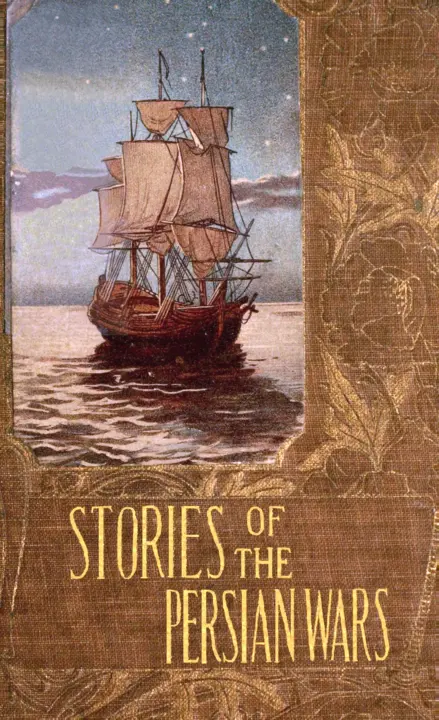
Stories of the Persian wars
Herodotus
THE CLASSIC COLLECTION · 1905
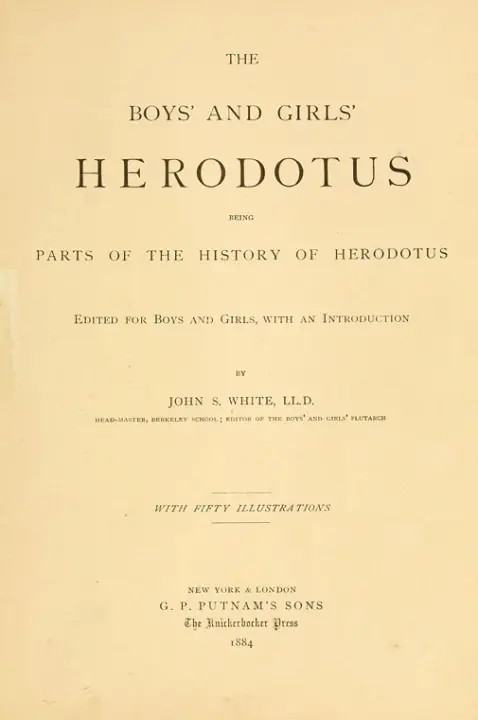
"The Boys' and Girls' Herodotus" by Herodotus is a historical account written in the late 19th century. This edition, edited for younger readers by John S. White, aims to make the classic writings of Herodotus accessible to boys and girls, blending historical facts with engaging storytelling. The work discusses the origins of historical events, particularly the conflicts between the Greeks and various nations, introduced through the lens of Herodotus's experiences and narrative style. At the start of the narrative, the scene is set in ancient Athens, near the end of the year 446 B.C., as the city faces political uncertainty. Herodotus is described as a famed historian sharing captivating tales before an audience, including a young Thucydides. The introduction highlights his intent to document the historical struggles between Greeks and barbarians, showcasing the origins of various conflicts, customs, and significant figures. The narrative establishes Herodotus’s honest and vivid storytelling approach that includes anecdotes, making it relatable and appealing to younger audiences. The opening chapters delve into the early effects of the conflict over respect and relationships that escalated into war, providing a foundation for the historical accounts that follow.
Introduction adapted from the source catalogue; source summaries may be automatically generated.
Free to read · English · 112,601 words · No account needed
MAKE TIME FOR A GOOD BOOK
On by default. Untick to stop anonymous reading totals. Each page counts after 10 seconds in view. How this works.
Anonymous counting is on unless you have switched it off.
When the Persians and the rest of the throng arrived in their flight at the wooden wall, they mounted the towers before the Lacedæmonians came up, and defended the wall in the best way they could; so that when the Lacedæmonians arrived, a vigorous battle took place before the walls. So long as the Athenians were absent, the barbarians defended themselves, and had much the advantage over the Lacedæmonians, as they were not skilled in attacking fortifications; but when the Athenians came, then a vehement fight at the walls took place, and continued for a long time. But at length the Athenians, by their valor and pluck, surmounted the wall, and made a breach; there at length the Greeks poured in. The Tegeans entered first, and plundered the tent of Mardonius, and among other things took away the manger for his horse, all of bronze, and well worth seeing. This manger of Mardonius the Tegeans placed in the temple of the Alean Minerva; but all the other things they took they carried to the same place as the rest of the Greeks. The barbarians no longer kept in close order, nor did any one think of valor; but they were in a state of consternation, as so many myriads of men were enclosed within so small a space; and the Greeks had such an easy opportunity of slaughtering them, that of an army of three hundred thousand men, except forty thousand with whom Artabazus fled, not three thousand survived. Of Lacedæmonians from Sparta, all that died in the engagement were ninety-one; of Tegeans, sixteen; and of Athenians, fifty-two.
Pausanias made proclamation that no one should touch the booty, and commanded the helots to bring together all the treasures. Dispersing themselves through the camp, they found tents decked with gold and silver, and couches gilt and plated, and golden bowls, and cups, and other drinking vessels; they also found sacks on the waggons, in which were discovered gold and silver cauldrons: and from the bodies that lay dead they stripped bracelets, necklaces, and scimetars of gold; but no account at all was taken of the variegated apparel. Of this the helots stole a great deal and sold it to the Æginetæ, so that the great wealth of the Æginetæ here had its beginning, for they purchased gold from the helots as if it had been bronze. They collected the treasures together, and took from them a tithe for the god at Delphi, from which the golden tripod was dedicated, which stands on the three-headed bronze serpent, close to the altar; they also took a tithe for the god at Olympia, from which they dedicated the bronze Jupiter, ten cubits high; and a tithe to the god at the Isthmus, from which was made the bronze Neptune, seven cubits high. They divided the rest, and each took the share he was entitled to, of the gold, silver, and other treasures, and beasts of burden. Now what choice treasures were given those others who most distinguished themselves at Platæa, is mentioned by no one. But for Pausanias, ten of every thing was selected and given him—slaves, horses, talents, camels, and all other treasures in like manner. It is said also that when Xerxes fled from Greece, he left all his own equipage to Mardonius; Pausanias, therefore, seeing Mardonius' equipage furnished with gold, silver, and various-colored hangings, ordered the bakers and cooks to prepare a supper in the same manner as for Mardonius: and, astonished at the profusion set before him of gold and silver couches handsomely carved, and gold and silver tables, and magnificent preparations for the supper, he in derision ordered his own attendants to prepare a Laconian supper by the side of it, and when the repast was spread, the difference was so ridiculous that he laughed, and sent for the generals of the Greeks and said: "Men of Greece, I have called you together to show you the folly of the leader of the Medes, who left such sumptuous fare as this, to come to us, who have such poor fare, to take it from us." A considerable time after these events, many of the Platæans found chests of gold and silver, and other precious things. And still later was discovered a skull without any seam, consisting of one bone, and an upper jaw which had teeth growing in a piece, all in one bone, both the front teeth and the grinders; and there was likewise discovered the skeleton of a man five cubits high.
Your reading position is saved on this browser. Take it to another device with a library code. Reading pages adapt to text, rather than matching a printed edition.
BEHIND THE BOOK
This eBook is for the use of anyone anywhere in the United States and most other parts of the world at no cost and with almost no restrictions whatsoever. You may copy it, give it away or re-use it under the terms of the Project Gutenberg License included with this eBook or online at www.gutenberg.org. If you are not located in the United States, you will have to check the laws of the country where you are located before using this eBook. Read the source licence.
The original source file, including credits and licence, is retained by this library. Request an original-format copy at no charge. Please include the book title and Project Gutenberg identifier #55758.
KEEP YOUR CURIOSITY GOING
Cécile Tormay

Moritz Busch
John L. Ransom
Frances Wright
Cécile Tormay

Mabel Potter Daggett