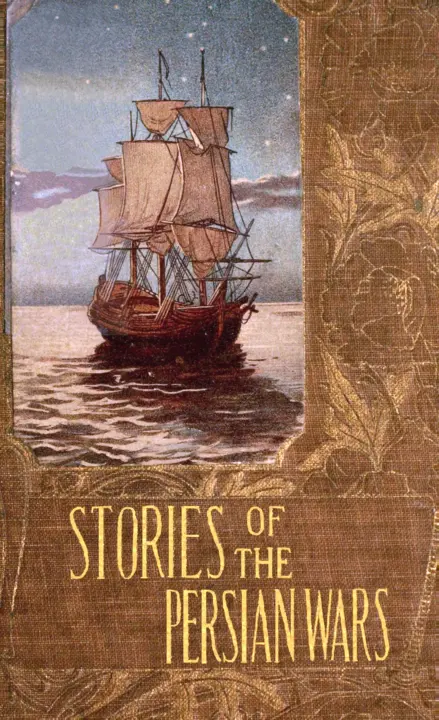
Stories of the Persian wars
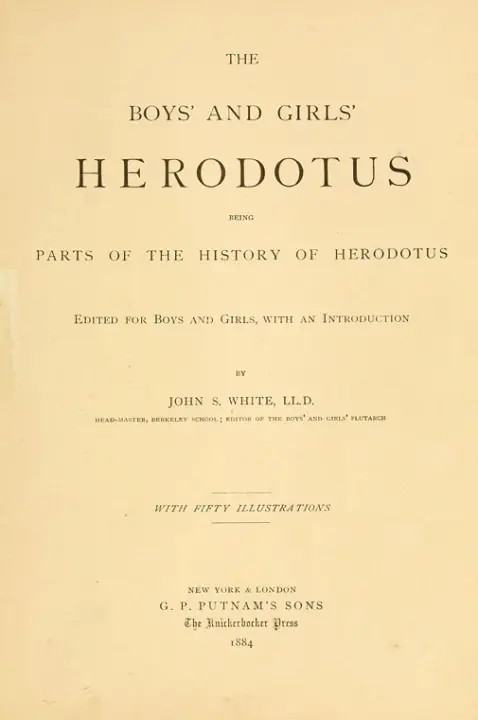
Herodotus
THE CLASSIC COLLECTION · 1905
"The Boys' and Girls' Herodotus" by Herodotus is a historical account written in the late 19th century. This edition, edited for younger readers by John S. White, aims to make the classic writings of Herodotus accessible to boys and girls, blending historical facts with engaging storytelling. The work discusses the origins of historical events, particularly the conflicts between the Greeks and various nations, introduced through the lens of Herodotus's experiences and narrative style. At the start of the narrative, the scene is set in ancient Athens, near the end of the year 446 B.C., as the city faces political uncertainty. Herodotus is described as a famed historian sharing captivating tales before an audience, including a young Thucydides. The introduction highlights his intent to document the historical struggles between Greeks and barbarians, showcasing the origins of various conflicts, customs, and significant figures. The narrative establishes Herodotus’s honest and vivid storytelling approach that includes anecdotes, making it relatable and appealing to younger audiences. The opening chapters delve into the early effects of the conflict over respect and relationships that escalated into war, providing a foundation for the historical accounts that follow.
Introduction adapted from the source catalogue; source summaries may be automatically generated.
Free to read · English · 112,601 words · No account needed
MAKE TIME FOR A GOOD BOOK
On by default. Untick to stop anonymous reading totals. Each page counts after 10 seconds in view. How this works.
Anonymous counting is on unless you have switched it off.
Aristagoras arrived at Sparta, when Cleomenes held the government; and he went to confer with him, as the Lacedæmonians say, carrying a bronze tablet, on which was engraved the circumference of the whole earth, the whole sea, and all rivers. "Wonder not, Cleomenes," said Aristagoras, "at my eagerness in coming here, for it is a great sorrow to us that the children of Ionians should be slaves instead of free, and above all others it is a disgrace to you, inasmuch as you are at the head of Greece. I adjure you by the Grecian gods, rescue the Ionians, who are of your own blood, from servitude. It is easy for you to effect this, for the barbarians are not valiant; whereas you, in matters relating to war, have attained to the utmost height of glory; their mode of fighting is, with bows and short spears, and they engage in battle wearing loose trousers, and turbans on their heads, so that they are easy to be overcome. Besides, there are treasures belonging to those who inhabit that continent, such as are not possessed by all other nations together; gold, silver, bronze, variegated garments, beasts of burden, and slaves; all these you may have if you will. They live adjoining one another as I will show you. Next to these Ionians are the Lydians, who inhabit a fertile country, and abound in silver." As he said this he showed the map of the earth, which he had brought with him, engraved on a tablet. "Next to the Lydians," proceeded Aristagoras, "are these Phrygians to the eastward, who are the richest in cattle and in corn of all with whom I am acquainted. Next to the Phrygians are the Cappadocians, whom we call Syrians; and bordering on them, the Cilicians, extending to this sea in which the island of Cyprus is situated; they pay an annual tribute of five hundred talents to the king. Next to the Cilicians are these Armenians, who also abound in cattle; and next to the Armenians are the Metienians, who occupy this country; and next them this territory of Cissia, in which Susa is situated, on this river Choaspes, and here the great king resides, and here are his treasures of wealth. If you take this city, you may boldly contend with Jupiter in wealth. As it is, you carry on war for a country of small extent, and not very fertile, and of narrow limits, with the Messenians, who are your equals in valor, and with the Arcadians and Argives, who have nothing akin to gold or silver, the desire of which induces men to hazard their lives in battle. But when an opportunity is offered to conquer all Asia with ease, will you prefer any thing else?" "Milesian friend," said Cleomenes, "I defer to give you an answer until the third day." They met at the appointed time and place, and Cleomenes asked Aristagoras, how many days' journey it was from the sea of the Ionians to the king. Aristagoras, though he was cunning in other things, and had deceived him with much address, made a slip in this; for he should not have told the real fact, if he wished to draw the Spartans into Asia; whereas he told him frankly that it was a three months' journey up there. Cutting short the rest of the description which Aristagoras was proceeding to give of the journey, Cleomenes said: "My friend, from Miletus, depart from Sparta before sunset; for you speak no agreeable language to the Lacedæmonians, in wishing to lead them a three months' journey from the sea;" and Cleomenes went home. Aristagoras, nothing daunted, taking an olive-branch in his hand, went to the house of Cleomenes, entered in, as a suppliant, and besought Cleomenes to listen to him. The latter's little child, a daughter, whose name was Gorgo, stood by him; she happened to be his only child, and was about eight or nine years of age. Cleomenes bade him say what he wished, and not mind the presence of the little girl. Thereupon Aristagoras promised him ten talents, if he would do as he desired; and as Cleomenes refused, Aristagoras went on increasing his offers, until he promised fifty talents, when little Gorgo cried out, "Papa, this stranger will corrupt you, if you don't quickly depart." Cleomenes, pleased with the advice of the child, retired to another apartment; and Aristagoras was forced to leave Sparta altogether, without ever getting another opportunity to give further particulars of the route to the city of the great king.
Your reading position is saved on this browser. Take it to another device with a library code. Reading pages adapt to text, rather than matching a printed edition.
BEHIND THE BOOK
This eBook is for the use of anyone anywhere in the United States and most other parts of the world at no cost and with almost no restrictions whatsoever. You may copy it, give it away or re-use it under the terms of the Project Gutenberg License included with this eBook or online at www.gutenberg.org. If you are not located in the United States, you will have to check the laws of the country where you are located before using this eBook. Read the source licence.
The original source file, including credits and licence, is retained by this library. Request an original-format copy at no charge. Please include the book title and Project Gutenberg identifier #55758.
KEEP YOUR CURIOSITY GOING
Cécile Tormay

Moritz Busch
John L. Ransom
Frances Wright
Cécile Tormay

Mabel Potter Daggett