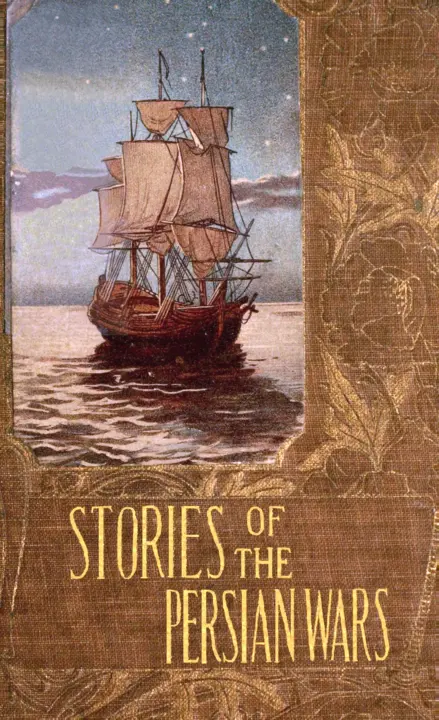
Stories of the Persian wars
Herodotus
THE CLASSIC COLLECTION · 1905
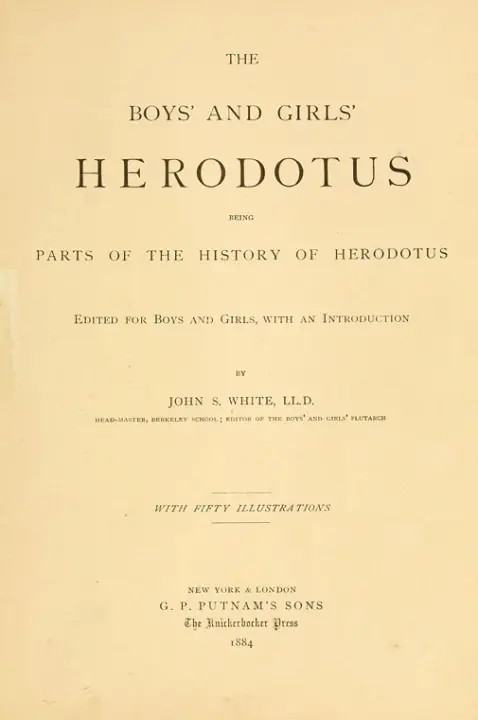
"The Boys' and Girls' Herodotus" by Herodotus is a historical account written in the late 19th century. This edition, edited for younger readers by John S. White, aims to make the classic writings of Herodotus accessible to boys and girls, blending historical facts with engaging storytelling. The work discusses the origins of historical events, particularly the conflicts between the Greeks and various nations, introduced through the lens of Herodotus's experiences and narrative style. At the start of the narrative, the scene is set in ancient Athens, near the end of the year 446 B.C., as the city faces political uncertainty. Herodotus is described as a famed historian sharing captivating tales before an audience, including a young Thucydides. The introduction highlights his intent to document the historical struggles between Greeks and barbarians, showcasing the origins of various conflicts, customs, and significant figures. The narrative establishes Herodotus’s honest and vivid storytelling approach that includes anecdotes, making it relatable and appealing to younger audiences. The opening chapters delve into the early effects of the conflict over respect and relationships that escalated into war, providing a foundation for the historical accounts that follow.
Introduction adapted from the source catalogue; source summaries may be automatically generated.
Free to read · English · 112,601 words · No account needed
MAKE TIME FOR A GOOD BOOK
On by default. Untick to stop anonymous reading totals. Each page counts after 10 seconds in view. How this works.
Anonymous counting is on unless you have switched it off.
Soothsayers among the Scythians are numerous, who divine by the help of a number of willow rods, in the following manner. They lay large bundles of twigs on the ground and untie them; and having placed each rod apart, they utter their predictions; and whilst they are pronouncing them, they gather up the rods again, and put them together again one by one. This is their national mode of divination. But the Enarees, or Androgyni, say that Venus gave them the power of divining by means of the bark of a linden tree: when a man has split the linden-tree in three pieces, twisting it round his own fingers, and then untwisting it, he utters a response.
When the king of the Scythians is sick, he sends for three of the most famous of the prophets, who prophesy in the manner above mentioned. When any of these prophets are proved to have sworn falsely, they put them to death in the following manner: they fill a wagon with faggots, and yoke oxen to it, then tie the feet of the prophets, bind their hands behind them, gag them, and enclose them in the midst of the faggots; then having set fire to them, they terrify the oxen, and let them go. Many oxen are burnt with the prophets, and many escape very much scorched, when the pole has been burnt asunder. Of the children of those whom he puts to death, the king kills all the males, but does not hurt the females.
The sepulchres of the kings are in the country of the Gerrhi. There, when their king dies, they dig a large square hole in the ground, to receive the corpse. Then, having the body covered with wax, the belly opened and cleaned, filled with bruised cypress, incense, parsley and anise-seed, and sewn up again, they carry it in a chariot to another nation; those who receive the corpse, brought to them, do the same as the Royal Scythians; they cut off part of their ear, shave off their hair, wound themselves on the arms, lacerate their forehead and nose, and drive arrows through their left hand. Thence they carry the corpse of the king to another nation whom they govern; and those to whom they first came accompany them. When they have carried the corpse round all the provinces, they arrive at the sepulchres among the Gerrhi, who are the most remote of the nations they rule over. Then, when they have placed the corpse in the grave on a bed of leaves, having fixed spears on each side of the dead body, they lay pieces of wood over it, and cover it over with mats. In the remaining space of the grave they bury one of the king's wives, having strangled her, and his cup-bearer, a cook, a groom, a page, a courier, and horses, and firstlings of everything else, and golden goblets; they make no use of silver or bronze. Then they all heap up a large mound, vieing with each other to make it as large as possible. At the expiration of a year, they take the most fitting of his remaining servants, all native Scythians; for whomsoever the king may order serve him, and they have no servants bought with money. Now when they have strangled fifty of these servants, and fifty of the finest horses, they take out their bowels, cleanse them, fill them with chaff, and sew them up again. Then placing the half of a wheel, with its concave side uppermost, on two pieces of wood, and the other half on two other pieces of wood, and preparing many of these in the same manner, they thrust thick pieces of wood through the horses lengthwise, up to the neck, mount them on the half-wheels; the foremost part of the half-wheels supporting the shoulders of the horses, and the hinder part the belly near the thighs, while the legs on both sides are suspended in the air; then, having put bridles and bits on the horses, they stretch them in front, and fasten them to a stake; they then mount upon each horse one of the fifty young men that have been strangled. They drive a straight piece of wood along the spine as far as the neck, and a part of this wood which projects from the bottom they fix into a hole bored in the other piece of wood that passes through the horse. The horsemen are then placed round the monument, and they depart.
Your reading position is saved on this browser. Take it to another device with a library code. Reading pages adapt to text, rather than matching a printed edition.
BEHIND THE BOOK
This eBook is for the use of anyone anywhere in the United States and most other parts of the world at no cost and with almost no restrictions whatsoever. You may copy it, give it away or re-use it under the terms of the Project Gutenberg License included with this eBook or online at www.gutenberg.org. If you are not located in the United States, you will have to check the laws of the country where you are located before using this eBook. Read the source licence.
The original source file, including credits and licence, is retained by this library. Request an original-format copy at no charge. Please include the book title and Project Gutenberg identifier #55758.
KEEP YOUR CURIOSITY GOING
Cécile Tormay

Moritz Busch
John L. Ransom
Frances Wright
Cécile Tormay

Mabel Potter Daggett