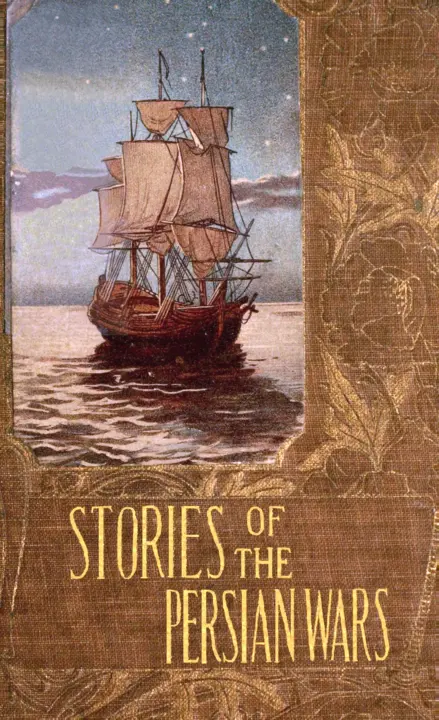
Stories of the Persian wars
Herodotus
THE CLASSIC COLLECTION · 1905
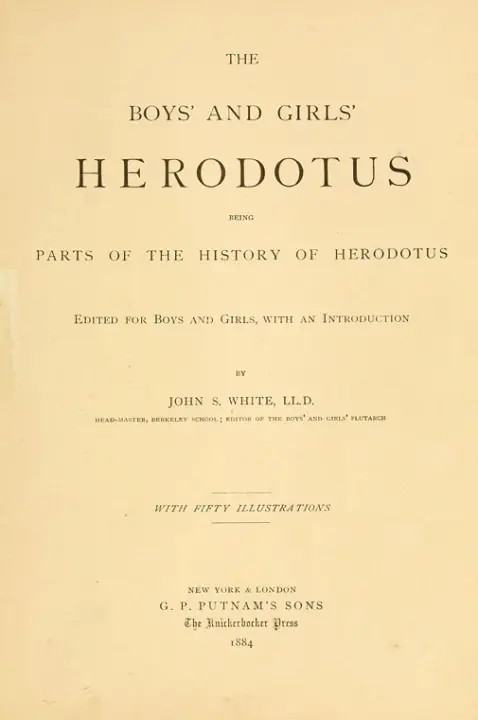
"The Boys' and Girls' Herodotus" by Herodotus is a historical account written in the late 19th century. This edition, edited for younger readers by John S. White, aims to make the classic writings of Herodotus accessible to boys and girls, blending historical facts with engaging storytelling. The work discusses the origins of historical events, particularly the conflicts between the Greeks and various nations, introduced through the lens of Herodotus's experiences and narrative style. At the start of the narrative, the scene is set in ancient Athens, near the end of the year 446 B.C., as the city faces political uncertainty. Herodotus is described as a famed historian sharing captivating tales before an audience, including a young Thucydides. The introduction highlights his intent to document the historical struggles between Greeks and barbarians, showcasing the origins of various conflicts, customs, and significant figures. The narrative establishes Herodotus’s honest and vivid storytelling approach that includes anecdotes, making it relatable and appealing to younger audiences. The opening chapters delve into the early effects of the conflict over respect and relationships that escalated into war, providing a foundation for the historical accounts that follow.
Introduction adapted from the source catalogue; source summaries may be automatically generated.
Free to read · English · 112,601 words · No account needed
MAKE TIME FOR A GOOD BOOK
On by default. Untick to stop anonymous reading totals. Each page counts after 10 seconds in view. How this works.
Anonymous counting is on unless you have switched it off.
This Democedes had been so harshly treated at Crotona by his father, who was of a severe temper, that he left him and went to Ægina; having settled there, in the first year, though he was unprovided with means, and had none of the instruments necessary for the exercise of his art, he surpassed the most skilful of their physicians. In the second year, the Æginetæ engaged him for a talent out of the public treasury; and in the third year the Athenians, for a hundred minæ; and in the fourth year Polycrates, for two talents; thus he came to Samos. From this man the Crotonian physicians obtained a great reputation; for at this period the physicians of Crotona were said to be the first throughout Greece, and the Cyrenæans the second. At the same time the Argives were accounted the most skilful of the Greeks in the art of music. Democedes, having completely cured Darius at Susa, had a very large house, and a seat at the king's table; and he had every thing he could wish for, except the liberty of returning to Greece. He obtained from the king a pardon for the Egyptian physicians who first attended the king, and were about to be empaled, because they had been outdone by a Greek physician; and in the next place he procured the liberty of a prophet of Elis, who had attended Polycrates, and lay neglected among the slaves. In short, Democedes had great influence with the king.
Not long after Atossa, daughter of Cyrus, and wife to Darius, had a tumor on her breast; after some time it burst, and spread considerably. As long as it was small, she concealed it, and from delicacy informed no one of it; when it became dangerous, she sent for Democedes and showed it to him. He said that he could cure her, but exacted a solemn promise, that she in return would perform for him whatever he should require of her, but added that he would ask nothing which might bring disgrace on her. When therefore he had healed her, and restored her to health, Atossa, instructed by Democedes, addressed Darius, in the following words: "O king, you, who possess so great power, sit idle, and do not add any nation or power to the Persians. It is right that a man who is both young and master of such vast treasures should render himself considerable by his actions, that the Persians may know that they are governed by a man. Two motives should influence you, to such a course: first, that the Persians may know that it is a worthy man who rules over them; and secondly, that they may be worn in war, and not tempted by too much ease to plot against you. You must perform some illustrious action while you are in the flower of your age; for the mind grows with the growth of the body, and as it grows old, grows old with it, and dull for every action." She spoke thus according to her instructions, and he answered: "Lady, you have mentioned the very things that I myself propose to do; for I have determined to make a bridge and march from this continent to the other, against the Scythians; and this shall shortly be put in execution." Atossa replied: "Give up the thought of marching first against the Scythians, for they will be in your power whenever you choose; but take my advice, and lead an army into Greece; for from the account I have heard, I am anxious to have Lacedæmonian, Argive, Athenian, and Corinthian attendants: and you have the fittest man in the world to show and inform you of every thing concerning Greece; I mean the person who cured your foot." Said Darius: "Well, since you think I ought to make my first attempt against Greece, I think it better first to send some Persians thither as spies with the man you mention; they, when they are informed of and have seen every particular, will make a report to me; and then, being thoroughly informed, I will turn my arms against them." No sooner said than done; for as soon as day dawned, he summoned fifteen eminent Persians, and commanded them to accompany Democedes along the maritime parts of Greece; and to take care that Democedes did not escape from them, but they must by all means bring him back again. He next summoned Democedes himself, and requested that when he should have conducted the Persians through all Greece, and shown it to them, to return; he also commanded him to take with him all his movables as presents to his father and brothers, promising to give him many times as much instead. Moreover, he said, that for the purpose of transporting the presents he would give a merchant-ship, filled with all kinds of precious things, which should accompany him on his voyage. Now Darius, in my opinion, promised him these things without any deceitful intention; but Democedes, fearing lest Darius was making trial of him, received all that was given, without eagerness, but said that he would leave his own goods where they were, that he might have them on his return; the merchant-ship he said he would accept.
Your reading position is saved on this browser. Take it to another device with a library code. Reading pages adapt to text, rather than matching a printed edition.
BEHIND THE BOOK
This eBook is for the use of anyone anywhere in the United States and most other parts of the world at no cost and with almost no restrictions whatsoever. You may copy it, give it away or re-use it under the terms of the Project Gutenberg License included with this eBook or online at www.gutenberg.org. If you are not located in the United States, you will have to check the laws of the country where you are located before using this eBook. Read the source licence.
The original source file, including credits and licence, is retained by this library. Request an original-format copy at no charge. Please include the book title and Project Gutenberg identifier #55758.
KEEP YOUR CURIOSITY GOING
Cécile Tormay

Moritz Busch
John L. Ransom
Frances Wright
Cécile Tormay

Mabel Potter Daggett