THE CLASSIC COLLECTION✦The Star of IndiaCLASSIC FREE BOOKS
The Star of India
Edward Sylvester Ellis
THE CLASSIC COLLECTION · 1883
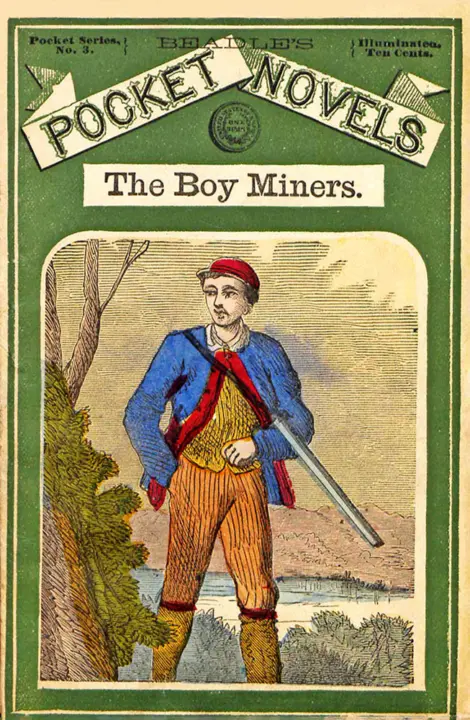
"The Boy Miners; Or, The Enchanted Island, A Tale of the Yellowstone Country" by Edward S. Ellis is a novel written in the late 19th century. This adventure story follows the journey of young gold miners, particularly focusing on brothers George and Edwin Inwood, and their companion Jim Tubbs, as they navigate the dangers of mining in the wilderness of California. The characters find themselves embroiled in conflict with the indigenous Mohave Indians while uncovering various mysteries and challenges along the way. At the start of the narrative, young Edwin Inwood is acting as a lookout for his brother George and their friend Jim Tubbs, who are busy mining for gold in a cave. Tension builds as Edwin spots a group of Mohave Indians approaching, prompting a hurried retreat into their hideout. After a close encounter with the Native Americans, the trio cleverly captures one of the Mohaves, leading to a strategic debate on how best to handle their situation. The opening chapters set the stage for a blend of adventure and conflict, suggesting themes of bravery, survival, and the complexities of human interaction in the wild, while introducing the characters' skills and personalities in the face of danger.
Introduction adapted from the source catalogue; source summaries may be automatically generated.
Free to read · English · 32,425 words · No account needed
MAKE TIME FOR A GOOD BOOK
On by default. Untick to stop anonymous reading totals. Each page counts after 10 seconds in view. How this works.
Anonymous counting is on unless you have switched it off.
It was a painful surprise both to Edwin Inwood and Jim Tubbs when they met each other in captivity. They conversed together, and acquainted themselves with their mutual history after their separation during the day.
“Poor George will be anxious enough about us,” said the boy. “I feel worse on his account than I do on my own.”
“What’s de matter wid him?” asked the negro, not exactly comprehending the force of this remark.
“Nothing, so far as I know; but what will he think when he comes back and finds nothing of us?”
“Tink we ain’t dere, I s’pose.”
“I don’t believe these people intend us any harm. They have treated us both so kindly that they will let us go to-morrow.”
“Hope so.”
“I see among these who came with you, the same one that we had in the
cave the other day.”
“Yes; me an’ him are great friends,” replied Jim, with an important air. “I kinder tink he always had a notion of me.”
They chatted together until toward morning, when, becoming sleepy, both lay down upon the ground, and slept until daylight. The African race is proverbial for its drowsy proclivities, and it required some hard shaking upon the part of Edwin before he could arouse his companion. But once awake, he was thoroughly so, and he arose to his feet.
The Mohaves had the camp-fire burning, and a number of birds, which resembled quails, cooking, while they had collected quite a quantity of mesquite beans, very numerous more south in California, and occasionally encountered further north. These furnished an abundant and nourishing breakfast, much needed by our friends.
Daylight brought another surprise in the shape of a third prisoner--a large, stalwart looking man, dressed in the garb of an Indian--in fact, no other personage than he who had guarded the lake and the Enchanted Island so zealously. He was sullen and obstinate, and his hands had been tied behind him for the purpose of security. He scowled at his fellow prisoners, as he was brought up, and undoubtedly hated them as thoroughly as he did his captors.
On the other hand, the Mohaves were particularly vindictive toward the man, and, from his appearance, had been subjecting him to suffering and torture for their own amusement. Only two held him, and they must certainly have secured him by strategy, as he was almost as muscular as Jim, and would have been an ugly customer in a hand-to-hand struggle.
“They’ve got quite a lot of us,” he remarked, addressing Inwood.
“Yes; dar am tree ob us.”
The stranger paid no heed to the negro, but spoke directly to Inwood.
Your reading position is saved on this browser. Take it to another device with a library code. Reading pages adapt to text, rather than matching a printed edition.
Edward Sylvester Ellis
Edward Sylvester Ellis
Edward Sylvester Ellis
Edward Sylvester Ellis
BEHIND THE BOOK
This eBook is for the use of anyone anywhere in the United States and most other parts of the world at no cost and with almost no restrictions whatsoever. You may copy it, give it away or re-use it under the terms of the Project Gutenberg License included with this eBook or online at www.gutenberg.org. If you are not located in the United States, you will have to check the laws of the country where you are located before using this eBook. Read the source licence.
The original source file, including credits and licence, is retained by this library. Request an original-format copy at no charge. Please include the book title and Project Gutenberg identifier #63868.
KEEP YOUR CURIOSITY GOING
Coulson Kernahan

Maurice Baring
Frances Wright
Cécile Tormay

Frederic Jesup Stimson

W. H. P. (William Henry Pope) Jarvis