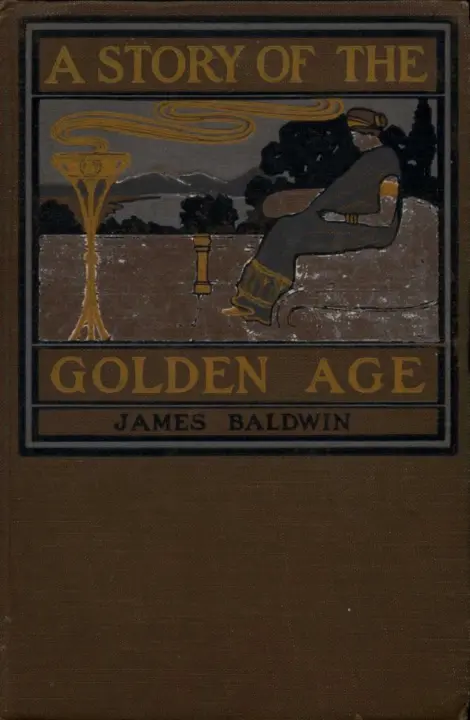
A Story of the Golden Age
James Baldwin

THE CLASSIC COLLECTION · 1884
"The Book-lover: A Guide to the Best Reading" by James Baldwin is a guidebook on literature and reading written in the late 19th century. This work serves as a comprehensive approach to the art of reading, focusing on the selection of meaningful literature and the importance of cultivating a love for good books. Baldwin draws from various literary sources to illustrate his points, aiming to inspire readers to enrich their intellectual lives through thoughtful reading choices. The beginning of the book introduces the author’s philosophy on the value and significance of books. It emphasizes that books are not merely static objects but living entities that serve as companions and mentors throughout one's life. Baldwin urges readers to make deliberate choices in their reading, advocating for the need to avoid poor literature and to seek out texts that nourish the mind and spirit. In this opening portion, Baldwin highlights the role of a scholar in making discerning choices and setting a foundation for a rich intellectual life through careful selection of reading material. He sets the stage for deeper discussions on how to read effectively and how libraries can serve as crucial resources for a scholar's development.
Introduction adapted from the source catalogue; source summaries may be automatically generated.
Free to read · English · 39,709 words · No account needed
MAKE TIME FOR A GOOD BOOK
On by default. Untick to stop anonymous reading totals. Each page counts after 10 seconds in view. How this works.
Anonymous counting is on unless you have switched it off.
We are brought now naturally to the subject of Theological Literature. The number of books in this department is very great, and there are wide differences of opinion with regard to the merits of many of the best-known works. Without attempting to select always the best, I shall name only a sufficient number of books necessary for the use of such non-professional readers as may desire to acquire a moderate knowledge of the commonly accepted theological doctrines—
McClintock and Strong’s Cyclopædia of Biblical, Theological, and Ecclesiastical Literature (10 vols.).
Smith’s Dictionary of the Bible.
Young’s Analytical Concordance to the Bible.
Barrow’s Sacred Geography and Antiquities.
Dean Stanley’s Sinai and Palestine in connection with their
History.
Clark’s Bible Atlas, with Maps and Plans.
Bissel’s Historic Origin of the Bible.
Lange’s Commentary on the Holy Scriptures.
Alford’s The Greek Testament; and The New Testament for English
Readers.
Oehler’s Theology of the Old Testament.
Weiss’s Biblical Theology of the New Testament.
Geikie’s Hours with the Bible.
Lenormant’s The Beginnings of History, according to the Bible and the Traditions of Oriental Peoples.
Dean Stanley’s Lectures on the History of the Jewish Church.
Geikie’s Life and Works of Christ.
Farrar’s Life of Christ.
Farrar’s Life and Work of St. Paul.
Conybeare and Howson’s Life and Epistles of St. Paul.
Schaff’s History of the Christian Church.
Dean Milman’s History of Latin Christianity (8 vols.).
Dean Stanley’s Lectures on the History of the Eastern Church.
Maurice’s Religions of the World.
James Freeman Clarke’s Ten Great Religions.
Moffatt’s Comparative History of Religions.
Trench’s Lectures on Mediæval Church History.
Ullman’s Reformers before the Reformation.
Fisher’s History of the Reformation.
Ranke’s History of the Popes during the Sixteenth and
Seventeenth Centuries.
Griesinger’s History of the Jesuits.
Baird’s Rise and Progress of the Huguenots in France.
Stevens’s History of Methodism.
Tyerman’s Life and Times of John Wesley.
Hagenbach’s History of Christian Doctrines (translated by C. W.
Buch).
Fisher’s Faith and Rationalism.
McCosh’s Christianity and Positivism.
Farrar’s Critical History of Free Thought in reference to the
Christian Religion.
Smith’s Faith and Philosophy.
Calderwood’s Relations of Science and Religion.
Max Müller’s Science of Religion.
Christlieb’s Counteracting Modern Infidelity.
Trench’s Shipwrecks of Faith.
Walker’s Philosophy of the Plan of Salvation.
Smyth’s Old Faiths in New Light.
Brooks’s Yale Lectures on Preaching.
Dorner’s System of Christian Doctrine.
Goulburn’s Thoughts on Personal Religion.
Your reading position is saved on this browser. Take it to another device with a library code. Reading pages adapt to text, rather than matching a printed edition.
James Baldwin
James Baldwin
James Baldwin
James Baldwin
BEHIND THE BOOK
This eBook is for the use of anyone anywhere in the United States and most other parts of the world at no cost and with almost no restrictions whatsoever. You may copy it, give it away or re-use it under the terms of the Project Gutenberg License included with this eBook or online at www.gutenberg.org. If you are not located in the United States, you will have to check the laws of the country where you are located before using this eBook. Read the source licence.
The original source file, including credits and licence, is retained by this library. Request an original-format copy at no charge. Please include the book title and Project Gutenberg identifier #47013.
KEEP YOUR CURIOSITY GOING

David Patterson (Spirit) Hatch

David Patterson (Spirit) Hatch

David Patterson (Spirit) Hatch

Ralph Waldo Emerson

Maurice Baring

Oscar Wilde & James McNeill Whistler