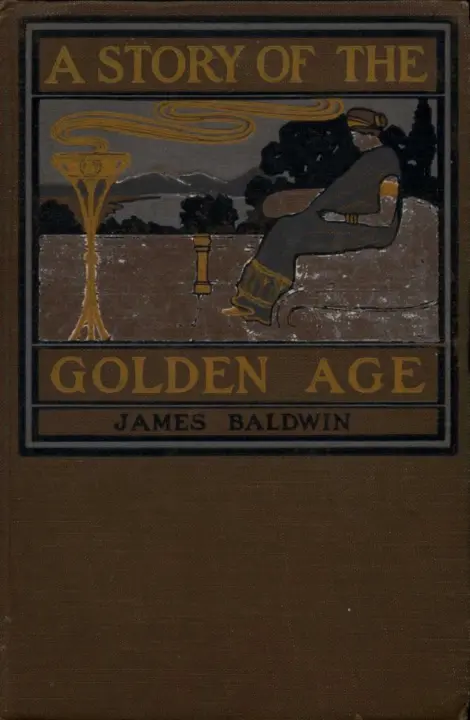
A Story of the Golden Age
James Baldwin

THE CLASSIC COLLECTION · 1884
"The Book-lover: A Guide to the Best Reading" by James Baldwin is a guidebook on literature and reading written in the late 19th century. This work serves as a comprehensive approach to the art of reading, focusing on the selection of meaningful literature and the importance of cultivating a love for good books. Baldwin draws from various literary sources to illustrate his points, aiming to inspire readers to enrich their intellectual lives through thoughtful reading choices. The beginning of the book introduces the author’s philosophy on the value and significance of books. It emphasizes that books are not merely static objects but living entities that serve as companions and mentors throughout one's life. Baldwin urges readers to make deliberate choices in their reading, advocating for the need to avoid poor literature and to seek out texts that nourish the mind and spirit. In this opening portion, Baldwin highlights the role of a scholar in making discerning choices and setting a foundation for a rich intellectual life through careful selection of reading material. He sets the stage for deeper discussions on how to read effectively and how libraries can serve as crucial resources for a scholar's development.
Introduction adapted from the source catalogue; source summaries may be automatically generated.
Free to read · English · 39,709 words · No account needed
MAKE TIME FOR A GOOD BOOK
On by default. Untick to stop anonymous reading totals. Each page counts after 10 seconds in view. How this works.
Anonymous counting is on unless you have switched it off.
+Dictionaries.+
No reader can well do without a good classical dictionary. The following are recommended as the best—
Anthon: Classical Dictionary.
Smith: Student’s Classical Dictionary.
———— Dictionary of Greek and Roman Antiquities.
Ginn & Heath’s Classical Atlas.
Kiepert’s Schulatlas.
+General Histories.+
Cox: General History of Greece.
Smith: Smaller History of Greece.
Felton: Ancient and Modern Greece.
Yonge: YOUNG FOLKS’ HISTORY OF GREECE.
Grote: History of Greece (12 vols.).
Curtius: History of Greece (5 vols.); translated from the German,
by A. W. Ward.
J. A. St. John: Ancient Greece.
+Mythology.+
Dwight: Grecian and Roman Mythology.
Murray: Manual of Mythology.
Keightley: Classical Mythology.
Gladstone: Juventus Mundi.
Ruskin: The Queen of the Air.
Cox: TALES OF ANCIENT GREECE.
Kingsley: THE GREEK HEROES.
Hawthorne: THE WONDER BOOK.
+Miscellaneous.+
Homer’s Iliad and Odyssey. Chapman’s translation is the best. Of the later versions, that of Lord Derby is preferable.
Church: STORIES FROM HOMER.
Butcher and Lang’s prose translation of the Odyssey.
Collins: The Iliad and the Odyssey (two volumes of “Ancient Classics for English Readers”).
Gladstone: Homer.
De Quincey: Homer and the Homeridæ (essay in “Literary Criticism”).
Fénelon: TELEMACHUS (translated by Hawkesworth).
Benjamin: Troy.
Goethe: Iphigenia in Tauris (drama, Swanwick’s translation).
The student of this period is referred also to Dr. Schliemann’s works: Ilios, Troja, and Mykenai.
Church: STORIES FROM HERODOTUS.
Swayne: Herodotus (Ancient Classics).
Brugsch Bey: History of Egypt.
Freeman: Historical Essays (2d series).
Ebers: Uarda (romance, descriptive of Egyptian life and manners fourteen centuries before Christ).
———— The Daughter of an Egyptian King (five centuries before Christ).
Smith: Student’s History of the East.
Cox: The Greeks and the Persians.
Abbott: THE HISTORY OF DARIUS THE GREAT.
Sankey: The Spartan Supremacy.
Bulwer: Pausanias the Spartan (romance, 475 B.C.).
Glover: Leonidas (epic poem).
Croly: The Death of Leonidas (poem).
Robert Browning: Pheidippides (poem in “Dramatic Idyls”).
Lloyd: The Age of Pericles (fifth century before Christ).
Cox: The Athenian Empire.
Landor: Pericles and Aspasia (in “Imaginary Conversations”).
Mrs. L. M. Child: Philothea (romance of the time of Pericles).
Curteis: The Macedonian Empire.
Abbott: THE HISTORY OF ALEXANDER THE GREAT.
Butcher: Demosthenes (Classical Writers).
Greenough: Apelles and his Contemporaries (a romance of the time of
Alexander).
Dryden: Alexander’s Feast (poem).
Bickersteth: Caubul (poem).
+Literature.+
Mahaffy: History of Greek Literature.
Schlegel: History of Dramatic Literature (first fourteen chapters).
Church: STORIES FROM THE GREEK TRAGEDIANS.
Copleston: Æschylus (Ancient Classics).
Mrs. Browning: Prometheus Bound (an English version of the great
tragedy).
Bishop Milman: Agamemnon.
Collins: Sophocles (Ancient Classics).
De Quincey: The Antigone of Sophocles (essay in “Literary Criticism”).
Donne: Euripides (Ancient Classics).
Froude: Sea Studies (essay in “Short Studies on Great Subjects”). Collins: Aristophanes (Ancient Classics).
Your reading position is saved on this browser. Take it to another device with a library code. Reading pages adapt to text, rather than matching a printed edition.
James Baldwin
James Baldwin
James Baldwin
James Baldwin
BEHIND THE BOOK
This eBook is for the use of anyone anywhere in the United States and most other parts of the world at no cost and with almost no restrictions whatsoever. You may copy it, give it away or re-use it under the terms of the Project Gutenberg License included with this eBook or online at www.gutenberg.org. If you are not located in the United States, you will have to check the laws of the country where you are located before using this eBook. Read the source licence.
The original source file, including credits and licence, is retained by this library. Request an original-format copy at no charge. Please include the book title and Project Gutenberg identifier #47013.
KEEP YOUR CURIOSITY GOING

David Patterson (Spirit) Hatch

David Patterson (Spirit) Hatch

David Patterson (Spirit) Hatch

Ralph Waldo Emerson

Maurice Baring

Oscar Wilde & James McNeill Whistler