
Letters to a Friend, Written to Mrs. Ezra S. Carr, 1866-1879
John Muir
THE CLASSIC COLLECTION · 1908
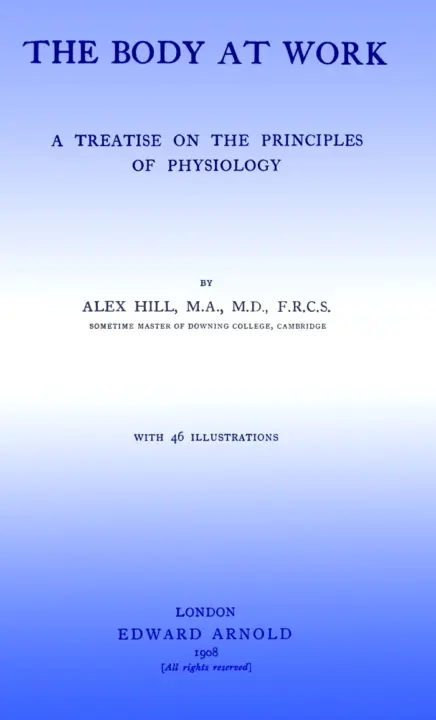
"The Body at Work: A Treatise on the Principles of Physiology" by Alex Hill is a scientific publication written in the early 20th century. The work discusses the various functions and interdependencies of physiological processes in living organisms, emphasizing the study of life and its manifestations rather than just anatomical structures. Hill aims to address the complexities of physiology in an accessible manner for readers unfamiliar with the foundational sciences. The opening of the treatise introduces the field of physiology, establishing it as the science concerned with the activities and functions of living beings. Hill contrasts physiology with anatomy, emphasizing that the former focuses on understanding how the body operates and responds to stimuli as opposed to merely detailing its structural components. He argues that the physiologist's role evolves through observational experimentation, leading to inferences about bodily functions, a process that historically highlights the interplay between living systems and their underlying structures. This section sets the stage for an exploration of life forms and their complex functionalities throughout the text.
Introduction adapted from the source catalogue; source summaries may be automatically generated.
Free to read · English · 172,268 words · No account needed
MAKE TIME FOR A GOOD BOOK
On by default. Untick to stop anonymous reading totals. Each page counts after 10 seconds in view. How this works.
Anonymous counting is on unless you have switched it off.
Tapeworms, resist digestion in the intestines, 21
Taste, confusion with sense of smell, 364
localization on tongue, 367
sense of, in fishes, 365
sensitiveness to quinine, 369
Taste-bulbs, their structure, 368
Tattooing, removal of pigment by leucocytes, 55
Tea, its dietetic value, 122
Teeth, 96
Tendon, the growth of, from cells, 28
Tension of gases in the lungs, 190
Tetanus, the vibratile contraction of muscle, 279
Thoracic duct, discharges lymph into veins, 43, 131
Thorax, negative pressure in, 222
Thorns on dendrites of nerve-cells, 300
Thyroid body or gland, forms an internal secretion, 86
relation to goitre, 85
structure of, 85
Tight-lacing, deformation of organs which it causes, 220
Tigroids, in nerve-cells, stores of energy, 320
Tissues, respiration in, 165, 193
Tone of muscles, 272
Tongue, as organ of taste, 367
Tonsils, function as guardians of the fauces, 53
structure, 52
Torpedo, electric organs of, 290
Touch, sensations of, 426
Toxins produced by microbes, 20
Urea, amount relatively to proteins consumed, 155
antecedents of, 146, 212
chemical formula, 211
secreted during period of starvation, 156
Uric acid, amount secreted daily, 213
artificial production of, 13
chemical formula, 13, 214
diathesis, its relation to diet, 140
due to metabolism of leucocytes, 53, 216
form in which excreted, 207
made in the liver of birds, 13
Urticaria due to abnormal composition of lymph, 41
Vaccination, protective value of, 22
Valves of heart, their mechanism, 226
Vascular system, tone of, 236, 240
Vaso-constrictor nerves, 236
Vaso-dilator nerves, 236
Vegetables, dietetic value of, 139
digestion of, 125, 137
Vermiform appendix, 88
Villi of intestine, absorption of food by, 130
fat seen in, during active digestion, 134
Viscera, their insensitiveness to injury, 316, 426
Vision, colour contrasts, 382
duration of images, 382
judgment of distance and size, 411
solidity, 401
stereoscopic, doctrine of corresponding points, 397
Visual purple, 381
Vital action, definition of expression, 205
Vivisection, 4
Vocal cords, structure, 431
how modified in singing, 435
Voice, breaking of, in boys, 434
falsetto, how produced, 435
range of human, 435
registers, 436
Vomiting, 105
Vowels, synthesis by tuning-forks, 439
Wandering cells, 33
Warmth, appreciation of, by skin, 429
Waste substances, classification, 194
how eliminated from body, 59
Waterfall, negative after-image of, 384
Water-weed, experiment proving that it respires, 24
Wear and tear of bioplasm, 145
Wisdom-tooth, tending to disappear, 96
Yawning, beneficial effect on circulation, 222
nervous mechanism of, 180
Young’s theory of colour-vision, 385
Zymogen, 110
Your reading position is saved on this browser. Take it to another device with a library code. Reading pages adapt to text, rather than matching a printed edition.
BEHIND THE BOOK
This eBook is for the use of anyone anywhere in the United States and most other parts of the world at no cost and with almost no restrictions whatsoever. You may copy it, give it away or re-use it under the terms of the Project Gutenberg License included with this eBook or online at www.gutenberg.org. If you are not located in the United States, you will have to check the laws of the country where you are located before using this eBook. Read the source licence.
The original source file, including credits and licence, is retained by this library. Request an original-format copy at no charge. Please include the book title and Project Gutenberg identifier #63089.
KEEP YOUR CURIOSITY GOING
John Muir

Asa Gray
Asa Gray

Florence Nightingale
Elizabeth Robins Pennell
Denison Olmsted