
Letters to a Friend, Written to Mrs. Ezra S. Carr, 1866-1879
John Muir
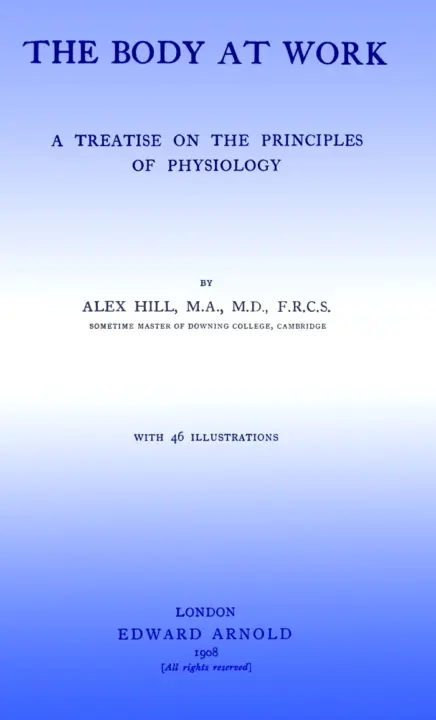
THE CLASSIC COLLECTION · 1908
"The Body at Work: A Treatise on the Principles of Physiology" by Alex Hill is a scientific publication written in the early 20th century. The work discusses the various functions and interdependencies of physiological processes in living organisms, emphasizing the study of life and its manifestations rather than just anatomical structures. Hill aims to address the complexities of physiology in an accessible manner for readers unfamiliar with the foundational sciences. The opening of the treatise introduces the field of physiology, establishing it as the science concerned with the activities and functions of living beings. Hill contrasts physiology with anatomy, emphasizing that the former focuses on understanding how the body operates and responds to stimuli as opposed to merely detailing its structural components. He argues that the physiologist's role evolves through observational experimentation, leading to inferences about bodily functions, a process that historically highlights the interplay between living systems and their underlying structures. This section sets the stage for an exploration of life forms and their complex functionalities throughout the text.
Introduction adapted from the source catalogue; source summaries may be automatically generated.
Free to read · English · 172,268 words · No account needed
MAKE TIME FOR A GOOD BOOK
On by default. Untick to stop anonymous reading totals. Each page counts after 10 seconds in view. How this works.
Anonymous counting is on unless you have switched it off.
The ear, like the eye, records amplitude of vibration; loudness. It also records rapidity of vibration, musical pitch, which corresponds with colour. But it seems to have a more difficult task than the eye, since it has to analyse, or at any rate has to transmit information regarding the form of compound vibrations. The meanings of these distinctions may be illustrated by reference to a tracing on the cylinder of a phonograph. A needle attached to the posterior surface of the thin metal plate against which one speaks scratches the surface of a rotating cylinder of hardened wax. Examined with a lens, the record is seen to be an irregularly changing line. The depth of the marks is a measure of loudness. Their varying number in a given time indicates the changing pitch of the voice which produced them. Their form is a record of the quality of its tone. The work of the ear, so far as it consists in the estimation of the amplitude and rapidity of pulsations of sound, is easy to describe, but the acoustics of form are complicated.
Light is transmitted as vibrations of æther. They are transverse to the direction in which the light is travelling. Sound cannot travel through a vacuum, since it is dependent upon displacements of material particles. The particles move forwards and backwards in the direction in which sound is progressing. Sound is a sequence of pulsations, alternate condensations and rarefactions of the media which conduct it. Their particles are first pressed together, and then rebound to positions farther apart. A sequence of to-and-fro movements, each smoothly continuous throughout the whole duration of a pulsation, would produce a pure musical tone. Tuning-forks carefully bowed settle down after a few seconds into unbroken oscillations, which convey to the air the to-and-fro movements of pure tones. Such tones vary in nothing but loudness and pitch. If their pulsations are slow, we speak of the pitch as “low”; if they are rapid, we say that their pitch is high. But if the sound produced by tuning-forks (and low-toned stopped organ-pipes) be omitted from the list, no pure tones reach our ears. The notes of flutes, fiddles, trumpets, pianos, have each a certain “quality” characteristic of the instrument. Even in a violin the G string has not the same timbre as the D string. Owing to the elasticity of the substances which originate and of the substances which transmit sound, its pulsations are not simple to-and-fro movements, uninterrupted from beginning to end. Each pulsation is partially broken at intervals; and the quality of the sound depends upon the number and relative accentuation of these partial interruptions. Sound travels through air at the rate of 1,100 feet per second. This figure, divided by the number of vibrations per second of a tone, gives the wave-length in air of a tone of that particular pitch. For example, the middle C has a vibratory rate of 256. Its wave-length is, therefore, somewhat over 4 feet. The lowest tone of an organ has a wave-length of 37 feet; its highest of 3½ inches. These figures give no information, however, regarding the movement of the particles which pass on the sound. When air is transmitting a note—say the middle C—its separate molecules do not move through a distance of 4 feet. Each molecule moves but a short distance, varying with the loudness of the tone; but the “wave” of crowding runs straight forward from the piano-string to the ear, the molecules at the end of each stage of 4 feet taking on a backward movement, so that the crowding, so far as the molecules of that particular section are concerned, returns to its starting-point. Between the piano-string and the ear there is a crowding and forward movement at 0, 4, 8, 12 ... feet; a spreading and backward movement at 2, 6, 10, 14 ... feet. Most illustrations which are intended to aid the mind in forming a definite picture of the transmission of sound are liable to be misinterpreted, because they translate rectilinear movements into waves. They represent the movements of the string, and not the movements of the molecules of air between the string and the ear; but with the aid of the imagination one may picture the positions of the particles in this path. The pulse, we will suppose, has just reached the limit of 12 feet. Half-way from its 8-foot halting place the molecules are again crowded, although not so densely. One-third of the distance from the same point there again appears a tendency to crowd. This latter point marks an interval of one-third of this wave plus the wave which led up to it. At the end of the ninth foot there is a crowding, though less marked—this wave plus the two preceding waves, divided into fourths. Within these intervals are other points at which the molecules have closed together, the distances from a nodal point depending upon the number of waves involved, and, speaking generally, growing less marked as the number increases. Such are the very complex pulsatile movements which reach the ear.
Your reading position is saved on this browser. Take it to another device with a library code. Reading pages adapt to text, rather than matching a printed edition.
BEHIND THE BOOK
This eBook is for the use of anyone anywhere in the United States and most other parts of the world at no cost and with almost no restrictions whatsoever. You may copy it, give it away or re-use it under the terms of the Project Gutenberg License included with this eBook or online at www.gutenberg.org. If you are not located in the United States, you will have to check the laws of the country where you are located before using this eBook. Read the source licence.
The original source file, including credits and licence, is retained by this library. Request an original-format copy at no charge. Please include the book title and Project Gutenberg identifier #63089.
KEEP YOUR CURIOSITY GOING
John Muir

Asa Gray
Asa Gray

Florence Nightingale
Elizabeth Robins Pennell
Denison Olmsted