
Letters to a Friend, Written to Mrs. Ezra S. Carr, 1866-1879
John Muir
THE CLASSIC COLLECTION · 1908
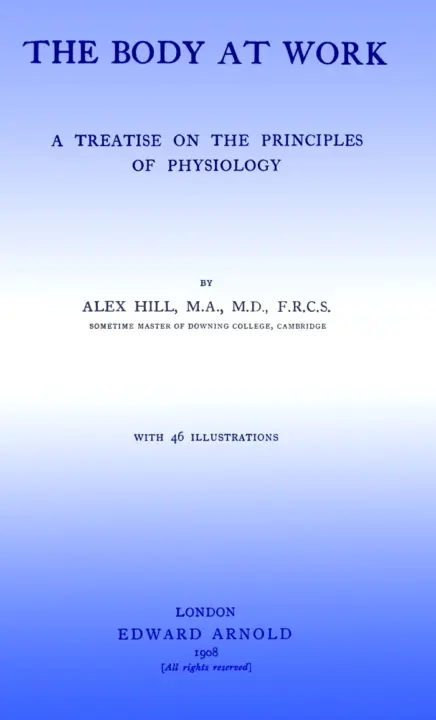
"The Body at Work: A Treatise on the Principles of Physiology" by Alex Hill is a scientific publication written in the early 20th century. The work discusses the various functions and interdependencies of physiological processes in living organisms, emphasizing the study of life and its manifestations rather than just anatomical structures. Hill aims to address the complexities of physiology in an accessible manner for readers unfamiliar with the foundational sciences. The opening of the treatise introduces the field of physiology, establishing it as the science concerned with the activities and functions of living beings. Hill contrasts physiology with anatomy, emphasizing that the former focuses on understanding how the body operates and responds to stimuli as opposed to merely detailing its structural components. He argues that the physiologist's role evolves through observational experimentation, leading to inferences about bodily functions, a process that historically highlights the interplay between living systems and their underlying structures. This section sets the stage for an exploration of life forms and their complex functionalities throughout the text.
Introduction adapted from the source catalogue; source summaries may be automatically generated.
Free to read · English · 172,268 words · No account needed
MAKE TIME FOR A GOOD BOOK
On by default. Untick to stop anonymous reading totals. Each page counts after 10 seconds in view. How this works.
Anonymous counting is on unless you have switched it off.
Every musical sound produced by a piano, a violin, or other instrument, is compounded of a fundamental or prime tone, and overtones, partial tones, or harmonics. The following table shows the more important partial tones which accompany the prime tone when the middle C on a pianoforte is struck:
Number of Number of Note. Vibrations. Interval. Ratio. Overtone.
C‴ 2,048 } 7th
} Super-Second 8/7
}
B″♭ 1,792 } 6th
} Sub-minor third 7/6
}
G″ 1,536 } 5th
} Minor third 6/5
}
E″ 1,280 } 4th
} Major third 5/4
}
C″ 1,024 } 3rd
} Fourth 4/3
}
G′ 768 } 2nd
} Fifth 3/2
}
C′ 512 } 1st
} Octave 2/1
C 256 } =Fundamental=
The quality of a musical note depends upon the number and relative loudness of its overtones. When several notes are sounded simultaneously, they blend into a chord or harmony, provided the intervals which separate them are equal to the intervals which separate the simpler overtones. Each of the notes yields overtones. The tones blend into a concord. Their partials are in unison. The variations in air-pressure of the compound tone are strictly periodic. If the ratios of the frequencies of its constituent notes are simple the product is a rich, full sound, such as a common chord.
At least one other character of the pulsations of sound must be taken into consideration if we wish to picture the nature of the force to which the ear responds. Tones which reach it from several instruments simultaneously are not necessarily in unison, or even in harmony. The overtones of a single note sounded on a piano or violin—the statement does not hold good for bells, nor is it strictly true of flutes or horns—must necessarily bear a simple proportional relation to their prime tone. They divide the grand pulsation into fractions “without a remainder.” But the vibrations of two tuning-forks which are slightly out of unison interfere one with the other at regular intervals. They produce “beats.” Everyone is familiar with the curious effect which is produced upon the eye when one row of railings is seen through another, or one expanse of wire-netting behind another. Sets of lines which occupy nearly the same positions in the line of sight combine to make a large pattern, which overlies the smaller pattern of the rails or netting. The same thing happens with sounds which coincide at considerable intervals, although in the case of sounds interference is as marked as reinforcement. If whilst a tuning-fork yielding 101 vibrations per second is singing another of 100 vibrations is brought into play, the vibrations of the second fork are superposed on those of the first. At a certain moment the forward movement of molecules of air induced by the first fork is reinforced by a forward push from the second. But half a second after this coincidence of phase an opposite result is produced—50½ vibrations of No. 1 have passed, but only 50 of No. 2. No. 2 is going backwards (inwards), whilst No. 1 is moving forwards (outwards). The same molecules are impelled backwards by No. 2 and forwards by No. 1. The result is a pause. The compound sound produced by the two forks reaches the ear in throbs. If the forks were vibrating at the rates of 101 and 99, there would be two pauses and two beats in every second; if at the rate of 202 and 198, four. The number of beats per second equals the difference in frequency of vibration of the tones. A pianoforte tuner does his work best if he has a musical ear, yet he may discharge his duties with competence without one. Having struck a note, he sounds its octave, holding both keys down, and listens for the beat. If the first note gave no beat with his tuning-fork, the second is in time when it likewise gives no beat with the first. We have met a tuner who did his work in this way; but it must be admitted that his tempering of the intervals of the octave with which he commenced, and consequently of the other octaves above and below it, left something to be desired. The result might have been satisfactory had he been provided with twelve tuning-forks.
Your reading position is saved on this browser. Take it to another device with a library code. Reading pages adapt to text, rather than matching a printed edition.
BEHIND THE BOOK
This eBook is for the use of anyone anywhere in the United States and most other parts of the world at no cost and with almost no restrictions whatsoever. You may copy it, give it away or re-use it under the terms of the Project Gutenberg License included with this eBook or online at www.gutenberg.org. If you are not located in the United States, you will have to check the laws of the country where you are located before using this eBook. Read the source licence.
The original source file, including credits and licence, is retained by this library. Request an original-format copy at no charge. Please include the book title and Project Gutenberg identifier #63089.
KEEP YOUR CURIOSITY GOING
John Muir

Asa Gray
Asa Gray

Florence Nightingale
Elizabeth Robins Pennell
Denison Olmsted