THE CLASSIC COLLECTION✦An outlaw’s diary: the CommuneCLASSIC FREE BOOKS
An outlaw’s diary: the Commune
Cécile Tormay
THE CLASSIC COLLECTION · 1926
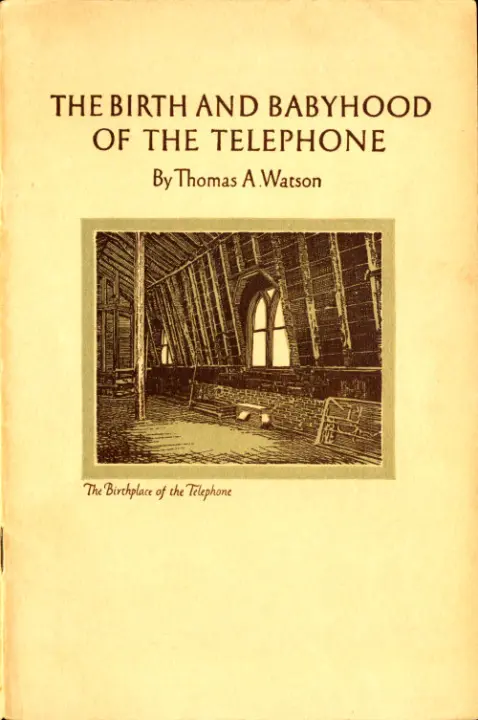
"The Birth and Babyhood of the Telephone" by Thomas Augustus Watson is a personal account detailing the early development of the telephone, written in the early 20th century. As a memoir, it likely reflects on the late 19th century, particularly the years 1874 to 1880 when significant breakthroughs in telecommunication took place. The book is centered around Watson's experiences as Alexander Graham Bell's assistant, offering insights into the historical context and technical challenges faced during the inception of the telephone. In this memoir, Watson recounts his journey from a young apprentice in an electrical workshop to becoming an integral part of Bell's experiments that would lead to the invention of the telephone. The narrative features the trials and errors associated with early telephony, including the development of various telephonic devices and instruments. Watson provides a detailed description of their groundbreaking experiments, culminating in the momentous occasion when he heard Bell's voice for the first time through a wire, signifying the birth of the telephone. The book not only serves as a historical record but also highlights the enthusiasm and determination of the pioneers who laid the groundwork for modern communication.
Introduction adapted from the source catalogue; source summaries may be automatically generated.
Free to read · English · 14,322 words · No account needed
MAKE TIME FOR A GOOD BOOK
On by default. Untick to stop anonymous reading totals. Each page counts after 10 seconds in view. How this works.
Anonymous counting is on unless you have switched it off.
Telephone Milestones
1892 Service opened between New York and Chicago, 900 miles. 1902 First long-distance underground cable in use, 10 miles—New York to Newark. 1915 First conversation from coast to coast, 3,650 miles—Boston to San Francisco. 1921 Opening of deep sea cable, 115 miles—Key West, Fla., to Havana, Cuba. 1927 Transatlantic telephone service opened between New York and London, 3,500 miles. First public demonstration of television by wire and radio. 1929 Ship-to-shore telephone service established. 1931 Teletypewriter exchange service inaugurated. 1935 First telephone call around the world. 1937 Connections possible to 93% of world’s telephones. 1938 Direct radio telephone circuit established between San Francisco and Australia.
Dec. 31, 1920 Dec. 31, 1925 Dec. 31, 1930 Dec. 31, 1935 Dec. 31, 1938
Number of Telephones[2] 8,133,759 11,909,571 15,187,296 13,573,025 15,761,095 Number of Central 5,767 6,147 6,639 6,896 6,975 Offices Miles of Pole Lines 362,481 394,529 428,212 407,454 399,368 Miles of Wire: In Underground Cable 14,207,000 27,769,000 45,116,000 47,639,000 50,783,000 In Aerial Cable 6,945,000 12,835,000 23,777,000 26,425,000 28,072,000 Open Wire 3,711,000 4,339,000 5,231,000 4,562,000 4,590,000 Total 24,863,000 44,943,000 74,124,000 78,626,000 83,445,000 Per Cent Total Wire 85.1 90.3 92.9 94.2 94.5 Mileage in Cable Average Daily Telephone Conversations:[3] Exchange 31,818,000 48,051,000 61,150,000 58,066,000 67,400,000 Toll and Long 1,307,000 2,090,000 2,884,000 2,224,000 2,497,000 Distance Total 33,125,000 50,141,000 64,034,000 60,290,000 69,897,000 Total Plant $1,373,802,000 $2,566,809,000 $4,028,836,000 $4,187,790,000 $4,489,078,000 Number of Employees[4] 228,943 292,902 318,119 241,169 257,443 Number of A.T.&T. Co. 139,448 362,179 567,694 657,465 646,882 Stockholders
Footnotes
[1]“Ahoy!” was the first telephone shout, and was used during the experiments, but “hello!” superseded it when the telephone got into practical use.
[2]Excludes private line telephones numbering 79,612 on December 31, 1938. Including telephones of about 6,500 connecting companies and more than 25,000 connecting rural lines, the total number of telephones in the United States which can be interconnected is approximately 19,885,000.
[3]For year ending December 31.
[4]The employees of the Western Electric Company, Inc., and the Bell Telephone Laboratories, Inc., numbering 34,910 on December 31, 1938, are not included.
Transcriber’s Notes
—Retained publication information from the printed edition: this eBook is public-domain in the country of publication.
—Silently corrected a few palpable typos.
—In the text versions only, text in italics is delimited by
underscores.
Your reading position is saved on this browser. Take it to another device with a library code. Reading pages adapt to text, rather than matching a printed edition.
BEHIND THE BOOK
This eBook is for the use of anyone anywhere in the United States and most other parts of the world at no cost and with almost no restrictions whatsoever. You may copy it, give it away or re-use it under the terms of the Project Gutenberg License included with this eBook or online at www.gutenberg.org. If you are not located in the United States, you will have to check the laws of the country where you are located before using this eBook. Read the source licence.
The original source file, including credits and licence, is retained by this library. Request an original-format copy at no charge. Please include the book title and Project Gutenberg identifier #54506.
KEEP YOUR CURIOSITY GOING
Cécile Tormay

Moritz Busch
John L. Ransom
Frances Wright
Cécile Tormay

Mabel Potter Daggett