THE CLASSIC COLLECTION✦An outlaw’s diary: the CommuneCLASSIC FREE BOOKS
An outlaw’s diary: the Commune
Cécile Tormay
THE CLASSIC COLLECTION · 1926
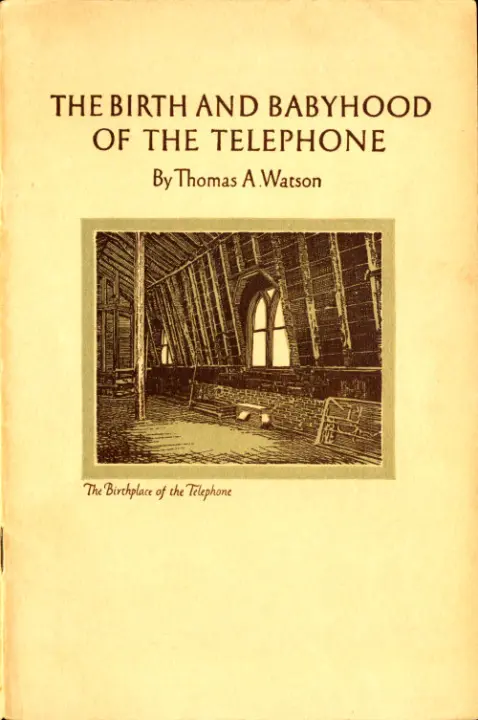
"The Birth and Babyhood of the Telephone" by Thomas Augustus Watson is a personal account detailing the early development of the telephone, written in the early 20th century. As a memoir, it likely reflects on the late 19th century, particularly the years 1874 to 1880 when significant breakthroughs in telecommunication took place. The book is centered around Watson's experiences as Alexander Graham Bell's assistant, offering insights into the historical context and technical challenges faced during the inception of the telephone. In this memoir, Watson recounts his journey from a young apprentice in an electrical workshop to becoming an integral part of Bell's experiments that would lead to the invention of the telephone. The narrative features the trials and errors associated with early telephony, including the development of various telephonic devices and instruments. Watson provides a detailed description of their groundbreaking experiments, culminating in the momentous occasion when he heard Bell's voice for the first time through a wire, signifying the birth of the telephone. The book not only serves as a historical record but also highlights the enthusiasm and determination of the pioneers who laid the groundwork for modern communication.
Introduction adapted from the source catalogue; source summaries may be automatically generated.
Free to read · English · 14,322 words · No account needed
MAKE TIME FOR A GOOD BOOK
On by default. Untick to stop anonymous reading totals. Each page counts after 10 seconds in view. How this works.
Anonymous counting is on unless you have switched it off.
Such is my very inadequate story of the earliest days of the telephone so far as they made part of my life. To-day when I go into a central office or talk over a long distance wire or read the annual report of the American Telephone and Telegraph Company, filled with figures up in the millions and even billions, when I think of the growth of the business, and the marvelous improvements that have been made since the day I left it, thinking there was nothing more to do but routine, I must say that all that early work I have told you about seems to shrink into a very small measure, and, proud as I always shall be, that I had the opportunity of doing some of that earliest work myself, my greatest pride is that I am one of the great army of telephone men, every one of whom has played his part in making the Bell Telephone service what it is to-day.
I thank you.
Early Chronology of the Telephone
1847, March 3—Birth of Alexander Graham Bell at Edinburgh, Scotland. 1854, January 18—Birth of Thomas A. Watson at Salem, Mass. 1870, August 1—Bell moves to America with his parents, arriving in Canada on this date, and settling at Brantford, Ontario. 1872, October 1—Permanent residence in the United States taken up by Bell at 35 West Newton Street, Boston. 1875, February 27—Written agreement between Bell, Sanders, and Hubbard forming “Bell Patent Association” to promote inventor’s work in telegraph field. June 2—Bell completes the invention of the Telephone, electrically transmitting overtones for the first time and verifying his principle of the electrical transmission of speech at 109 Court Street, Boston. June 3—First telephone instrument constructed by Watson according to Bell’s specifications. September—Bell at Brantford begins writing specifications for a telephone patent. 1876, February 14—Application for telephone patent filed with U. S. Patent Office, Washington, D. C. March 7—U. S. Patent 174,465 issued to Bell, covering fundamental principles of the Electric Speaking Telephone. March 10—First complete sentence transmitted by telephone by Bell to Watson, “Mr. Watson, come here; I want you.” Between two rooms at 5 Exeter Place, Boston. June 25—Bell exhibits his Telephone to the Judges of the Centennial Exhibition at Philadelphia, on which he is awarded the Exhibition’s medal. August 10—Experimental one-way talk—8 miles, Brantford to Paris, Ontario. September 1—Contract with Thomas A. Watson for one-half his time—the beginning of telephone research laboratories. October 9—First experimental two-way telephone conversation between different towns—2 miles, between Boston and Cambridgeport, Mass. November 26—Conversation over railroad telegraph wires—16 miles, Boston to Salem. 1877, February 12—Bell’s first public lecture and demonstration of his new invention given before the Essex Institute in Salem, where he had lived and had done some of his experimenting. April 4—First outdoor line for regular telephone use installed—Boston to Somerville. May 17—Telephone lines first interconnected by means of an experimental switchboard at 342 Washington Street, Boston. July 9—“Bell Telephone Co., Gardiner G. Hubbard, Trustee,” the first telephone organization, formed. August 1—First stock issue—5,000 shares—dividing interest in the business between seven original stockholders: A. G. Bell, Mrs. Bell, G. G. Hubbard, Mrs. Hubbard, C. E. Hubbard, Thomas Sanders and Thomas A. Watson. August 10—First Bell telephone employee hired in Boston—Robert W. Devonshire. 1878, January 28—Opening of first commercial telephone exchange at New Haven, Conn., serving 8 lines and 21 telephones. May 22—Theodore N. Vail accepts General Managership of Bell Telephone Company. 1879, March 13—Certificate of Incorporation filed in Boston for National Bell Telephone Company for purpose of unifying telephone development throughout the country. November 10—Agreement signed by Western Union Telegraph Co. admitting validity of Bell’s basic telephone patents. 1880, December 31—47,900 Bell telephones in the United States. 1881, January 1—First telephone dividend, inaugurating a continuous regular series of payments to stockholders. January 10—Formal opening of telephone service by overhead wire between Boston and Providence—45 miles. A metallic circuit was first successfully tried out on this route by J. J. Carty. 1882, April 16—Experimental laying of underground telephone cable—5 miles, Attleboro to West Mansfield, Mass. 1884, March 27—Telephone service opened experimentally between Boston and New York by overhead wires of hard-drawn copper—235 miles. 1885, March 3—Certificate of Incorporation filed in Albany, N. Y., for the American Telephone and Telegraph Company for the purpose of effecting intercommunication “with one or more points in each and every other city, town or place in said State, and in each and every other of the United States, and in Canada and Mexico—and also by cable and other appropriate means with the rest of the known world.”
Your reading position is saved on this browser. Take it to another device with a library code. Reading pages adapt to text, rather than matching a printed edition.
BEHIND THE BOOK
This eBook is for the use of anyone anywhere in the United States and most other parts of the world at no cost and with almost no restrictions whatsoever. You may copy it, give it away or re-use it under the terms of the Project Gutenberg License included with this eBook or online at www.gutenberg.org. If you are not located in the United States, you will have to check the laws of the country where you are located before using this eBook. Read the source licence.
The original source file, including credits and licence, is retained by this library. Request an original-format copy at no charge. Please include the book title and Project Gutenberg identifier #54506.
KEEP YOUR CURIOSITY GOING
Cécile Tormay

Moritz Busch
John L. Ransom
Frances Wright
Cécile Tormay

Mabel Potter Daggett