THE CLASSIC COLLECTION✦The Pentateuch of printingCLASSIC FREE BOOKS
The Pentateuch of printing
William Blades
THE CLASSIC COLLECTION · 1861
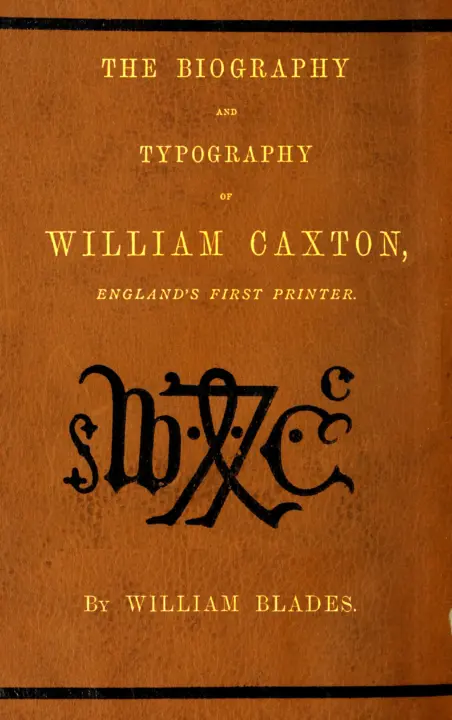
"The biography and typography of William Caxton, England's first printer" by Blades is a historical and bibliographical study written in the late 19th century. It charts Caxton’s life and career alongside a meticulous analysis of his printed output, types, devices, and working methods, situating him within the rise of printing in England and the Low Countries. Drawing on company records, embassies, and court circles, it follows Caxton from Kentish origins through mercantile Bruges to Westminster, while also cataloguing his editions and discussing their rarity and features.
The opening of the volume sets the scope: a revised reprint that condenses earlier scholarship and adds notes on Caxton’s printer’s device and punctuation, while underscoring printing’s civilizational impact. It then outlines the plan—first a documentary life of Caxton, then detailed descriptions of his books by type, with appendices from Mercers’ and Bruges records. The narrative begins with Caxton’s birth in the Weald of Kent amid strong Flemish influence, a dialect anecdote about “eyren/eggs,” and a sober weighing of name variants to suggest a likely Causton connection. It proceeds to his 1438 apprenticeship to the wealthy mercer Robert Large, depicting London apprentice life, Large’s household and will, and vivid city scenes—dearth, pageantry, religious persecution, and civic unrest—culminating in Caxton’s departure abroad. In Bruges he emerges as a prosperous merchant, then Governor of the English Nation (Merchant Adventurers), mediating trade disputes, enforcing measures, and corresponding with London while treaties lapsed and were renewed; he begins translating the Recuyell under Duchess Margaret’s patronage and likely moves toward printing with Colard Mansion. A broad survey follows of 15th‑century bibliophilia—royal and ducal libraries in France and Burgundy, Louis de Bruges’s collection, English patrons—and of the book trades’ guild structure at Bruges and Antwerp. Finally, an initial technical chapter contrasts manuscripts and early print, explaining materials, binding habits, blank leaves, one‑page printing, signatures, hand‑painted initials, undated colophons, and typeforms that closely imitated contemporary handwriting.
Introduction adapted from the source catalogue; source summaries may be automatically generated.
Free to read · English · 119,581 words · No account needed
MAKE TIME FOR A GOOD BOOK
On by default. Untick to stop anonymous reading totals. Each page counts after 10 seconds in view. How this works.
Anonymous counting is on unless you have switched it off.
The question of the invention of moveable types, like that of the origin of paper, is one into which we have no need here to enter. The majority of writers on this subject having been unacquainted with the characteristics of type, have strayed far and wide in the discussion. M. Bernard, however, writing as a practical printer, has done much to dispel numerous misapprehensions, and especially that common error of supposing that the first moveable types were cut in wood.
We now proceed to lay before the reader the earliest notices of typefounders, and such evidence as may explain the mechanics of typefounding in the fifteenth century, especially with reference to the types of Caxton.
Perhaps no part of the Typographic Art is hidden in more utter darkness than the early manufacture of the types. Considerable secrecy no doubt accompanied all the operations of the first printers, and was maintained down to a comparatively late period. Moreover, it was but natural that the results of the new art should hold a more prominent place in men’s minds than the processes by which those results were produced; and thus, although printers and printing were often mentioned, we find nothing concerning the mechanical part of typefounding anterior to that curious little book of trades, with illustrations by Jost Amman, which was issued at Frankfort in 1568. The author, in the few lines which accompany the illustration, omits all reference to the process, but, from the woodcut of the “Schrifftgiesser” and his tools, we shall draw some practical inferences concerning early typefounding.
Whether Caxton, whose account of his first typographical venture is contained in the prologue to the Third Book of “The Recuyell,” made himself acquainted with the manufacture as well as with the use of his types there is no evidence to prove. He simply remarks, “Therefore I have practysed and lerned at my grete charge and dispense to ordeyne this said book in prynte.” If he only procured types and presses, and acquired the requisite knowledge to control their use, it no doubt cost him a large sum. The probability is that his first two founts were cast at Bruges according to his instructions, and that he brought the second over with him to Westminster. But, when once settled in his native country, we may well consider whether he would not, for convenience sake, have become his own typefounder. No stray hint or remark can be found to incline us to the one opinion or the other. Several generations of printers passed away before we find in any work the slightest allusion to English typefounders. The earliest appears in Archbishop Parker’s preface to Asser’s Chronicle of King Alfred, where, in speaking of the Saxon types with which the book was printed, the editor states that as far as he knew, Day, the printer, was the first to cut them:--“Iam verò cum Dayus typographus primus (& omnium certè quod sciam solus) has formulas æri inciderit: facilè quæ Saxonicis literis perscripta sunt, iisdem typis diuulgabuntur.” This leads us to suppose that John Day was only one typefounder among others, and that therefore the art was at that time by no means a new one in England. Seventy years later we find typefounding a distinct trade in London, and under rigid Government protection, as we learn from the following decree:--
Your reading position is saved on this browser. Take it to another device with a library code. Reading pages adapt to text, rather than matching a printed edition.
William Blades
William Blades
William Blades
BEHIND THE BOOK
This eBook is for the use of anyone anywhere in the United States and most other parts of the world at no cost and with almost no restrictions whatsoever. You may copy it, give it away or re-use it under the terms of the Project Gutenberg License included with this eBook or online at www.gutenberg.org. If you are not located in the United States, you will have to check the laws of the country where you are located before using this eBook. Read the source licence.
The original source file, including credits and licence, is retained by this library. Request an original-format copy at no charge. Please include the book title and Project Gutenberg identifier #78654.
KEEP YOUR CURIOSITY GOING
Cécile Tormay

Moritz Busch
John L. Ransom
Frances Wright
Cécile Tormay

Mabel Potter Daggett