THE CLASSIC COLLECTION✦The Pentateuch of printingCLASSIC FREE BOOKS
The Pentateuch of printing
William Blades
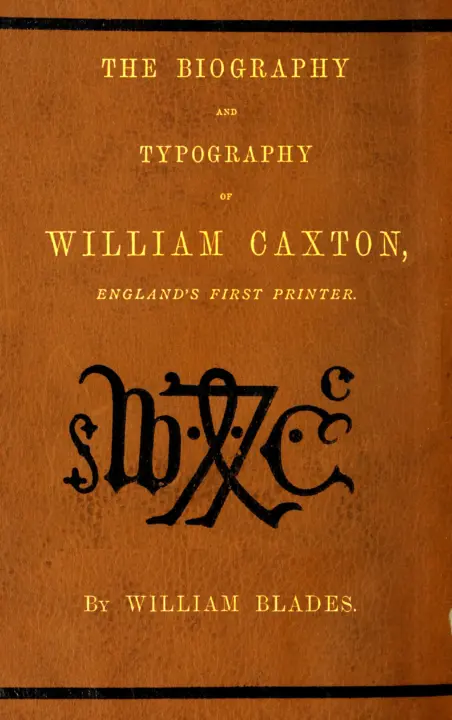
THE CLASSIC COLLECTION · 1861
"The biography and typography of William Caxton, England's first printer" by Blades is a historical and bibliographical study written in the late 19th century. It charts Caxton’s life and career alongside a meticulous analysis of his printed output, types, devices, and working methods, situating him within the rise of printing in England and the Low Countries. Drawing on company records, embassies, and court circles, it follows Caxton from Kentish origins through mercantile Bruges to Westminster, while also cataloguing his editions and discussing their rarity and features.
The opening of the volume sets the scope: a revised reprint that condenses earlier scholarship and adds notes on Caxton’s printer’s device and punctuation, while underscoring printing’s civilizational impact. It then outlines the plan—first a documentary life of Caxton, then detailed descriptions of his books by type, with appendices from Mercers’ and Bruges records. The narrative begins with Caxton’s birth in the Weald of Kent amid strong Flemish influence, a dialect anecdote about “eyren/eggs,” and a sober weighing of name variants to suggest a likely Causton connection. It proceeds to his 1438 apprenticeship to the wealthy mercer Robert Large, depicting London apprentice life, Large’s household and will, and vivid city scenes—dearth, pageantry, religious persecution, and civic unrest—culminating in Caxton’s departure abroad. In Bruges he emerges as a prosperous merchant, then Governor of the English Nation (Merchant Adventurers), mediating trade disputes, enforcing measures, and corresponding with London while treaties lapsed and were renewed; he begins translating the Recuyell under Duchess Margaret’s patronage and likely moves toward printing with Colard Mansion. A broad survey follows of 15th‑century bibliophilia—royal and ducal libraries in France and Burgundy, Louis de Bruges’s collection, English patrons—and of the book trades’ guild structure at Bruges and Antwerp. Finally, an initial technical chapter contrasts manuscripts and early print, explaining materials, binding habits, blank leaves, one‑page printing, signatures, hand‑painted initials, undated colophons, and typeforms that closely imitated contemporary handwriting.
Introduction adapted from the source catalogue; source summaries may be automatically generated.
Free to read · English · 119,581 words · No account needed
MAKE TIME FOR A GOOD BOOK
On by default. Untick to stop anonymous reading totals. Each page counts after 10 seconds in view. How this works.
Anonymous counting is on unless you have switched it off.
The discovery of Caxton’s will would probably settle satisfactorily many questions about his family and relations, but all the registries in which it might possibly have been deposited have been searched without success.
That our knowledge of William Caxton is confined almost entirely to his public life, is much to be regretted. We can trace to some extent his career in commerce as well as in diplomacy. As a printer too, we can judge of him by an examination of his works; but when we wish to portray the man as a master, or in domestic life, or we desire to know what his neighbours thought of him, we fail for want of reliable material. From his appending a bitter satire on “women” to the “Dictes and Sayings of the Philosophers,” we might have inclined to think him a bachelor, did we not know that he had a wife and daughter when he came to England; but that he was unmarried while “governor” at Bruges is almost certain, as the rules of celibacy were very strict among merchants living out of their own countries. The Steel Yard merchants had a stringent law on the subject, and the Merchant Adventurers were doubtless guided by the same policy.
We naturally turn to the prologues and epilogues attached to Caxton’s translations for traits of character, but here again, we are surrounded by difficulties. There existed in those days no rights in literature. Every author took from others what best suited his purpose, and that without acknowledgment, except to give authority to his own opinions. This practice has involved many of the works of that period in considerable obscurity. Caxton was not free from this characteristic of his age, and we accordingly find him appropriating whole prologues and epilogues from the French originals, altering them only when inapplicable to himself. Such instances may be seen in the “Chess Book,” the “Mirror,” the “Golden Legend,” “Charles,” and others. Great care is therefore requisite to distinguish between Caxton’s own thoughts and the mere translation of those of others. But, after making due allowance for all this, there yet remains, in Caxton’s prologues and epilogues, a substratum of individuality, which must be the basis for any right appreciation of his character. His repeated eulogies of Edward IV, and the members of his family, indicate that all his political sympathies were with the House of York. This was but natural, for the development of trade consequent upon amity between England and the princes of the Low Countries, made all the English merchants staunch adherents to the White Rose. His writings also reveal that he had a deep sense of religion, and was strict in the observance of his Christian duties. Although in one sense the greatest reformer that this country has ever known, he was quite unconscious of the tendency of the art which he introduced. In the tone of his mind he was indeed eminently conservative, comparing the good old times of his apprenticeship with the degeneracy of the succeeding generations, when in the youth of London there was “no kernel nor good corn found, but chaff for the most part.” Much concerned was he to note in his latter days the decline of chivalry, and he urged his Sovereign to take immediate measures for its revival, even to the extent of engaging in a new crusade against the Turks for the recovery of the “holy cyte of Jherusalem.” Conservative as he was in theory, there seems reason to believe that he was no less so in practice. Caxton never gave in to the new-fangled ideas of printers about the advantage of title-pages to books, though if we may judge from the fact of Wynken de Worde using them immediately after his master’s death, he was of the reverse opinion. In the adoption of signatures, initials, and lines of an even length, he was very tardy, and from the use of red ink he was evidently averse.
Your reading position is saved on this browser. Take it to another device with a library code. Reading pages adapt to text, rather than matching a printed edition.
William Blades
William Blades
William Blades
BEHIND THE BOOK
This eBook is for the use of anyone anywhere in the United States and most other parts of the world at no cost and with almost no restrictions whatsoever. You may copy it, give it away or re-use it under the terms of the Project Gutenberg License included with this eBook or online at www.gutenberg.org. If you are not located in the United States, you will have to check the laws of the country where you are located before using this eBook. Read the source licence.
The original source file, including credits and licence, is retained by this library. Request an original-format copy at no charge. Please include the book title and Project Gutenberg identifier #78654.
KEEP YOUR CURIOSITY GOING
Cécile Tormay

Moritz Busch
John L. Ransom
Frances Wright
Cécile Tormay

Mabel Potter Daggett