THE CLASSIC COLLECTION✦The Pentateuch of printingCLASSIC FREE BOOKS
The Pentateuch of printing
William Blades
THE CLASSIC COLLECTION · 1861
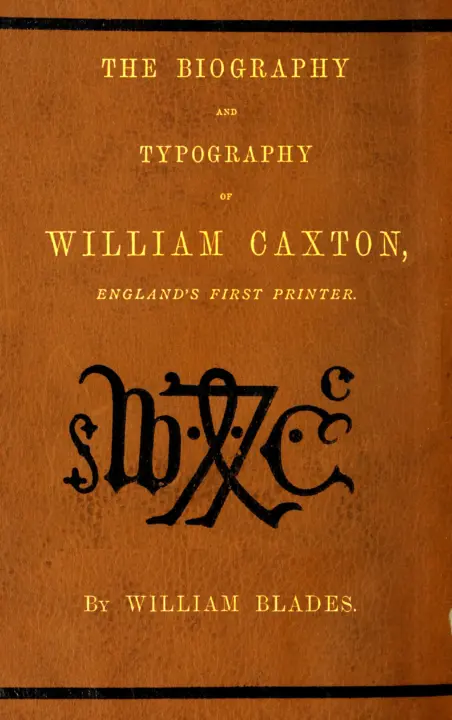
"The biography and typography of William Caxton, England's first printer" by Blades is a historical and bibliographical study written in the late 19th century. It charts Caxton’s life and career alongside a meticulous analysis of his printed output, types, devices, and working methods, situating him within the rise of printing in England and the Low Countries. Drawing on company records, embassies, and court circles, it follows Caxton from Kentish origins through mercantile Bruges to Westminster, while also cataloguing his editions and discussing their rarity and features.
The opening of the volume sets the scope: a revised reprint that condenses earlier scholarship and adds notes on Caxton’s printer’s device and punctuation, while underscoring printing’s civilizational impact. It then outlines the plan—first a documentary life of Caxton, then detailed descriptions of his books by type, with appendices from Mercers’ and Bruges records. The narrative begins with Caxton’s birth in the Weald of Kent amid strong Flemish influence, a dialect anecdote about “eyren/eggs,” and a sober weighing of name variants to suggest a likely Causton connection. It proceeds to his 1438 apprenticeship to the wealthy mercer Robert Large, depicting London apprentice life, Large’s household and will, and vivid city scenes—dearth, pageantry, religious persecution, and civic unrest—culminating in Caxton’s departure abroad. In Bruges he emerges as a prosperous merchant, then Governor of the English Nation (Merchant Adventurers), mediating trade disputes, enforcing measures, and corresponding with London while treaties lapsed and were renewed; he begins translating the Recuyell under Duchess Margaret’s patronage and likely moves toward printing with Colard Mansion. A broad survey follows of 15th‑century bibliophilia—royal and ducal libraries in France and Burgundy, Louis de Bruges’s collection, English patrons—and of the book trades’ guild structure at Bruges and Antwerp. Finally, an initial technical chapter contrasts manuscripts and early print, explaining materials, binding habits, blank leaves, one‑page printing, signatures, hand‑painted initials, undated colophons, and typeforms that closely imitated contemporary handwriting.
Introduction adapted from the source catalogue; source summaries may be automatically generated.
Free to read · English · 119,581 words · No account needed
MAKE TIME FOR A GOOD BOOK
On by default. Untick to stop anonymous reading totals. Each page counts after 10 seconds in view. How this works.
Anonymous counting is on unless you have switched it off.
The reader who examines this list may well be astonished at the number here given of unique Caxtons. Out of 102 works above enumerated, no less than 38 are known to us by single copies, or by fragments only. The fact is almost incredible even to those most conversant with the rarities of the Westminster Press; and the question naturally arises--If about one-third of Caxton’s issue has been nearly destroyed, how numerous may have been the editions of which we shall never learn the existence? A glance at the titles of the uniques will show that the books most liable to destruction, probably owing in part to their being much used, and in part to the destructiveness of religious sectarianism, are those, directly or indirectly, of an ecclesiastical character--such as “Horæ,” “Psalters,” “Meditacions,” &c. School-books also, such as the “Stans Puer,” “Catho,” &c., are always difficult of preservation. On the other hand, there seems no especial reason for the almost total destruction of such works as the romances of “King Arthur,” “The Four Sons of Aymon,” “Blanchardin,” “Charles the Great,” the second edition of “Reynard,” or the various short poems in quarto.
The greatest number of copies ever brought together is 83, being the number now in the British Museum; but of these 25 are duplicates, leaving the number of works 58, of which three are mere fragments. The Caxtons in Earl Spencer’s Library, although numerically less than those of the National Library, make nevertheless a more complete collection, and embrace 57 separate works. Other Libraries come far behind these two. The Public Library, Cambridge, has 42 separate works, a total considerably augmented by the numerous unique pieces of poetry in quarto. The Bodleian has 34 separate works, and the Duke of Devonshire 25.
Abbey, Meaning of word, 73
Adventurers (See Merchant Adventurers)
Advertisement printed by Caxton, 72, 239
Æneid by Virgil, 347
Æsop, The Fables of, printed by Caxton, 48, 91, 287
Aforge, Daniel, 86
Ailly, Cardinal Pierre d’, 228
Alburgh, John, 150
Alcock, Bishop, 181
Aldus, Pius Romanus, 106
Alfonse, The Fables of, printed by Caxton, 287
Almonry, The, Its position, &c., 73, 74, 75, 79
Alphage, St., Parish of, 4
Ambassadors at Bruges, 27
Ames, Joseph, Note on Caxton’s death, 85
Amman, Jost, 104
Anderson’s History of Commerce, 26
Anelida, Queen, and False Arcyte, printed by Caxton, 212
Anne, St., Chapel of, 73, 74
Apprentices, Entry and Issues of, 6
Apprentices, Duties of, 8
Apprentices and Executors, 14
Apprentices, Oath of, 145
Apprenticeship of Caxton, 5
Arbre de, Batailles, 337
Arcyte, Queen Anelida, and False, printed by Caxton, 212
Ars moriendi, printed by Caxton, 358
Art, The, and Craft to know well to Die, printed by Caxton, 346, 354
Arthur, The Noble Histories of King, and of certain of his Knights, printed by Caxton, 304
Arundel, Earl of, his Device, 81
Ascensius Jodocus Badius, 128
Assumption, Guild of Lady of, 77
Atkyns, Richard, Origin and Growth of Printing, 90
Your reading position is saved on this browser. Take it to another device with a library code. Reading pages adapt to text, rather than matching a printed edition.
William Blades
William Blades
William Blades
BEHIND THE BOOK
This eBook is for the use of anyone anywhere in the United States and most other parts of the world at no cost and with almost no restrictions whatsoever. You may copy it, give it away or re-use it under the terms of the Project Gutenberg License included with this eBook or online at www.gutenberg.org. If you are not located in the United States, you will have to check the laws of the country where you are located before using this eBook. Read the source licence.
The original source file, including credits and licence, is retained by this library. Request an original-format copy at no charge. Please include the book title and Project Gutenberg identifier #78654.
KEEP YOUR CURIOSITY GOING
Cécile Tormay

Moritz Busch
John L. Ransom
Frances Wright
Cécile Tormay

Mabel Potter Daggett