THE CLASSIC COLLECTION✦The Pentateuch of printingCLASSIC FREE BOOKS
The Pentateuch of printing
William Blades
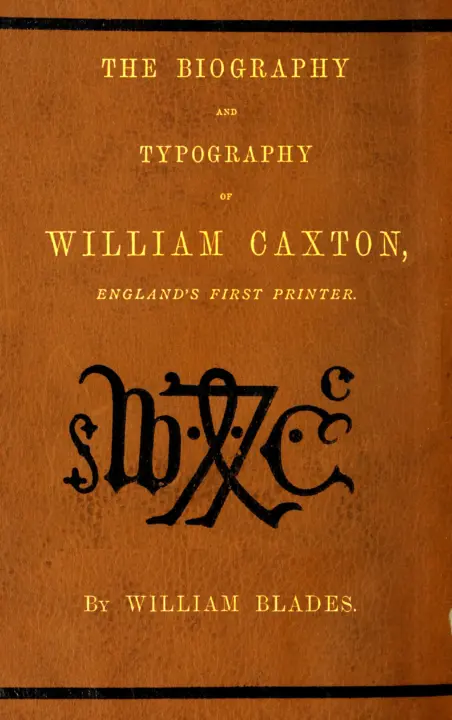
THE CLASSIC COLLECTION · 1861
"The biography and typography of William Caxton, England's first printer" by Blades is a historical and bibliographical study written in the late 19th century. It charts Caxton’s life and career alongside a meticulous analysis of his printed output, types, devices, and working methods, situating him within the rise of printing in England and the Low Countries. Drawing on company records, embassies, and court circles, it follows Caxton from Kentish origins through mercantile Bruges to Westminster, while also cataloguing his editions and discussing their rarity and features.
The opening of the volume sets the scope: a revised reprint that condenses earlier scholarship and adds notes on Caxton’s printer’s device and punctuation, while underscoring printing’s civilizational impact. It then outlines the plan—first a documentary life of Caxton, then detailed descriptions of his books by type, with appendices from Mercers’ and Bruges records. The narrative begins with Caxton’s birth in the Weald of Kent amid strong Flemish influence, a dialect anecdote about “eyren/eggs,” and a sober weighing of name variants to suggest a likely Causton connection. It proceeds to his 1438 apprenticeship to the wealthy mercer Robert Large, depicting London apprentice life, Large’s household and will, and vivid city scenes—dearth, pageantry, religious persecution, and civic unrest—culminating in Caxton’s departure abroad. In Bruges he emerges as a prosperous merchant, then Governor of the English Nation (Merchant Adventurers), mediating trade disputes, enforcing measures, and corresponding with London while treaties lapsed and were renewed; he begins translating the Recuyell under Duchess Margaret’s patronage and likely moves toward printing with Colard Mansion. A broad survey follows of 15th‑century bibliophilia—royal and ducal libraries in France and Burgundy, Louis de Bruges’s collection, English patrons—and of the book trades’ guild structure at Bruges and Antwerp. Finally, an initial technical chapter contrasts manuscripts and early print, explaining materials, binding habits, blank leaves, one‑page printing, signatures, hand‑painted initials, undated colophons, and typeforms that closely imitated contemporary handwriting.
Introduction adapted from the source catalogue; source summaries may be automatically generated.
Free to read · English · 119,581 words · No account needed
MAKE TIME FOR A GOOD BOOK
On by default. Untick to stop anonymous reading totals. Each page counts after 10 seconds in view. How this works.
Anonymous counting is on unless you have switched it off.
The preface finishes the page. The second verso is blank.
On sig. ~a j~,
~ℂ How the lyon kynge of alle bestys sent oute hys
maude ‖ mentys that alle beestys sholde come to hys feest
and court / ‖~
~ℂ Capitulo Primo~
The conclusion of the text cannot be given, no perfect copy being at present known. For an account of the first edition of this celebrated allegory see ante page 229.
The only EXISTING COPY is in the Pepysian Library, Cambridge. It unfortunately wants the last two leaves, containing the epilogue of Caxton, and ends on sig. ~i~ 4 verso, with these words,
~And her wyth wil J leue fforw
hat haue J to wryte of thyse mysdedis J haue ynowh to doo~
It is in good condition, but cropped, measuring 9 × 6¾ inches. Pepys’s arms on the binding, and his book-plate inside. The wanting leaves are supplied in manuscript of seventeenth century.
NO. 85.--THE HISTORY OF BLANCHARDIN AND EGLANTINE. Folio. Sine ullâ
notâ. (1489?)
COLLATION.--Imperfectly known. The introductory matter makes a 3n, signed ~i~, ~ii~, ~iij~, the sixth leaf being blank. ~A B C D E F G H J K L M~ are 4ns, and there were probably several other additional signatures.
TYPOGRAPHICAL PARTICULARS.--Without title. The type is all No. 6. The lines, which are all of one length, measure 4⅝ inches, and there are 31 to a full page. Woodcut initials. Without folios or catchwords.
The Text begins on sig. ~j~ recto, with a prologue by Caxton,
~U~ ~Nto the right noble puyssaut & excellet pryncesse my redoubted lady my lady margarete duchesse of So- mercete / moder vnto our naturel & souerayn lord and most~
and finishes on the verso of the same leaf,
~Joyes desirs in thys present lyf: ℂ And after this short and transytorye lyff . euerlastynge lyff in heuen Amen /~
The table follows on sig. ~ij~, with a 2-line initial,
~H~ ~Ere begynneth the table of the victoryous prynce Blanchardyn / sone of the noble kyng of Fryse~
and finishes on the 5th recto, which, however, in the only copy known, is, unfortunately, in manuscript. This appears to have been copied from the very rare reprint by Wynken de Worde, the last four lines being--“How Blanchardin wedded his love the proude | pucelle in amours: And of the grete ioye that | was made there . and of the Kynge of Fryse deth capl° liiij°”
The sixth leaf is blank. On sig. ~A j~ recto the first chapter
commences as follows:--
~ℂ The first chapitre of this present boke conteyneth how Blanchardyn departed out of the court of his fader kynge of fryse / Capitulo primo .~
~T~ ~Hat tyme when the Right happy . wele of~
All the text after sig. ~M iiij~ is wanting in the only known copy.
Your reading position is saved on this browser. Take it to another device with a library code. Reading pages adapt to text, rather than matching a printed edition.
William Blades
William Blades
William Blades
BEHIND THE BOOK
This eBook is for the use of anyone anywhere in the United States and most other parts of the world at no cost and with almost no restrictions whatsoever. You may copy it, give it away or re-use it under the terms of the Project Gutenberg License included with this eBook or online at www.gutenberg.org. If you are not located in the United States, you will have to check the laws of the country where you are located before using this eBook. Read the source licence.
The original source file, including credits and licence, is retained by this library. Request an original-format copy at no charge. Please include the book title and Project Gutenberg identifier #78654.
KEEP YOUR CURIOSITY GOING
Cécile Tormay

Moritz Busch
John L. Ransom
Frances Wright
Cécile Tormay

Mabel Potter Daggett