THE CLASSIC COLLECTION✦The Pentateuch of printingCLASSIC FREE BOOKS
The Pentateuch of printing
William Blades
THE CLASSIC COLLECTION · 1861
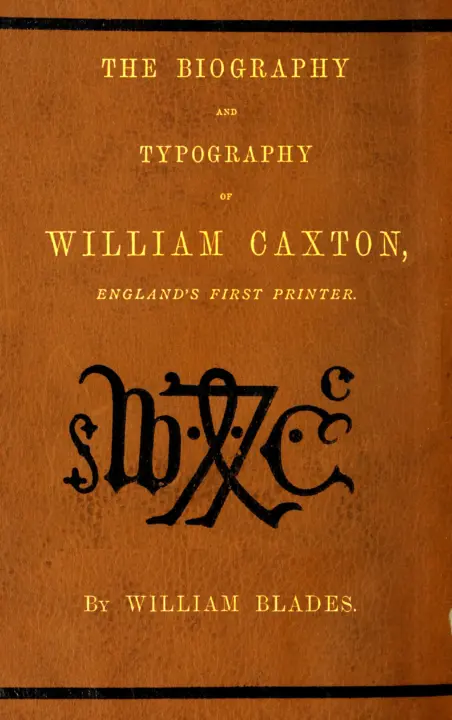
"The biography and typography of William Caxton, England's first printer" by Blades is a historical and bibliographical study written in the late 19th century. It charts Caxton’s life and career alongside a meticulous analysis of his printed output, types, devices, and working methods, situating him within the rise of printing in England and the Low Countries. Drawing on company records, embassies, and court circles, it follows Caxton from Kentish origins through mercantile Bruges to Westminster, while also cataloguing his editions and discussing their rarity and features.
The opening of the volume sets the scope: a revised reprint that condenses earlier scholarship and adds notes on Caxton’s printer’s device and punctuation, while underscoring printing’s civilizational impact. It then outlines the plan—first a documentary life of Caxton, then detailed descriptions of his books by type, with appendices from Mercers’ and Bruges records. The narrative begins with Caxton’s birth in the Weald of Kent amid strong Flemish influence, a dialect anecdote about “eyren/eggs,” and a sober weighing of name variants to suggest a likely Causton connection. It proceeds to his 1438 apprenticeship to the wealthy mercer Robert Large, depicting London apprentice life, Large’s household and will, and vivid city scenes—dearth, pageantry, religious persecution, and civic unrest—culminating in Caxton’s departure abroad. In Bruges he emerges as a prosperous merchant, then Governor of the English Nation (Merchant Adventurers), mediating trade disputes, enforcing measures, and corresponding with London while treaties lapsed and were renewed; he begins translating the Recuyell under Duchess Margaret’s patronage and likely moves toward printing with Colard Mansion. A broad survey follows of 15th‑century bibliophilia—royal and ducal libraries in France and Burgundy, Louis de Bruges’s collection, English patrons—and of the book trades’ guild structure at Bruges and Antwerp. Finally, an initial technical chapter contrasts manuscripts and early print, explaining materials, binding habits, blank leaves, one‑page printing, signatures, hand‑painted initials, undated colophons, and typeforms that closely imitated contemporary handwriting.
Introduction adapted from the source catalogue; source summaries may be automatically generated.
Free to read · English · 119,581 words · No account needed
MAKE TIME FOR A GOOD BOOK
On by default. Untick to stop anonymous reading totals. Each page counts after 10 seconds in view. How this works.
Anonymous counting is on unless you have switched it off.
A great similarity prevailed in the internal management of all foreign guilds, arising from the fact that foreigners were regarded by the natives with jealousy and suspicion. The laws which governed the Esterlings in London, who lived in a strongly-built enclosure, called the Steel Yard, the site of which is now occupied by the City station of the South Eastern Railway Company, were much the same as those under which the English Nation lived in Bruges and other cities. The foreign merchant had, in Caxton’s time, to brave a large amount of popular dislike, and to put up with great restraints on his liberty. Not only did he trade under harassing restrictions, but he resigned all hopes of domestic ties and family life. As in a monastery, each member had his own dormitory, whilst at meal-times there was a common table. Marriage was out of the question, and concubinage was followed by expulsion. Every member was bound to sleep in the house, and to be indoors by a fixed time in the evening, and for the sake of good order no woman of any description was allowed within the walls.
When Caxton entered upon his duties as governor, he acted under the articles of a treaty of trade between the two countries, which had been many years in force, but which would terminate on November 1st, 1465. It was highly necessary that a renewal of this treaty should be made before that date, and we accordingly find that the king issued a commission, dated October 24th, 1464, in which he showed great wisdom by joining in one mission a clever statesman and a successful merchant. These were Sir Richard Whitehill, who had already been employed in several important embassies, and William Caxton, who, as the chief Englishman in Bruges, and well acquainted with all trade questions, was “a most fit person.” They were, however, unsuccessful, although for what reason does not appear, and the treaty being still unrenewed, a “convencion of lordes” was fixed to meet at St. Omer on October 1st, 1465, to consider the matter. This convention does not appear to have taken place, for on the 14th of the same month, the wardens of the Mercers’ Company wrote a long letter to Caxton, informing him that “the convention holdeth not;” that the king, taking into consideration the near approach of the term of the existing treaty, had written to the mayor of London requesting him “to provide a person” to go over to the Duke of Burgundy about the “prorogation of the intercourse;” that the wardens of the Mercers with the wardens of divers Fellowships, Adventurers, considering that hitherto in similar cases the king, “with the advice of his council, had made provision in that behalf,” and that it was not their part to take upon themselves a matter of such great weight, had urged the mayor to write a letter to the king in the most pleasant wise that he could, beseeching him “to provide for this matter;” and that, considering the near approach of the term of the treaty and the uncertainty of any speedy action by the king, Caxton had better consult with his fellow merchants at Bruges in as “goodly haste” as possible as to the best means of protecting their goods and persons until such time as the treaty might be renewed. This interesting letter, which appears in full in the Mercers’ books, was signed by the four wardens, and addressed “a W. Caxton.”
Your reading position is saved on this browser. Take it to another device with a library code. Reading pages adapt to text, rather than matching a printed edition.
William Blades
William Blades
William Blades
BEHIND THE BOOK
This eBook is for the use of anyone anywhere in the United States and most other parts of the world at no cost and with almost no restrictions whatsoever. You may copy it, give it away or re-use it under the terms of the Project Gutenberg License included with this eBook or online at www.gutenberg.org. If you are not located in the United States, you will have to check the laws of the country where you are located before using this eBook. Read the source licence.
The original source file, including credits and licence, is retained by this library. Request an original-format copy at no charge. Please include the book title and Project Gutenberg identifier #78654.
KEEP YOUR CURIOSITY GOING
Cécile Tormay

Moritz Busch
John L. Ransom
Frances Wright
Cécile Tormay

Mabel Potter Daggett