THE CLASSIC COLLECTION✦The Pentateuch of printingCLASSIC FREE BOOKS
The Pentateuch of printing
William Blades
THE CLASSIC COLLECTION · 1861
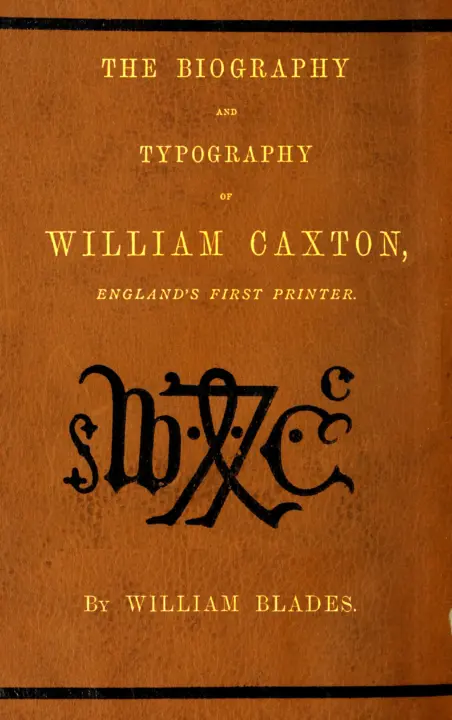
"The biography and typography of William Caxton, England's first printer" by Blades is a historical and bibliographical study written in the late 19th century. It charts Caxton’s life and career alongside a meticulous analysis of his printed output, types, devices, and working methods, situating him within the rise of printing in England and the Low Countries. Drawing on company records, embassies, and court circles, it follows Caxton from Kentish origins through mercantile Bruges to Westminster, while also cataloguing his editions and discussing their rarity and features.
The opening of the volume sets the scope: a revised reprint that condenses earlier scholarship and adds notes on Caxton’s printer’s device and punctuation, while underscoring printing’s civilizational impact. It then outlines the plan—first a documentary life of Caxton, then detailed descriptions of his books by type, with appendices from Mercers’ and Bruges records. The narrative begins with Caxton’s birth in the Weald of Kent amid strong Flemish influence, a dialect anecdote about “eyren/eggs,” and a sober weighing of name variants to suggest a likely Causton connection. It proceeds to his 1438 apprenticeship to the wealthy mercer Robert Large, depicting London apprentice life, Large’s household and will, and vivid city scenes—dearth, pageantry, religious persecution, and civic unrest—culminating in Caxton’s departure abroad. In Bruges he emerges as a prosperous merchant, then Governor of the English Nation (Merchant Adventurers), mediating trade disputes, enforcing measures, and corresponding with London while treaties lapsed and were renewed; he begins translating the Recuyell under Duchess Margaret’s patronage and likely moves toward printing with Colard Mansion. A broad survey follows of 15th‑century bibliophilia—royal and ducal libraries in France and Burgundy, Louis de Bruges’s collection, English patrons—and of the book trades’ guild structure at Bruges and Antwerp. Finally, an initial technical chapter contrasts manuscripts and early print, explaining materials, binding habits, blank leaves, one‑page printing, signatures, hand‑painted initials, undated colophons, and typeforms that closely imitated contemporary handwriting.
Introduction adapted from the source catalogue; source summaries may be automatically generated.
Free to read · English · 119,581 words · No account needed
MAKE TIME FOR A GOOD BOOK
On by default. Untick to stop anonymous reading totals. Each page counts after 10 seconds in view. How this works.
Anonymous counting is on unless you have switched it off.
As an English merchant residing in Bruges, Caxton would necessarily be subject to the laws and regulations of the Chartered Company called the MERCHANT ADVENTURERS, whose Governor had control over all English and Scotch traders in those parts. All foreign trade was then carried on by means of Trading Guilds. These associations, which occupy a prominent position in the early history of European commerce, had in most cities a common place of residence, and were governed by laws and charters granted on one side by the government of their own country, and on the other side by the government of the country in which they had settled. They appear to have originated in a common necessity. The trader in a foreign country was always an object of suspicion to the inhabitants, and often found himself restricted by its laws as to the articles he should buy or sell, and to the prices he should give or receive. These laws being frequently unjust and subversive of all legitimate trade, besides being often strained to the great injury of individuals, it was found expedient for all traders in foreign lands to unite, and by combined action to secure that recognition of their rights which the individual could not obtain. Hence arose the Association of Merchant Adventurers, which consisted of English merchants, who ventured their goods in foreign markets. The Mercers, whose foreign trade far exceeded that of all other Companies, appear to have originated this Association in the thirteenth century, under the name of the Guild or Fraternity of St. Thomas-à-Becket, and to have retained the principal management of its affairs until their disconnection in the sixteenth century. Although Grocers, Drapers, Fishmongers, and several other trade guilds yielded their quota of members, and added their influence when support was needed, yet there were more Mercers among the Merchant Adventurers than liverymen of any other company; the meetings of the Association at their headquarters in London were held in Mercers’ Hall, and their transactions entered in the same minute-book with those of the Mercers’ Company itself until 1526, when they became entirely independent, although the last link was not severed until the Great Fire of London in 1666 destroyed the office which the Merchant Adventurers held of the Mercers under their Hall. It appears, however, from the records of the Founders’ Company, that the Merchant Adventurers became their tenants in 1565; that the Founders borrowed a large sum of money from them, for which, in 1647, £200 was paid for interest; and that in 1683 the Founders leased the Sising Room and the Gown Room of their new Hall in Lothbury to the Merchant Adventurers for £16 per annum. Several charters were granted by English kings to the “Adventurers” in various parts of Europe for their internal government. In 1407, Henry IV granted authority to the English merchants in Holland, Flanders, Prussia, and other States, to assemble and elect governors, with power to rule all English merchants repairing thither, and to make reasonable ordinances. Henry VI renewed these powers in 1444. On the accession of the House of York, the Mercers consulted the City Recorder and “Rigby” respecting their Corporation, and by the statute 1 Ed. IV, c. i., passed for confirming the titles of those who held under grants of any of the three preceding kings, therein described as “in fact and not in right” kings of England, all grants to the wardens of the Mercers were specially confirmed. The Merchant Adventurers now obtained a larger charter, dated April 16th, 1462, which Hakluyt calls “The Merchant Adventurers’ Patent,” for the better government of the English merchants residing in Brabant, Flanders, &c., and under its provisions William Obray was appointed “Governor of the English Merchants” at Bruges.
Your reading position is saved on this browser. Take it to another device with a library code. Reading pages adapt to text, rather than matching a printed edition.
William Blades
William Blades

William Blades
BEHIND THE BOOK
This eBook is for the use of anyone anywhere in the United States and most other parts of the world at no cost and with almost no restrictions whatsoever. You may copy it, give it away or re-use it under the terms of the Project Gutenberg License included with this eBook or online at www.gutenberg.org. If you are not located in the United States, you will have to check the laws of the country where you are located before using this eBook. Read the source licence.
The original source file, including credits and licence, is retained by this library. Request an original-format copy at no charge. Please include the book title and Project Gutenberg identifier #78654.
KEEP YOUR CURIOSITY GOING
Cécile Tormay

Moritz Busch
John L. Ransom
Frances Wright
Cécile Tormay

Mabel Potter Daggett