THE CLASSIC COLLECTION✦The Pentateuch of printingCLASSIC FREE BOOKS
The Pentateuch of printing
William Blades
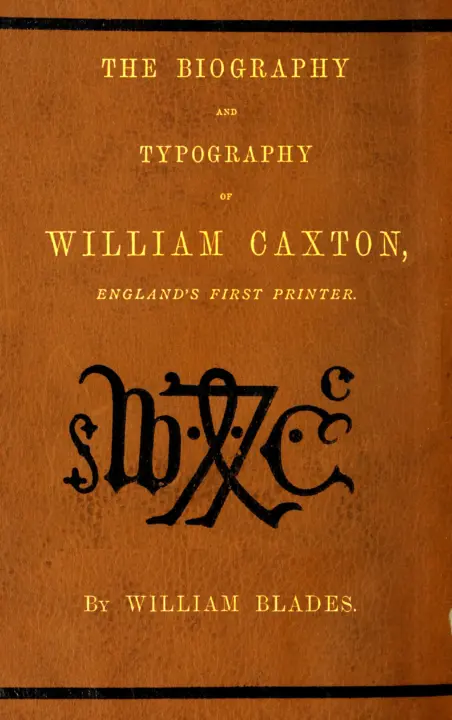
THE CLASSIC COLLECTION · 1861
"The biography and typography of William Caxton, England's first printer" by Blades is a historical and bibliographical study written in the late 19th century. It charts Caxton’s life and career alongside a meticulous analysis of his printed output, types, devices, and working methods, situating him within the rise of printing in England and the Low Countries. Drawing on company records, embassies, and court circles, it follows Caxton from Kentish origins through mercantile Bruges to Westminster, while also cataloguing his editions and discussing their rarity and features.
The opening of the volume sets the scope: a revised reprint that condenses earlier scholarship and adds notes on Caxton’s printer’s device and punctuation, while underscoring printing’s civilizational impact. It then outlines the plan—first a documentary life of Caxton, then detailed descriptions of his books by type, with appendices from Mercers’ and Bruges records. The narrative begins with Caxton’s birth in the Weald of Kent amid strong Flemish influence, a dialect anecdote about “eyren/eggs,” and a sober weighing of name variants to suggest a likely Causton connection. It proceeds to his 1438 apprenticeship to the wealthy mercer Robert Large, depicting London apprentice life, Large’s household and will, and vivid city scenes—dearth, pageantry, religious persecution, and civic unrest—culminating in Caxton’s departure abroad. In Bruges he emerges as a prosperous merchant, then Governor of the English Nation (Merchant Adventurers), mediating trade disputes, enforcing measures, and corresponding with London while treaties lapsed and were renewed; he begins translating the Recuyell under Duchess Margaret’s patronage and likely moves toward printing with Colard Mansion. A broad survey follows of 15th‑century bibliophilia—royal and ducal libraries in France and Burgundy, Louis de Bruges’s collection, English patrons—and of the book trades’ guild structure at Bruges and Antwerp. Finally, an initial technical chapter contrasts manuscripts and early print, explaining materials, binding habits, blank leaves, one‑page printing, signatures, hand‑painted initials, undated colophons, and typeforms that closely imitated contemporary handwriting.
Introduction adapted from the source catalogue; source summaries may be automatically generated.
Free to read · English · 119,581 words · No account needed
MAKE TIME FOR A GOOD BOOK
On by default. Untick to stop anonymous reading totals. Each page counts after 10 seconds in view. How this works.
Anonymous counting is on unless you have switched it off.
~exultacion de leesse espirituelle / Puis encores sil te plaist me donne que par ce septenuaire des pseaulmes de peniten- ce lesquelz correspondent aux sept affectz de lomme prins pour les sept degrez de leschielle de penitence Je puisse mō- ter et paruenir atoy en cette tant glorieuse cite de Jherusa- lem en laquelle tu habites et te offrir auec les sains et be- neurez le sacrifice de loenge sans fin /: AMEN~
REMARKS.--This work is a translation from the original Latin of Cardinal Pierre d’Ailly, entitled “Meditaciones Circa Septem Psalmos Penitentiales.” It was composed about the end of the fourteenth century, and translated shortly after into French, but by whom is uncertain, although from the style it is supposed by several of his biographers to have been from the pen of the Cardinal himself. It has been attributed to Antoine Belard, but on insufficient grounds, as his version, printed at Lyons in 1542, was a much later production. The Cardinal was the author of at least 42 works, many of which are preserved in Harl. MS., No. 637; but neither in the British Museum nor in the National Library, Paris, does there appear to be a MS. copy of this commentary on the Penitential Psalms. About 1483 the original Latin was printed at Paris by Ant. Caylaut, and another edition of German, 15th cent. workmanship, but without Name, Place, or Date, is in the British Museum. It was also reprinted at Strasbourg in 1490, and in the “Orthodoxographa,” Basle, 1555. The Commentary on the Penitential Psalms printed by Wynken de Worde was composed by Bishop Alcock, and has nothing in common with this.
Pierre d’Ailly was born of poor parents at Compiègne in 1350. His father, at the cost of many personal privations, procured for him a sound elementary education, and at an early age he obtained the appointment of Bursar in the celebrated College of Navarre. He made himself master of the philosophy and science of his age, studying especially metaphysics and astronomy. When only twenty-five he was accounted the greatest scholar and most skilful debater of the time. In 1380 the University of Paris conferred upon him the degree of Doctor, and in the following year he delivered his famous oration upon the healing of the Papal schism which at that time was disturbing all Christendom. This procured for him the benefice of Noyon, which he held till 1384. He was then recalled to Paris to be Grand Master of the College of Navarre, where only twelve years before he had studied as a pupil. At this period his fame was greatly increased by his successful pleadings before Pope Clement VII. against the new-fangled doctrine of the Immaculate Conception of the Virgin Mary. In 1389 he became Chancellor of the University of Paris, as well as Confessor and Almoner to the young king Charles VI. Already well versed in Church politics, he now became initiated in Court mysteries, and by a happy mixture of wisdom, wit, and polished manners, greatly increased his fame and power. In 1394 the Canons of La Sainte Chapelle having become very neglectful of their duties, he was appointed Treasurer, and soon initiated some sweeping reforms. Two years later he was consecrated Bishop of Cambray, where his firmness and prudence in the most trying circumstances exercised the most happy influence on his Diocese. His favours and patronage were conferred on those most worthy by their piety, zeal, and abilities to receive them, and especially was he anxious to avoid even the appearance of simony. In 1411 he was chosen Cardinal, and it was about this time that he published the “Meditationes” upon which this article is founded. He distinguished himself at the Councils of Pisa and Constance, and was President of the Session at which John Huss was condemned to be burnt. He died in 1420 at the height of his fame.
Your reading position is saved on this browser. Take it to another device with a library code. Reading pages adapt to text, rather than matching a printed edition.
William Blades
William Blades
William Blades
BEHIND THE BOOK
This eBook is for the use of anyone anywhere in the United States and most other parts of the world at no cost and with almost no restrictions whatsoever. You may copy it, give it away or re-use it under the terms of the Project Gutenberg License included with this eBook or online at www.gutenberg.org. If you are not located in the United States, you will have to check the laws of the country where you are located before using this eBook. Read the source licence.
The original source file, including credits and licence, is retained by this library. Request an original-format copy at no charge. Please include the book title and Project Gutenberg identifier #78654.
KEEP YOUR CURIOSITY GOING
Cécile Tormay

Moritz Busch
John L. Ransom
Frances Wright
Cécile Tormay

Mabel Potter Daggett