THE CLASSIC COLLECTION✦In quest of the perfect bookCLASSIC FREE BOOKS
In quest of the perfect book
William Dana Orcutt
THE CLASSIC COLLECTION · 1914
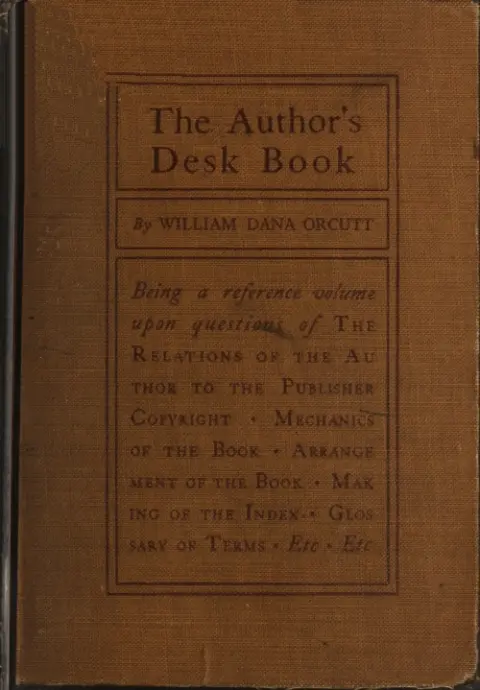
"The Author's Desk Book" by William Dana Orcutt is a reference manual that serves as a comprehensive guide on the relationship between authors and publishers, including aspects of copyright law, manuscript submission, and the mechanics of book production, written in the early 20th century. The book discusses the intricacies involved in publishing, focusing on mutual responsibilities and the importance of cooperation between authors and publishers for successful literary ventures. The opening of this volume introduces the fundamental aspects of the relationships between authors and publishers, highlighting the essential nature of mutual trust and understanding in this often complex interaction. Orcutt emphasizes that while both parties aim for success, misunderstandings can arise due to differences in business acumen, especially since many authors are not well-versed in the intricacies of the publishing industry. He also touches on the role of literary agents and the significance of contracts, underscoring the evolving nature of publishing rights, particularly in light of new media such as film adaptations. Throughout this portion, Orcutt lays the groundwork for a deeper exploration of the practicalities and legalities that govern literary creation and distribution.
Introduction adapted from the source catalogue; source summaries may be automatically generated.
Free to read · English · 39,202 words · No account needed
MAKE TIME FOR A GOOD BOOK
On by default. Untick to stop anonymous reading totals. Each page counts after 10 seconds in view. How this works.
Anonymous counting is on unless you have switched it off.
When a corporation is much less known by the first words of its name than by a later part, enter under the later part: e.g., Christian Endeavor, Young People's Society of.
Enter guilds under the name of the trade: e.g., Stationers Company, not Master and Keepers or Wardens and Commonality of the Mystery and Art of Stationers of the City of London, which is the corporate title.
Enter bodies whose legal name begins with such words as Board, Corporation, Trustees under that part of the name by which they are usually known: e.g., Trustees of the Eastern Dispensary; President and Fellows of Harvard College; Proprietors of the Boston Athenæum; Contributors to the Asylum for the Relief of Persons Deprived of their Reason. Cross-reference from the first word of the legal name.
Enter the name of a firm under the family name rather than the forename, and do not fill out the forenames: e.g., Friedlander und Sohn, Raphael, not under Raphael; Stokes, F. A. Co., not Stokes, Frederick A. Co.
The consulter is much more likely to remember the family than the Christian name. Whether the Christian name is written at the end or thus, Town (John) and Bowers (Henry), all firms should be arranged after all the other entries of the first family name, i.e., Friedlander und Sohn after all the Friedlanders.
This rule might be extended to include corporations, colleges, libraries, etc., whose legal names include forenames. Entry under a forename, as Silas Bronson Library, and especially under initials, as T. B. Scott Public Library, is awkward. But the public habit is not yet sufficiently settled to justify an exception.
Enter the universities of the European continent and of Central and South America under the name of the place; all other societies under Königliche, Herzogliche, etc.
Cross-reference from the first word in the university names and from
the place of societies.
A few learned academies, commonly called by the names of the cities where they are established, may be entered under the place with a cross-reference from the name. These are Berlin, Göttingen, Leipzig, Lisbon, Madrid, Munich, St. Petersburg, Vienna.
Enter national libraries, museums, and galleries, as well as libraries, museums, and galleries instituted or supported by a city, under the place, provided they have not a distinctive name.
Example of place: Paris Bibliothèque Nationale. Boston Public
Library.
Example of name: Berkshire Athenæum; Boston Athenæum; British Museum; Forbes Library; Marucceliana, Biblioteca; Reuben Hoar Public Library.
Enter observatories under the name of the place: e.g., Greenwich, Observatory. Pulkowa, Sternwarte; except that:
Your reading position is saved on this browser. Take it to another device with a library code. Reading pages adapt to text, rather than matching a printed edition.
William Dana Orcutt
William Dana Orcutt
William Dana Orcutt
William Dana Orcutt
BEHIND THE BOOK
This eBook is for the use of anyone anywhere in the United States and most other parts of the world at no cost and with almost no restrictions whatsoever. You may copy it, give it away or re-use it under the terms of the Project Gutenberg License included with this eBook or online at www.gutenberg.org. If you are not located in the United States, you will have to check the laws of the country where you are located before using this eBook. Read the source licence.
The original source file, including credits and licence, is retained by this library. Request an original-format copy at no charge. Please include the book title and Project Gutenberg identifier #53520.
KEEP YOUR CURIOSITY GOING

Charles G. (Charles Griffith) Ross
Hannah Webster Foster

Emily Lawless
Edwin Hamlin Carr

Charles De Lano Hine
Andrew Ure