THE CLASSIC COLLECTION✦In quest of the perfect bookCLASSIC FREE BOOKS
In quest of the perfect book
William Dana Orcutt
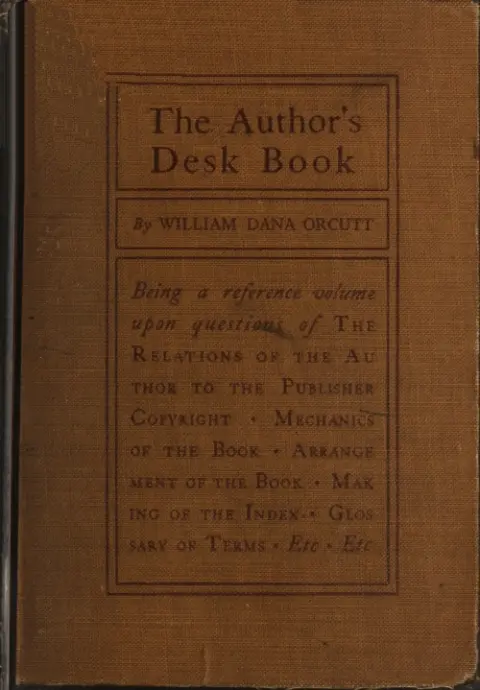
THE CLASSIC COLLECTION · 1914
"The Author's Desk Book" by William Dana Orcutt is a reference manual that serves as a comprehensive guide on the relationship between authors and publishers, including aspects of copyright law, manuscript submission, and the mechanics of book production, written in the early 20th century. The book discusses the intricacies involved in publishing, focusing on mutual responsibilities and the importance of cooperation between authors and publishers for successful literary ventures. The opening of this volume introduces the fundamental aspects of the relationships between authors and publishers, highlighting the essential nature of mutual trust and understanding in this often complex interaction. Orcutt emphasizes that while both parties aim for success, misunderstandings can arise due to differences in business acumen, especially since many authors are not well-versed in the intricacies of the publishing industry. He also touches on the role of literary agents and the significance of contracts, underscoring the evolving nature of publishing rights, particularly in light of new media such as film adaptations. Throughout this portion, Orcutt lays the groundwork for a deeper exploration of the practicalities and legalities that govern literary creation and distribution.
Introduction adapted from the source catalogue; source summaries may be automatically generated.
Free to read · English · 39,202 words · No account needed
MAKE TIME FOR A GOOD BOOK
On by default. Untick to stop anonymous reading totals. Each page counts after 10 seconds in view. How this works.
Anonymous counting is on unless you have switched it off.
Enter treaties under the name of each of the contracting parties, with a cross-reference from the name of the place of negotiation, when the treaty is commonly called by that name, and from any other usual appellation: e.g., treaty of Versailles, Barrier treaty, Jay's treaty.
=Parties and sects:=
Enter the official publications of any political party or religious denomination or order, under the name of the party, or denomination, or order: e.g.,
Platforms, manifestoes, addresses, etc., go under Democratic Party,
Republican Party, etc.
Confessions of faith, creeds, catechisms, liturgies, breviaries, missals, hours, offices, prayer books, etc., go under Baptists, Benedictines, Catholic Church, Church of England, Friends, etc.
That part of a body which belongs to any place should be entered under the name of the body, not the place: e.g., Congregationalists in New England, Congregationalists in Massachusetts, not New England Congregationalists, Massachusetts Congregationalists. But cross-references must be made from the place (indeed in cases like Massachusetts Convention, Essex Conference, it may be doubted whether those well-known names should not be the headings).
Enter corporations and quasi corporations, both English and foreign, under their names as they read, neglecting an initial article or serial number when there is one.
Enter orders of knighthood, both those of medieval times and their honorary modern equivalents, under the significant word of the English title: e.g., Garter, Order of the; Malta, Knights of; Templars, Knights; Teutonic Order; Freemasons. But the American Knights Templars, being merely a division of the Freemasons, belong under Freemasons; so of other regular masonic bodies.
The colleges of an English university and the unnamed professional schools of an American university go under the university's name. Such professional schools, if they have a distinctive name, particularly if at a distance from the university, or for any other reason less closely connected with it, go under their own name: e.g., Oxford University, Magdalen College; Harvard University, Veterinary School; but Barnard College, Columbia University; Radcliffe College, Harvard University; Sheffield Scientific School of Yale University.
College libraries go under the name of the college: e.g., Harvard College, University Library. But the Bodleian Library may be put under Bodleian.
Local college societies go under the name of the college; intercollegiate societies and Greek letter fraternities under their own names: e.g., Φ B K A, of Harvard.
Alumni and Alumnæ associations go under the name of the school or college: e.g., Harvard Alumni Association of New York.
Schools supported by public taxation go under the name of the city or town maintaining them, whether they have an individual name or not.
Your reading position is saved on this browser. Take it to another device with a library code. Reading pages adapt to text, rather than matching a printed edition.
William Dana Orcutt
William Dana Orcutt
William Dana Orcutt
William Dana Orcutt
BEHIND THE BOOK
This eBook is for the use of anyone anywhere in the United States and most other parts of the world at no cost and with almost no restrictions whatsoever. You may copy it, give it away or re-use it under the terms of the Project Gutenberg License included with this eBook or online at www.gutenberg.org. If you are not located in the United States, you will have to check the laws of the country where you are located before using this eBook. Read the source licence.
The original source file, including credits and licence, is retained by this library. Request an original-format copy at no charge. Please include the book title and Project Gutenberg identifier #53520.
KEEP YOUR CURIOSITY GOING

Charles G. (Charles Griffith) Ross
Hannah Webster Foster

Emily Lawless
Edwin Hamlin Carr

Charles De Lano Hine
Andrew Ure