THE CLASSIC COLLECTION✦In quest of the perfect bookCLASSIC FREE BOOKS
In quest of the perfect book
William Dana Orcutt
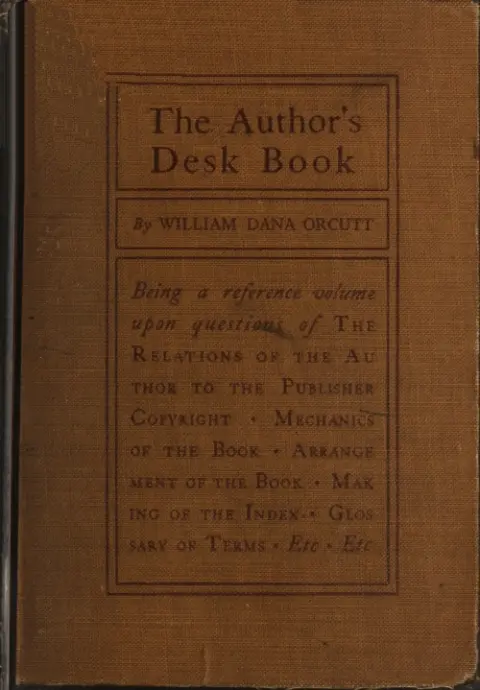
THE CLASSIC COLLECTION · 1914
"The Author's Desk Book" by William Dana Orcutt is a reference manual that serves as a comprehensive guide on the relationship between authors and publishers, including aspects of copyright law, manuscript submission, and the mechanics of book production, written in the early 20th century. The book discusses the intricacies involved in publishing, focusing on mutual responsibilities and the importance of cooperation between authors and publishers for successful literary ventures. The opening of this volume introduces the fundamental aspects of the relationships between authors and publishers, highlighting the essential nature of mutual trust and understanding in this often complex interaction. Orcutt emphasizes that while both parties aim for success, misunderstandings can arise due to differences in business acumen, especially since many authors are not well-versed in the intricacies of the publishing industry. He also touches on the role of literary agents and the significance of contracts, underscoring the evolving nature of publishing rights, particularly in light of new media such as film adaptations. Throughout this portion, Orcutt lays the groundwork for a deeper exploration of the practicalities and legalities that govern literary creation and distribution.
Introduction adapted from the source catalogue; source summaries may be automatically generated.
Free to read · English · 39,202 words · No account needed
MAKE TIME FOR A GOOD BOOK
On by default. Untick to stop anonymous reading totals. Each page counts after 10 seconds in view. How this works.
Anonymous counting is on unless you have switched it off.
(a) University observatories go under the university: e.g., Harvard College. Astronomical Observatory, at Cambridge. (Cross-reference from Cambridge.)
(b) Any observatory having an individual name may go under that: e.g., Lick Observatory, Yerkes Observatory.
Enter expositions under the place where they were held: e.g.,
Buffalo, Pan-American Exposition, 1901; Chicago, World's Columbian Exposition, 1893; New Orleans, World's Industrial and Cotton Centennial Exhibition, 1884-85; Philadelphia, Centennial Exhibition, 1876.
Cross-reference from an individual name.
Enter American State universities and State historical, agricultural and medical societies, whether supported by the State or not, under the name of the State, unless they are better known by a distinctive name. The State's name usually enters into the name of these societies and they are known outside of the State by its name. Cross-reference when necessary.
Enter churches under the name of the place.
Single churches have usually been entered under the place, a practice which arose in American indexes from our way of naming churches "The First Church in----," "The Second Church of----," etc., and applies very well to a majority of English churches, whose name generally includes the name of the parish. It is more in accordance with indexing principles to limit the local entry of churches to First Church, etc., and those which have only the name of the town or parish, and to put all others (as St. Sepulchre's, St. Mary Aldermansbury) under their names, as they read, and to treat convents and monasteries in the same way; but the convenience of having a single definite rule has been held to outweigh in this case the claims of consistency.
The parishes of London (as Kensington, Marylebone, Southwark), like the parts of Boston (Dorchester, Roxbury, etc.), or of any other composite city, would be put under their own names, not under the name of the city.
A few cathedrals generally known by some other name may be entered under it: e.g., St. Paul's, London; Notre Dame, Paris; St. Peter's, Rome; St. Sophia, Constantinople.
Put monasteries and convents, like churches, under the place, unless better known by the name.
National banks designated merely by number (as First National Bank of Boston) go under the name of the place.
Young men's Christian associations, mercantile library associations, and the like, should have local entry.
Private schools having no distinctive name go under the name of the
proprietor.
Private libraries, galleries and museums go under the name of the
proprietor.
Buildings are for the most part provided for in the above rules, as museums, galleries, libraries, churches, etc. Any others should be entered under their names, with a cross-reference from the city.
Your reading position is saved on this browser. Take it to another device with a library code. Reading pages adapt to text, rather than matching a printed edition.
William Dana Orcutt
William Dana Orcutt
William Dana Orcutt
William Dana Orcutt
BEHIND THE BOOK
This eBook is for the use of anyone anywhere in the United States and most other parts of the world at no cost and with almost no restrictions whatsoever. You may copy it, give it away or re-use it under the terms of the Project Gutenberg License included with this eBook or online at www.gutenberg.org. If you are not located in the United States, you will have to check the laws of the country where you are located before using this eBook. Read the source licence.
The original source file, including credits and licence, is retained by this library. Request an original-format copy at no charge. Please include the book title and Project Gutenberg identifier #53520.
KEEP YOUR CURIOSITY GOING

Charles G. (Charles Griffith) Ross
Hannah Webster Foster

Emily Lawless
Edwin Hamlin Carr

Charles De Lano Hine
Andrew Ure