THE CLASSIC COLLECTION✦In quest of the perfect bookCLASSIC FREE BOOKS
In quest of the perfect book
William Dana Orcutt
THE CLASSIC COLLECTION · 1914
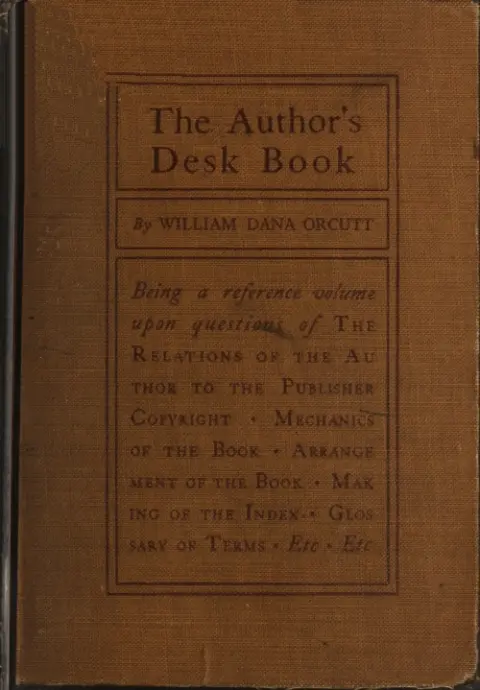
"The Author's Desk Book" by William Dana Orcutt is a reference manual that serves as a comprehensive guide on the relationship between authors and publishers, including aspects of copyright law, manuscript submission, and the mechanics of book production, written in the early 20th century. The book discusses the intricacies involved in publishing, focusing on mutual responsibilities and the importance of cooperation between authors and publishers for successful literary ventures. The opening of this volume introduces the fundamental aspects of the relationships between authors and publishers, highlighting the essential nature of mutual trust and understanding in this often complex interaction. Orcutt emphasizes that while both parties aim for success, misunderstandings can arise due to differences in business acumen, especially since many authors are not well-versed in the intricacies of the publishing industry. He also touches on the role of literary agents and the significance of contracts, underscoring the evolving nature of publishing rights, particularly in light of new media such as film adaptations. Throughout this portion, Orcutt lays the groundwork for a deeper exploration of the practicalities and legalities that govern literary creation and distribution.
Introduction adapted from the source catalogue; source summaries may be automatically generated.
Free to read · English · 39,202 words · No account needed
MAKE TIME FOR A GOOD BOOK
On by default. Untick to stop anonymous reading totals. Each page counts after 10 seconds in view. How this works.
Anonymous counting is on unless you have switched it off.
Distinctive epithets are to be in the same language as the name:
e.g.,
Kniaz, fürst von, Freiherr zu, duc de Magenta, Bishop of Lincoln, évêque de Meaux; but Emperor of Germany, King of France, not kaiser and roi, when names of sovereign princes are given in English. Treat in the same way patronymics habitually joined with a person's name; as, Clemens Alexandrinus.
Prefixes (i.e., titles which in speaking come before the name), as Hon., Mrs., Rev., etc., should in the heading be placed before the Christian name (as Smith, Capt. John), and suffixes as Jr., D.D., LL.D., after it (as Channing, James Ellery, D.D.).
Hereditary titles generally follow the Christian name, as Derby, Thomas Stanley, 1st earl of; but British courtesy titles (i.e., those given to the younger sons of dukes and marquesses) precede, as Wellesley, Lord Charles (2d son of the Duke of Wellington). In other languages than English, French, and German the title usually precedes the forename; as, Alfieri, Conte Vittorio. Occasionally a French nobleman uniformly places his title before his forenames; as, Gasparin, Comte Agénor de.
Lord should be replaced by the exact title in the names of English noblemen: e.g., Lord Macaulay should be entered as Macaulay, 1st baron. Lord in the title of Scotch judges follows the family name; as, Kames, H. Home, afterwards Lord.
The title Baronet is given in the form Scott, Sir Walter, bart.
Patronymic phrases, as of Dedham, follow all the names; but they must immediately follow the family name when they are always used in close connection with it, as Girault de St. Farjeau, Eusèbe; similarly aîné, fils, jeune, as Dumas fils, Alexandre; Didot fils, Ambroise. Latin appellatives should not in general be separated from their nouns by a comma; as, Caesar Heisterbacensis.
The name of a king's wife should be written thus: Charlotte, Queen, consort of George III of England. Anne Boleyn Queen, 2d consort of Henry VIII of England.
=Countries and places:=
Index under countries or places important events relating to them: e.g., Montreal, Cartier's description of houses at. Also make reference under name: e.g., Cartier, description of houses at Montreal.
Enter congresses of several nations under the name of the place of meeting (as that usually gives them their name), with cross-references from the nations taking part in them, and from any name by which they are popularly known: e.g., the Congress of London, of Paris, of Verona, International Peace Congress at the Hague.
Your reading position is saved on this browser. Take it to another device with a library code. Reading pages adapt to text, rather than matching a printed edition.
William Dana Orcutt
William Dana Orcutt
William Dana Orcutt
William Dana Orcutt
BEHIND THE BOOK
This eBook is for the use of anyone anywhere in the United States and most other parts of the world at no cost and with almost no restrictions whatsoever. You may copy it, give it away or re-use it under the terms of the Project Gutenberg License included with this eBook or online at www.gutenberg.org. If you are not located in the United States, you will have to check the laws of the country where you are located before using this eBook. Read the source licence.
The original source file, including credits and licence, is retained by this library. Request an original-format copy at no charge. Please include the book title and Project Gutenberg identifier #53520.
KEEP YOUR CURIOSITY GOING

Charles G. (Charles Griffith) Ross
Hannah Webster Foster

Emily Lawless
Edwin Hamlin Carr

Charles De Lano Hine
Andrew Ure