An Ambitious Woman: A Novel
Edgar Fawcett
THE CLASSIC COLLECTION · 1883
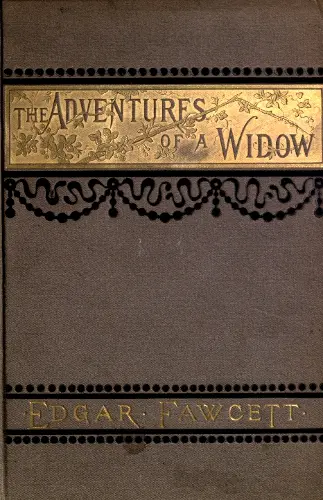
"The Adventures of a Widow: A Novel" by Edgar Fawcett is a fiction narrative likely written in the late 19th century. The story's central focus revolves around Pauline Van Corlear, a young woman navigating the complexities of society after marrying a significantly older gentleman, Mr. Hamilton Varick. As she transitions from girlhood to widowhood, the narrative seemingly explores themes of independence, societal expectations, and personal transformation. The opening of the novel sets the stage in New York, describing the shifting character of Bond Street, once a bastion of old-world gentility now beset by commercialism. Mr. Varick, a wealthy man returned from Paris, marries eighteen-year-old Pauline, who feels the weight of societal pressure to secure her future through marriage. In the initial chapters, we see Pauline’s internal conflict as she reconciles her ambitions with the constraints imposed by her social world, setting up a storyline rich in both character development and commentary on the era's societal norms. Her early interactions, especially with her cousin Courtlandt and her husband Varick, hint at her struggles with personal desires versus societal expectations.
Introduction adapted from the source catalogue; source summaries may be automatically generated.
Free to read · English · 67,822 words · No account needed
MAKE TIME FOR A GOOD BOOK
On by default. Untick to stop anonymous reading totals. Each page counts after 10 seconds in view. How this works.
Anonymous counting is on unless you have switched it off.
"I was in my own house, though," said Pauline, with an intonation that betokened the dawn of repentance. "He was very exasperating, truly, but--I was in my own house, you know."
"Of course you were," exclaimed Kindelon, "and he treated you as if it belonged to somebody else. We are all apt to assert a proprietary right when a fellow-citizen ventures to relieve us of our purse, and I think a similar claim holds good with regard to our self-respect."
Pauline presently came to a standstill. She looked troubled, and her gaze remained downcast for a little while. But soon she lifted it and met Kindelon's eyes steadily watching her.
"You don't think I was unjustifiably rude?" she asked.
"No; indeed I do not. I don't think you were rude at all."
She was silent for a brief interval. Then she said, without taking her eyes in the least from her companion's face,--
"Do you believe that most women would have acted the same?"
"No," he said, with a quick, slight laugh, "because most women have neither your brains nor your independence."
"And you like both in a woman?"
"I like both in you," he said, lowering his handsome head a little as he
uttered the words.
"Do you think Cora Dares would have acted as I have done?" Pauline
asked.
He made an impatient gesture; he appeared for a moment distressed and
embarrassed.
"You and Cora Dares are--are not the same," he said, almost
stammeringly.
"Oh, I know that very well," answered Pauline. "I have had very good reason to know that we are not the same. We are extremely different. By the way, she is not here to-night."
"Not here?" he repeated interrogatively, but with a suggestion of drolly
helpless duplicity.
Pauline raised one finger, shaking it at him for an instant and no more. The gesture, transient as it was, seemed to convey a world of significance. No doubt Kindelon tacitly admitted this, though his face preserved both its ordinary color and composure.
"You are well aware that she is not here," Pauline said.
"Why do you say that?" he asked.
"I think so."
"But perhaps you may be mistaken. Perhaps you have merely fancied that I have noticed Miss Cora's non-appearance."
"Perhaps," Pauline repeated. She seemed to be saying the word to her own thoughts. But suddenly her manner became far less absent. "Mrs. Dares told me that Miss Cora had a headache to-night," she said, with brisk activity. "We can all have headaches, you know," she went on, "when we choose."
Kindelon nodded slowly. "I have heard that it is an accommodating malady," he said, in tones that were singularly lifeless and neutral.
Your reading position is saved on this browser. Take it to another device with a library code. Reading pages adapt to text, rather than matching a printed edition.
Edgar Fawcett
Frank R. Stockton & Edgar Fawcett & Franklin Fyles & Anna Katharine Green & Henry Harland & Ingersoll Lockwood & Joaquin Miller & Kirk Munroe & Brainard Gardner Smith & Maurice Thompson & A. C. (Andrew Carpenter) Wheeler
Edgar Fawcett
BEHIND THE BOOK
This eBook is for the use of anyone anywhere in the United States and most other parts of the world at no cost and with almost no restrictions whatsoever. You may copy it, give it away or re-use it under the terms of the Project Gutenberg License included with this eBook or online at www.gutenberg.org. If you are not located in the United States, you will have to check the laws of the country where you are located before using this eBook. Read the source licence.
The original source file, including credits and licence, is retained by this library. Request an original-format copy at no charge. Please include the book title and Project Gutenberg identifier #37185.
KEEP YOUR CURIOSITY GOING
Coulson Kernahan

Maurice Baring
Frances Wright
Cécile Tormay

Frederic Jesup Stimson

W. H. P. (William Henry Pope) Jarvis