An Ambitious Woman: A Novel
Edgar Fawcett
THE CLASSIC COLLECTION · 1883
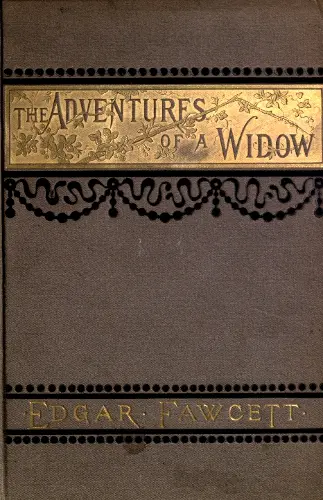
"The Adventures of a Widow: A Novel" by Edgar Fawcett is a fiction narrative likely written in the late 19th century. The story's central focus revolves around Pauline Van Corlear, a young woman navigating the complexities of society after marrying a significantly older gentleman, Mr. Hamilton Varick. As she transitions from girlhood to widowhood, the narrative seemingly explores themes of independence, societal expectations, and personal transformation. The opening of the novel sets the stage in New York, describing the shifting character of Bond Street, once a bastion of old-world gentility now beset by commercialism. Mr. Varick, a wealthy man returned from Paris, marries eighteen-year-old Pauline, who feels the weight of societal pressure to secure her future through marriage. In the initial chapters, we see Pauline’s internal conflict as she reconciles her ambitions with the constraints imposed by her social world, setting up a storyline rich in both character development and commentary on the era's societal norms. Her early interactions, especially with her cousin Courtlandt and her husband Varick, hint at her struggles with personal desires versus societal expectations.
Introduction adapted from the source catalogue; source summaries may be automatically generated.
Free to read · English · 67,822 words · No account needed
MAKE TIME FOR A GOOD BOOK
On by default. Untick to stop anonymous reading totals. Each page counts after 10 seconds in view. How this works.
Anonymous counting is on unless you have switched it off.
Pauline put forth her hand, and let it rest on his broad, strong arm for
a second or two.
"Did Miss Cora have a headache?" she asked.
He threw back his head, and shook it with a sudden sound of his breath which resembled a sigh of irritation, and yet was not quite that.
"Upon my word, I don't know!" he cried softly.
Just then Pauline found herself confronted by Mr. Howe, the novelist. His stoop was very apparent; it seemed even more consumptive than usual; his slim hand was incessantly touching and retouching his blue spectacles, which gleamed opaque and with a goblin suggestion from the smooth-shaven, scholarly pallor of his visage.
"Excuse me, Mrs. Varick," he began, "but I--I wish to speak a word with
you."
Pauline smiled and assumed an affable demeanor. It cost her an effort to do so, for certain acute reasons; but she nevertheless achieved good results.
"A great many words, Mr. Howe," she answered, "if you wish."
Mr. Howe gave a sickly smile. "Oh, I don't ask a great many," he faltered; and it at once became evident that he was for some reason ill at ease, disconsolate, abysmally depressed.
"You are annoyed," said Pauline, chiefly because she found nothing else, as a would-be courteous hostess, to say.
"Annoyed?" came the hesitant reply, while Mr. Howe rearranged his blue spectacles with a hand that seemed to assume a new momentary decisiveness. "I am grieved, Mrs. Varick. I am grieved because a friend of mine has received a slight from you, and I hope that it is an unintentional slight. I--I want to ask you whether it cannot be corrected. I allude to Mr. Bedlowe."
"Mr. Bedlowe!" repeated Pauline amazedly. She turned to Kindelon as she
spoke.
"Oh, yes," came Kindelon's ready answer; "you remember Bedlowe, of
course."
"I remember Mr. Bedlowe," said Pauline, sedately.
"Ah! you seem to have forgotten him!" exclaimed Mr. Howe, with a great deal of gentlemanly distress. He had discontinued all manual connection with his blue glasses; he had even pressed both hands together, in a rotatory, nervous way, while he went on speaking. "I hope you did not mean to leave poor Bedlowe out," he proceeded, with quite a funereal pathos. "The poor fellow feels it dreadfully. I promised him I would say nothing about the matter, and yet (as you see) I have broken my promise."
"I think Mrs. Varick is sorry to see that you have broken your promise," said Kindelon, shortly and tepidly.
Mr. Howe glanced at Kindelon through his glasses. He was obliged to raise his head as he did so, on account of their differing statures.
Your reading position is saved on this browser. Take it to another device with a library code. Reading pages adapt to text, rather than matching a printed edition.
Edgar Fawcett
Frank R. Stockton & Edgar Fawcett & Franklin Fyles & Anna Katharine Green & Henry Harland & Ingersoll Lockwood & Joaquin Miller & Kirk Munroe & Brainard Gardner Smith & Maurice Thompson & A. C. (Andrew Carpenter) Wheeler
Edgar Fawcett
BEHIND THE BOOK
This eBook is for the use of anyone anywhere in the United States and most other parts of the world at no cost and with almost no restrictions whatsoever. You may copy it, give it away or re-use it under the terms of the Project Gutenberg License included with this eBook or online at www.gutenberg.org. If you are not located in the United States, you will have to check the laws of the country where you are located before using this eBook. Read the source licence.
The original source file, including credits and licence, is retained by this library. Request an original-format copy at no charge. Please include the book title and Project Gutenberg identifier #37185.
KEEP YOUR CURIOSITY GOING
Coulson Kernahan

Maurice Baring
Frances Wright
Cécile Tormay

Frederic Jesup Stimson

W. H. P. (William Henry Pope) Jarvis