An Ambitious Woman: A Novel
Edgar Fawcett
THE CLASSIC COLLECTION · 1883
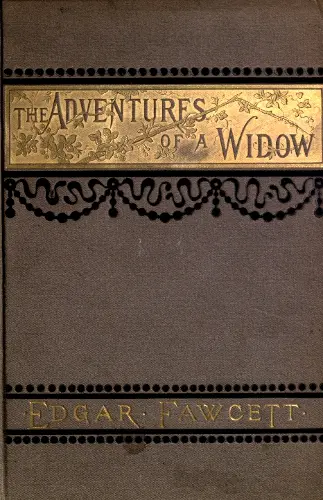
"The Adventures of a Widow: A Novel" by Edgar Fawcett is a fiction narrative likely written in the late 19th century. The story's central focus revolves around Pauline Van Corlear, a young woman navigating the complexities of society after marrying a significantly older gentleman, Mr. Hamilton Varick. As she transitions from girlhood to widowhood, the narrative seemingly explores themes of independence, societal expectations, and personal transformation. The opening of the novel sets the stage in New York, describing the shifting character of Bond Street, once a bastion of old-world gentility now beset by commercialism. Mr. Varick, a wealthy man returned from Paris, marries eighteen-year-old Pauline, who feels the weight of societal pressure to secure her future through marriage. In the initial chapters, we see Pauline’s internal conflict as she reconciles her ambitions with the constraints imposed by her social world, setting up a storyline rich in both character development and commentary on the era's societal norms. Her early interactions, especially with her cousin Courtlandt and her husband Varick, hint at her struggles with personal desires versus societal expectations.
Introduction adapted from the source catalogue; source summaries may be automatically generated.
Free to read · English · 67,822 words · No account needed
MAKE TIME FOR A GOOD BOOK
On by default. Untick to stop anonymous reading totals. Each page counts after 10 seconds in view. How this works.
Anonymous counting is on unless you have switched it off.
"Interference!" echoed Mr. Barrowe, with querulous asperity. "Ah, madam, I think I recognize just who has been advising you, now; you make my suspicion a certainty." He glanced irately enough toward Kindelon as he spoke the last words.
Kindelon took a step or two forward, reaching Pauline's side and pausing there. His manner, as he began to speak, showed no anger, but rather that blending of decision and carelessness roused by an adversary from whom we have slight fear of defeat.
"Come, Barrowe," he said, "if you mean me you had better state so plainly. As it happens, Mrs. Varick was advised, in the matter of not sending Miss Cragge an invitation, solely by herself. But if she had asked my counsel it would entirely have agreed with her present course."
"No doubt," almost snarled Mr. Barrowe. "The ill turn comes to the same thing. We need not split hairs. I made no personal reference to you, Kindelon; but if the cap fits you can wear it."
"I should like to hand it back to you with a bunch of bells on it," said
Kindelon.
"Is that what you call Irish wit?" replied Mr. Barrowe, while his lips grew pale. "If so, you should save it for the columns of the 'Asteroid,' which sadly needs a little."
"The 'Asteroid' never prints personalities," returned Kindelon, with nonchalant mockery. "It leaves that kind of journalism to your friend Miss Cragge."
"Miss Cragge, sir," muttered Barrowe, "is a lady."
"I did not say she was a gentleman," retorted Kindelon, "though her general deportment has more than once cast a doubt upon her sex."
Mr. Barrowe gave a faint shiver. "I'm glad I haven't it on my conscience," he declared, "that I injured an honest girl to gratify a mere spite." He at once turned to Pauline, now. "Madam," he pursued, "I must warn you that your project will prove a dire failure if you attempt to develop it on a system of despotic preferences. We were all glad to come to you, in a liberal, democratic, intellectual spirit. But the very moment you undertake the establishment of a society formed on a basis of capricious likes and dislikes, I assure you that you are building on sand and that your structure will fall."
"In that case, Mr. Barrowe," said Pauline, stung by his unwarranted officiousness into the employment of biting irony, "you can have no excuse if you allow yourself to be buried in my ruins."
She passed rapidly away, while Kindelon accompanied her. "You were quite right," came his speedy encouragement, as they moved onward together. "You showed that insufferable egotist the door in the politest and firmest manner possible."
Your reading position is saved on this browser. Take it to another device with a library code. Reading pages adapt to text, rather than matching a printed edition.
Edgar Fawcett
Frank R. Stockton & Edgar Fawcett & Franklin Fyles & Anna Katharine Green & Henry Harland & Ingersoll Lockwood & Joaquin Miller & Kirk Munroe & Brainard Gardner Smith & Maurice Thompson & A. C. (Andrew Carpenter) Wheeler
Edgar Fawcett
BEHIND THE BOOK
This eBook is for the use of anyone anywhere in the United States and most other parts of the world at no cost and with almost no restrictions whatsoever. You may copy it, give it away or re-use it under the terms of the Project Gutenberg License included with this eBook or online at www.gutenberg.org. If you are not located in the United States, you will have to check the laws of the country where you are located before using this eBook. Read the source licence.
The original source file, including credits and licence, is retained by this library. Request an original-format copy at no charge. Please include the book title and Project Gutenberg identifier #37185.
KEEP YOUR CURIOSITY GOING
Coulson Kernahan

Maurice Baring
Frances Wright
Cécile Tormay

Frederic Jesup Stimson

W. H. P. (William Henry Pope) Jarvis