
Love Letters of a Violinist, and Other Poems
Eric Mackay
THE CLASSIC COLLECTION · 1836
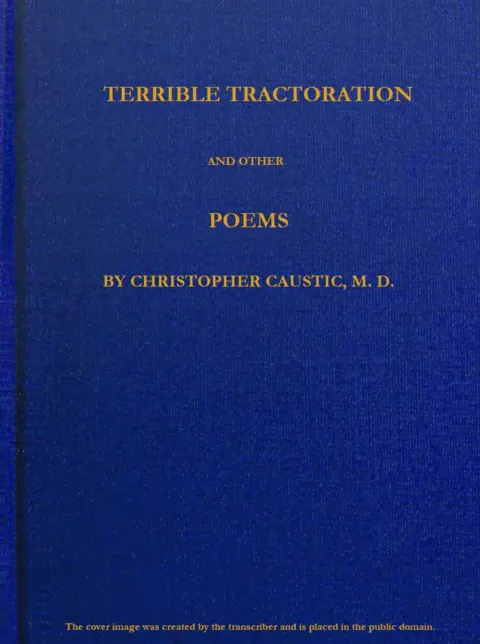
"Terrible Tractoration, and Other Poems" by Thomas Green Fessenden is a satirical collection of poetry that was likely written in the early 19th century. The book centers around a character named Dr. Christopher Caustic, an eccentric and ambitious physician who seeks recognition for his grand scientific inventions and theories. Through humorous and ironic verse, the poetry critiques various contemporary medical practices, particularly the controversial use of metallic tractors, which were promoted as a cure for diseases but were viewed with skepticism by many. The beginning of the work introduces us to Dr. Caustic, who laments his fallen fortunes as he navigates the trials of being a poet and a scientist in a world that seems to value superficial cures over genuine medical knowledge. He reflects on his past successes and the financial struggles that have led him to turn to poetry to make a living. This opening sets the stage for Caustic's various rants and proclamations regarding the absurdities of contemporary medicine and society, while simultaneously establishing his character as both a visionary and a figure of mockery within the realm of medical science. The tone is playful yet critical, inviting readers to explore a world of folly and irony through humorous verse.
Introduction adapted from the source catalogue; source summaries may be automatically generated.
Free to read · English · 51,557 words · No account needed
MAKE TIME FOR A GOOD BOOK
On by default. Untick to stop anonymous reading totals. Each page counts after 10 seconds in view. How this works.
Anonymous counting is on unless you have switched it off.
The fever, meeting such a mound,
Will turn about and quit the ground,
And leave the fortunate dirt-protected
Inhabitants, quite uninfected.
Filth, on earth’s surface, it is clear,
Its like attracts from th’ atmosphere,
And always leaves a pure vicinity,
By laws of chemical affinity.[37]
Our citizens, their next resource
Should cause a “social intercourse,”
By perforating banks and bounds
’Twixt vaults and wells and burying-grounds.
For such good management ensures
Against expense in digging sewers;
Because a well, ’tis very plain,
Serve all its neighborhood for a drain.
These things accomplish’d ’twill be very
Correct their relatives to bury
Scarce under ground, in the most populous
And busy part of the metropolis.
For ’twould be decorous, at least.
In memory of the dear deceased,
At once to answer two good ends,
To drink to and to drink our friends.
Thus Artemisia, ’twas I think,
Made her dead husband diet drink,
And thereby, probably enough,
Saved gallipots of doctor’s stuff.
Proceed to scoop each populous place in
To something very like a basin,
And let the centre of your mart
Be on or near the lowest part.
Well, after all these things are finish’d,
Let no man’s efforts be diminish’d,
But this good maxim keep in view,
That nought is done if aught’s to do.
Then fall too, gentlemen, and grub
Up every root and tree and shrub,
Each trace of vegetation found
In town and out, for ten miles round.
Your “useful labors” to complete
In every square, side-walk and street,
By way of ornament then please
To set out Bohun Upas trees.
If after all the fiend we find
Is not to emigrate inclined,
But like too many a foreign caitiff
Declares on oath he is a native,
To counteract him, my advice is
To tow us down the polar ices,
And when a field or two is brought us,
’Twill drive him into winter quarters.
This thing your worships well know can
Be done on Doctor Darwin’s plan,
And ’tis the best work, past a doubt,
Our gun boats can be set about.
Paulo majora nunc canamus,[38]
And hope the public will not blame us
If we should soar, (’tis our intention,)
Above your worship’s comprehension.
We’ve form’d the most tremendous plan,
Which ever stretch’d the mind of man,
And which to nothing less aspires
Than making moons from central fires.
If theories of Doctor Hutton
Be worth the shadow of a button,
And Doctor Darwin has not blunder’d,
We’ll turn out full moons by the hundred.[39]
Your reading position is saved on this browser. Take it to another device with a library code. Reading pages adapt to text, rather than matching a printed edition.
BEHIND THE BOOK
This eBook is for the use of anyone anywhere in the United States and most other parts of the world at no cost and with almost no restrictions whatsoever. You may copy it, give it away or re-use it under the terms of the Project Gutenberg License included with this eBook or online at www.gutenberg.org. If you are not located in the United States, you will have to check the laws of the country where you are located before using this eBook. Read the source licence.
The original source file, including credits and licence, is retained by this library. Request an original-format copy at no charge. Please include the book title and Project Gutenberg identifier #65068.
KEEP YOUR CURIOSITY GOING
Eric Mackay
Edmund Gosse
Sophia Margaretta Hensley
Gilbert Parker
George MacDonald

Elizabeth Bibesco