
Love Letters of a Violinist, and Other Poems
Eric Mackay
THE CLASSIC COLLECTION · 1836
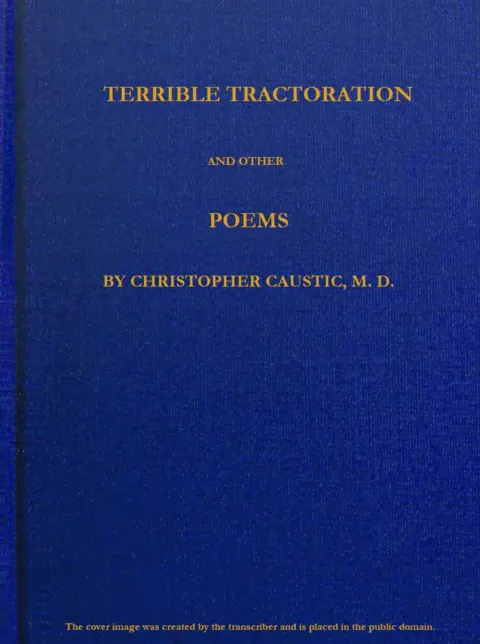
"Terrible Tractoration, and Other Poems" by Thomas Green Fessenden is a satirical collection of poetry that was likely written in the early 19th century. The book centers around a character named Dr. Christopher Caustic, an eccentric and ambitious physician who seeks recognition for his grand scientific inventions and theories. Through humorous and ironic verse, the poetry critiques various contemporary medical practices, particularly the controversial use of metallic tractors, which were promoted as a cure for diseases but were viewed with skepticism by many. The beginning of the work introduces us to Dr. Caustic, who laments his fallen fortunes as he navigates the trials of being a poet and a scientist in a world that seems to value superficial cures over genuine medical knowledge. He reflects on his past successes and the financial struggles that have led him to turn to poetry to make a living. This opening sets the stage for Caustic's various rants and proclamations regarding the absurdities of contemporary medicine and society, while simultaneously establishing his character as both a visionary and a figure of mockery within the realm of medical science. The tone is playful yet critical, inviting readers to explore a world of folly and irony through humorous verse.
Introduction adapted from the source catalogue; source summaries may be automatically generated.
Free to read · English · 51,557 words · No account needed
MAKE TIME FOR A GOOD BOOK
On by default. Untick to stop anonymous reading totals. Each page counts after 10 seconds in view. How this works.
Anonymous counting is on unless you have switched it off.
We mean to bore us, at a venture,
Some auger-holes through Hutton’s centre,
Thus give an unexpected vent
To Hutton’s fires in prison pent.
We’ll fan his furnace by a pair
Of bellows made of Franklin’s air,[40]
For air, (a truth Count Rumford knew well,)
Contains the very soul of fuel.
Then pour in suddenly the ocean
To add eclat to our explosion;--
Water, your worships know, or may know,
Adds terribly to a volcano.
Each orifice will then give birth
To grand satellites of earth,
Disploded dreadfully, dear me!
Like Darwin’s moon from southern sea.
How will the universe admire,
When my vast bickering globes of fire,
In grand Darwinian style shall rise,
Like flying mountains through the skies.
Though said sublime explosions must
Destroy good Doctor Burnet’s crust,[41]
By Parker’s cement we’ll endeavor[42]
To make his shell as good as ever.
Now when we’ve made our batch of moons,
Philosophers, unless they’re loons,
Will, though we’re such a surly gnostic,
Name one of them “GREAT DOCTOR CAUSTIC!”
These, among many, are but few
Of mighty things that I could do;
All which I’ll state, if ’tis your pleasure,
Much more at large when more at leisure.
Now, it appears, from what I state here,
My plans for mending human nature
Entitle me to take the chair
From Rousseau, Godwin, or Voltaire.
They are of most immense utility;
All tend to man’s perfectibility;
And if pursued, I dare to venture ye,
He’ll be an angel in a century.
Although St Pierre, a knowing chap,
Deserves a feather in his cap
For having boldly set his foot on
The foolish trash of Isaac Newton;[43]
Contrived a scheme, which very nice is,
For making tides of polar ices;
And fed old Ocean’s tub with fountains,
From arctic and antarctic mountains.
Though Mister Godwin told us how
To make a clever sort of plough,[44]
Which would e’en set itself to work,
And plough an acre in a jerk.
Though Price’s projects are so clever,
They show us how to live for ever[45]
Unless we blunder, to our cost,
And break our heads against a post!
Though Darwin, thinking to dismay us,
Made dreadful clattering in chaos,
And form’d, with horrid quakes t’ assist him,
His new exploded solar system.[46]
Though Volney, having in his view,
First peer’d our continent through and through,[47]
Left us a specimen of the quality
Of graduated French morality.[48]
Though Priestley manufactured souls,
For which we had him o’er the coals,
A thing we had forgot to mention,
For making use of our invention.
Your reading position is saved on this browser. Take it to another device with a library code. Reading pages adapt to text, rather than matching a printed edition.
BEHIND THE BOOK
This eBook is for the use of anyone anywhere in the United States and most other parts of the world at no cost and with almost no restrictions whatsoever. You may copy it, give it away or re-use it under the terms of the Project Gutenberg License included with this eBook or online at www.gutenberg.org. If you are not located in the United States, you will have to check the laws of the country where you are located before using this eBook. Read the source licence.
The original source file, including credits and licence, is retained by this library. Request an original-format copy at no charge. Please include the book title and Project Gutenberg identifier #65068.
KEEP YOUR CURIOSITY GOING
Eric Mackay
Edmund Gosse
Sophia Margaretta Hensley
Gilbert Parker
George MacDonald

Elizabeth Bibesco