
Love Letters of a Violinist, and Other Poems
Eric Mackay
THE CLASSIC COLLECTION · 1836
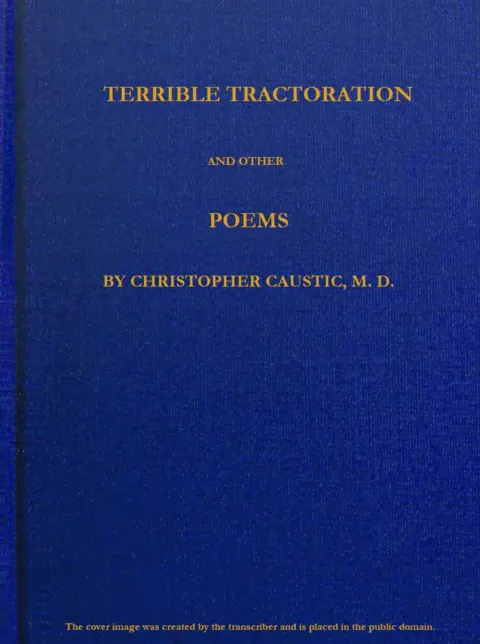
"Terrible Tractoration, and Other Poems" by Thomas Green Fessenden is a satirical collection of poetry that was likely written in the early 19th century. The book centers around a character named Dr. Christopher Caustic, an eccentric and ambitious physician who seeks recognition for his grand scientific inventions and theories. Through humorous and ironic verse, the poetry critiques various contemporary medical practices, particularly the controversial use of metallic tractors, which were promoted as a cure for diseases but were viewed with skepticism by many. The beginning of the work introduces us to Dr. Caustic, who laments his fallen fortunes as he navigates the trials of being a poet and a scientist in a world that seems to value superficial cures over genuine medical knowledge. He reflects on his past successes and the financial struggles that have led him to turn to poetry to make a living. This opening sets the stage for Caustic's various rants and proclamations regarding the absurdities of contemporary medicine and society, while simultaneously establishing his character as both a visionary and a figure of mockery within the realm of medical science. The tone is playful yet critical, inviting readers to explore a world of folly and irony through humorous verse.
Introduction adapted from the source catalogue; source summaries may be automatically generated.
Free to read · English · 51,557 words · No account needed
MAKE TIME FOR A GOOD BOOK
On by default. Untick to stop anonymous reading totals. Each page counts after 10 seconds in view. How this works.
Anonymous counting is on unless you have switched it off.
We gagg’d sage Darwin’s polar bear,
And would not let him “vomit air;”[34]
Thus spoil’d the Boreal ventilator,
And made a vacuum at the equator.
And then, by Doctor Priestley’s aid,
A vital atmosphere was made,
And stretch’d abroad, and found to answer,
From Capricorn quite on to Cancer.
We set an air balloon in motion
To float on th’ atmospheric ocean,
Annex’d a log, which never fail’d,
To give the distance which it sail’d:
And form’d a rudder, I assure it ye,
By which we steer’d with great security,
And could make good our destination
To any harbor in creation.
And we had nineteen pair of oars,
All mann’d with philosophic rowers,
Could therefore sail without a breeze,
Or stem a hurricane with ease.[35]
We now make public our intention
By aid of said superb invention,
To send a well arm’d air balloon
To take and colonize the moon.
A most inveterate believer
In foreign source of yellow fever,
We say his sconce must be fuliginous,
Who holds that plague to be indigenous.
As to th’ extent of its dominion
We’ll give our medical opinion;
When next we greet your worships, please
To give security for fees.
This dire disorder is contagious
And its contagion is outrageous,[36]
’Twill rage like wild-fire, anywhere,
On dryest soil, in purest air.
It is an animalcule, which
Is propagated like the itch,--
Communicated like small pox,
But can’t be bred in dirty docks.
From patient’s breath an emanation,
By contact or approximation
It may, as learned men have stated,
Be everywhere disseminated.
From friends infected, children, wives,
Let all men scamper then, for lives;
The wretches shun like Charon’s ferry,
And leave the dead themselves to bury.
’T is true some simpletons have said
A kind of fever may be bred
By heat conjoin’d with putrefaction,
Which suits contagionists to a fraction.
They tell you, if these causes may
Produce the plague in Africa,
It would, to common sense, appear
They might effect the fever here.
That true philosophy expects
From all like causes like effects;
For Nature never play’d a prank
To cheat us, like a mountebank.
But these dull dolts don’t understand
That in “Columbia’s happy land,”
Nature, for sake of “Freedom’s cause,”
Will set aside her general laws.
Said yellow fever can endure
Nothing offensive or impure,
Bad water or mephitic air
Or dead cats in a thoroughfare.
Therefore, good cits, in sultry weather
Collect your dirtiness together,
And then contrive to lodge it pretty
Nigh to the centre of the city.
Your reading position is saved on this browser. Take it to another device with a library code. Reading pages adapt to text, rather than matching a printed edition.
BEHIND THE BOOK
This eBook is for the use of anyone anywhere in the United States and most other parts of the world at no cost and with almost no restrictions whatsoever. You may copy it, give it away or re-use it under the terms of the Project Gutenberg License included with this eBook or online at www.gutenberg.org. If you are not located in the United States, you will have to check the laws of the country where you are located before using this eBook. Read the source licence.
The original source file, including credits and licence, is retained by this library. Request an original-format copy at no charge. Please include the book title and Project Gutenberg identifier #65068.
KEEP YOUR CURIOSITY GOING
Eric Mackay
Edmund Gosse
Sophia Margaretta Hensley
Gilbert Parker
George MacDonald

Elizabeth Bibesco