
Love Letters of a Violinist, and Other Poems
Eric Mackay
THE CLASSIC COLLECTION · 1836
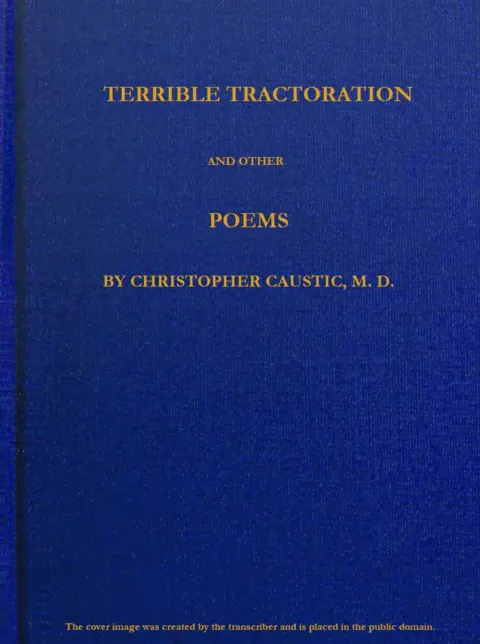
"Terrible Tractoration, and Other Poems" by Thomas Green Fessenden is a satirical collection of poetry that was likely written in the early 19th century. The book centers around a character named Dr. Christopher Caustic, an eccentric and ambitious physician who seeks recognition for his grand scientific inventions and theories. Through humorous and ironic verse, the poetry critiques various contemporary medical practices, particularly the controversial use of metallic tractors, which were promoted as a cure for diseases but were viewed with skepticism by many. The beginning of the work introduces us to Dr. Caustic, who laments his fallen fortunes as he navigates the trials of being a poet and a scientist in a world that seems to value superficial cures over genuine medical knowledge. He reflects on his past successes and the financial struggles that have led him to turn to poetry to make a living. This opening sets the stage for Caustic's various rants and proclamations regarding the absurdities of contemporary medicine and society, while simultaneously establishing his character as both a visionary and a figure of mockery within the realm of medical science. The tone is playful yet critical, inviting readers to explore a world of folly and irony through humorous verse.
Introduction adapted from the source catalogue; source summaries may be automatically generated.
Free to read · English · 51,557 words · No account needed
MAKE TIME FOR A GOOD BOOK
On by default. Untick to stop anonymous reading totals. Each page counts after 10 seconds in view. How this works.
Anonymous counting is on unless you have switched it off.
So famed Aldini, erst in France,
Led dead folks down a country-dance,
And made them rigadoon and chasse
As well as when alive, I dare say!
And I once offer’d, very prettily,
To patch up Frenchmen kill’d in Italy,
Though shot, or stabb’d, or hack’d with fell blows,
As wives patch coats when out at elbows!
Profoundly versed in chymic science,
I could bid matter’s law defiance;
Was up to nature, or beyond her,
In mimic earthquakes, rain, and thunder![28]
And by a shock of electricity,
(I tell the truth without duplicity)
I did (what won’t again be soon done)
E’en fairly knock the man in the moon down![29]
On ocean’s bottom we can travel,
Thorough mud and thorough gravel;
While over head hoarse tempests hurtle
With more adroitness than a turtle.
Priestly first caused our head to teem
With this most eligible scheme,
Supplied us vital air, which stuff
We took like macaroni snuff.[30]
Encamp’d beneath a huge ice island,
For nineteen years we didn’t come nigh land,
And could have staid, as well as not,
E’en had the sea been boiling hot.
In car triumphant, drawn by whales,
Tackled to their tremendous tails,
We rode sublime, and claim’d a right
To everything which hove in sight.
Old Neptune’s realm, ’tis our intent,
To make a Yankee-settlement,
And if Britannia interferes[31]
We’il twist her ugly lion’s ears.
An Iceland burning mountain’s gorge
We metamorphos’d to a forge,
And made therein as many as
Ten thousand tons of solid gas.
This we can let off at our leisure,
Like Shakspeare’s conjurer, wield at pleasure
The explosive elements of thunder,
With power to rive the globe asunder.
And if the theory of Babbage[32]
Is worth a single head of cabbage,
This grand plenipotent gas of ours
Will supersede all moving powers.
With this will drive aerial cars,
Send hourly coaches to the stars,
A lightning opposition line
Would be a snail compared to mine.
We seized the moon, by mickle strength,
And brought her down, within arm’s length,--
And made her, under our protection,
Submit to critical inspection.
Her Natural History and Topography,
With plates of Pendleton’s lithography,
We mean to print and publish soon,
And call it MIRROR OF THE MOON.
Like us, was never man besides
To calculate aerial tides;
Though Volney undertook to do it
He wanted science to go through it.[33]
But we can let your worships know
Which way, next year the wind will blow,
And indicate without verbosity,
The measure of its mean velocity.
Your reading position is saved on this browser. Take it to another device with a library code. Reading pages adapt to text, rather than matching a printed edition.
BEHIND THE BOOK
This eBook is for the use of anyone anywhere in the United States and most other parts of the world at no cost and with almost no restrictions whatsoever. You may copy it, give it away or re-use it under the terms of the Project Gutenberg License included with this eBook or online at www.gutenberg.org. If you are not located in the United States, you will have to check the laws of the country where you are located before using this eBook. Read the source licence.
The original source file, including credits and licence, is retained by this library. Request an original-format copy at no charge. Please include the book title and Project Gutenberg identifier #65068.
KEEP YOUR CURIOSITY GOING
Eric Mackay
Edmund Gosse
Sophia Margaretta Hensley
Gilbert Parker
George MacDonald

Elizabeth Bibesco