
Love Letters of a Violinist, and Other Poems
Eric Mackay
THE CLASSIC COLLECTION · 1836
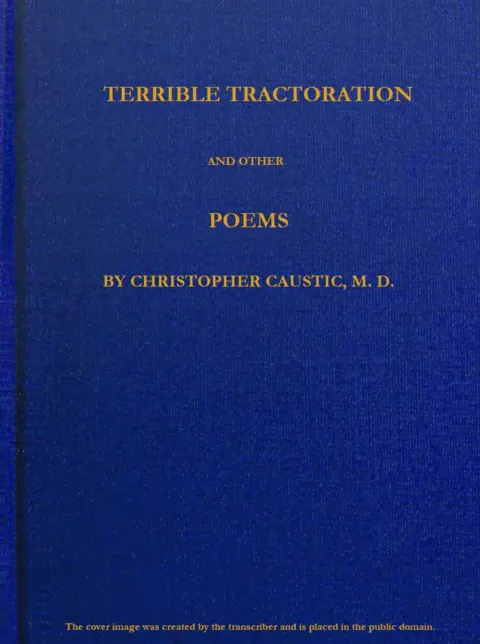
"Terrible Tractoration, and Other Poems" by Thomas Green Fessenden is a satirical collection of poetry that was likely written in the early 19th century. The book centers around a character named Dr. Christopher Caustic, an eccentric and ambitious physician who seeks recognition for his grand scientific inventions and theories. Through humorous and ironic verse, the poetry critiques various contemporary medical practices, particularly the controversial use of metallic tractors, which were promoted as a cure for diseases but were viewed with skepticism by many. The beginning of the work introduces us to Dr. Caustic, who laments his fallen fortunes as he navigates the trials of being a poet and a scientist in a world that seems to value superficial cures over genuine medical knowledge. He reflects on his past successes and the financial struggles that have led him to turn to poetry to make a living. This opening sets the stage for Caustic's various rants and proclamations regarding the absurdities of contemporary medicine and society, while simultaneously establishing his character as both a visionary and a figure of mockery within the realm of medical science. The tone is playful yet critical, inviting readers to explore a world of folly and irony through humorous verse.
Introduction adapted from the source catalogue; source summaries may be automatically generated.
Free to read · English · 51,557 words · No account needed
MAKE TIME FOR A GOOD BOOK
On by default. Untick to stop anonymous reading totals. Each page counts after 10 seconds in view. How this works.
Anonymous counting is on unless you have switched it off.
Though brother Graham, it is said,
Stuffs christians with unbolted bread,
Our belly timber, quite as good,
Is made of any kind of wood.[24]
You know the common farmer takes
His white oak wood for fencing stakes,
But Lady Caustic fits in style,
Superior white oak steaks, to broil.
She’s famous, too, for white oak cheese,
Harder than granite, ten degrees;
So hard that we’re obliged to take it
To some trip-hammer works to break it.
Good hemlock bark philosophized
In soup, by epicures is prized,
A paste of button-wood, quoth I,
Is cap-a-pie to cap a pie.
A stick of bass-wood, being bevill’d
By gastronomic art bedevill’d,
Or served as Welchmen cook their cheese,
A man of taste will always please.
From saw dust, bran and pebble stones,
And quantum suff. of pounded bones,
We form the most delicious dishes
That e’er indulged the gourmand’s wishes.
When our great plans are brought to pass,
Mankind en masse may go to grass;
And every rover, will moreover,
Enjoy his lot like pig in clover.
We next crave liberty to mention
Another wonderful invention;
A sort of stenographic still,
Alias a Patent Author’s mill.
We fill its hopper with a set
Of letters of the alphabet,
And turn out eulogies, orations,
Or themes for July celebrations,--
News, both domestic and extraneous,
Essays, and extracts miscellaneous,
We manufacture by the means
Of said superlative machines.
This last invention also reaches
To making Congress members’ speeches;
Would they adopt it, though we’ve said it,
T’would cent per cent enhance their credit.
We hammer’d out a lawyer’s jaw mill,
Which went by water like a saw-mill
With so much clamor, fire and fury,
It thunderstruck the judge and jury.
A syllogism, which embraces
All knotty, complicated cases,
We fabricated and applied
To every cause which could be tried.
Oft have I quench’d man’s vital spark:
“The soul’s old cottage,” cold and dark,
Again, in spite of death, our grand ill,
Illumed as one would light a candle.[25]
Display’d a mode in Latin thesis
To pick the human frame to pieces;
The parts deposit by themselves,
Like mineral specimens on shelves;--
And having scour’d off every particle
Which clogg’d the motions of the article,
The vital functions to restore
To healthier action than before.[26]
Thus, brother Ovid said or sung once,
The Gods of old folks could make young ones[27]
By process, not one whit acuter,
Than making new pots from old pewter.
Your reading position is saved on this browser. Take it to another device with a library code. Reading pages adapt to text, rather than matching a printed edition.
BEHIND THE BOOK
This eBook is for the use of anyone anywhere in the United States and most other parts of the world at no cost and with almost no restrictions whatsoever. You may copy it, give it away or re-use it under the terms of the Project Gutenberg License included with this eBook or online at www.gutenberg.org. If you are not located in the United States, you will have to check the laws of the country where you are located before using this eBook. Read the source licence.
The original source file, including credits and licence, is retained by this library. Request an original-format copy at no charge. Please include the book title and Project Gutenberg identifier #65068.
KEEP YOUR CURIOSITY GOING
Eric Mackay
Edmund Gosse
Sophia Margaretta Hensley
Gilbert Parker
George MacDonald

Elizabeth Bibesco