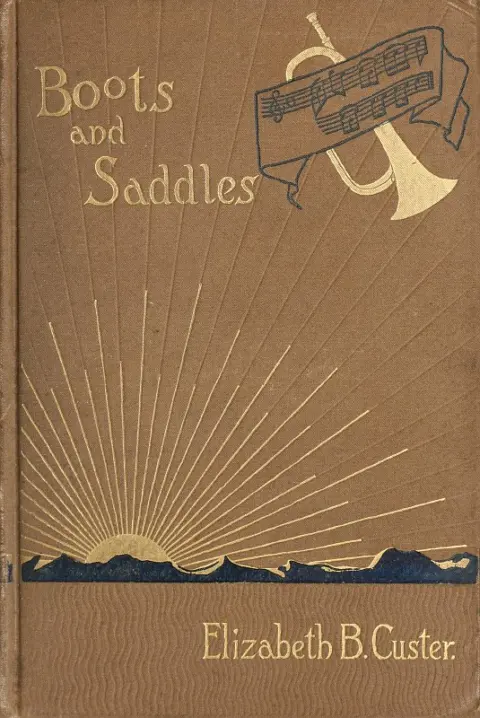
“Boots and Saddles”; Or, Life in Dakota with General Custer
Elizabeth Bacon Custer
THE CLASSIC COLLECTION · 1887
"Tenting on the Plains; or, General Custer in Kansas and Texas" by Elizabeth B. Custer is a historical account written in the late 19th century. The book recounts the experiences of General George Armstrong Custer and his wife, Libbie, as they embark on a journey to Texas after the American Civil War. Through vivid descriptions and personal reflections, it likely explores themes of military life, post-war challenges, and the camaraderie between Custer, his troops, and family. The opening of the narrative sets a poignant tone as General Custer prepares for departure from the Army of the Potomac amidst a heartfelt farewell from his soldiers. Libbie Custer reflects on the emotional weight of their parting, suggesting a deep bond with the men under her husband's command. The reader is introduced to the excitement of the journey to Texas, marked by the chaotic joy of discharged soldiers aboard the train and Libbie’s own anxieties about the challenges they would face in this lawless land. As they travel, the couple encounters moments that highlight the abrupt transition from military life to their new frontier adventures, emphasizing both the excitement and uncertainty that lay ahead.
Introduction adapted from the source catalogue; source summaries may be automatically generated.
Free to read · English · 136,932 words · No account needed
MAKE TIME FOR A GOOD BOOK
On by default. Untick to stop anonymous reading totals. Each page counts after 10 seconds in view. How this works.
Anonymous counting is on unless you have switched it off.
As we resumed our ride to the steamer, the General, who was usually an admirable pathfinder, proposed a new and shorter road; and liking variety too much to wish to travel the same country twice over, all gladly assented. Everything went very well for a time. We were absorbed in talking, noting new scenes on the route, or, as was our custom when riding off from the public highway, we sang some chorus; and thus laughing, singing, joking, we galloped over the ground thoughtlessly into the very midst of serious danger. Apparently, nothing before us impeded our way. We knew very little of the nature of the soil in that country, but had become somewhat accustomed to the bayous that either start from the river or appear suddenly inland, quite disconnected from any stream. On that day we dashed heedlessly to the bank of a wide bayou that poured its waters into the Red River. Instead of thinking twice, and taking the precaution to follow its course farther up into the country, where the mud was dryer and the space to cross much narrower, we determined not to delay, and prepared to go over. The most venturesome dashed first on to this bit of dried slough, and though the crust swayed and sunk under the horses' flying feet, it still seemed caked hard enough to bear every weight. There were seams and fissures in portions of the bayou, through which the moist mud oozed; but these were not sufficient warning to impetuous people. Another and another sprang over the undulating soil. Having reached the other side, they rode up and down the opposite bank shouting to us where they thought it the safest to cross, and of course interlarded their directions with good-natured scoffing about hesitation, timidity, and so on. The General, never second in anything when he could help it, remained behind to fortify my sinking heart and urge me to undertake the crossing with him. He reminded me how carefully Custis Lee had learned to follow and to trust to him, and he would doubtless plant his hoofs in the very tracks of his own horse. Another of our party tried to bolster up my courage, assuring me that if the heavy one among us was safely on the other bank, my light weight might be trusted. I dreaded making the party wait until we had gone further up the bayou, and might have mustered up the required pluck had I not met with trepidation on the part of my horse. His fine, delicate ears told me, as plainly as if he could speak, that I was asking a great deal of him. We had encountered quicksands together in the bed of a Virginia stream, and both horse and rider were recalling the fearful sensation when the animal's hindlegs sank, leaving his body engulfed in the soil. With powerful struggles with his forefeet and muscular shoulders, we plunged to the right and left, and found at last firm soil on which to escape. With such a recollection still fresh, as memory is sure to retain terrors like that, it was hardly a wonder that we shrank from the next step. His trembling flanks shook as much as the unsteady hand that held his bridle. He quivered from head to foot, and held back. I urged, and patted his neck, while we both continued to shiver on the brink. The General laughed at the two cowards we really were, but still gave us time to get our courage up to the mark. The officer remaining with us continued to encourage me with assurances that there was "not an atom of danger," and finally, with a bound, shouting out, "Look how well I shall go over!" sprang upon the vibrating crust. In an instant, with a crack like a pistol, the thin layer of solid mud broke, and down went the gay, handsomely caparisoned fellow, engulfed to his waist in the foul black crust. There was at once a commotion. With no ropes, it was hard to effect his release. His horse helped him most, struggling frantically for the bank, while the officers, having flung themselves off from their animals to rush to his rescue, brought poles and tree branches, which the imbedded man was not slow to grasp and drag himself from the perilous spot when only superhuman strength could deliver him, as the mud of a bayou sucks under its surface with great rapidity anything with which it comes in contact. As soon as the officer was dragged safely on to firm earth, a shout went up that rent the air with its merriment. Scarcely any one spoke while they labored to save the man's life, but once he was out of peril, the rescuers felt their hour had come. They called out to him, in tones of derision, the vaunting air with which he said just before his engulfment, "Look at me; see how I go over!" He was indeed a sorry sight, plastered from head to foot with black mud. Frightened as I was--for the trembling had advanced to shivering, and my chattering teeth and breathless voice were past my control--I still felt that little internal tremor of laughter that somehow pervades one who has a sense of the ludicrous in very dangerous surroundings.
Your reading position is saved on this browser. Take it to another device with a library code. Reading pages adapt to text, rather than matching a printed edition.
Elizabeth Bacon Custer
BEHIND THE BOOK
This eBook is for the use of anyone anywhere in the United States and most other parts of the world at no cost and with almost no restrictions whatsoever. You may copy it, give it away or re-use it under the terms of the Project Gutenberg License included with this eBook or online at www.gutenberg.org. If you are not located in the United States, you will have to check the laws of the country where you are located before using this eBook. Read the source licence.
The original source file, including credits and licence, is retained by this library. Request an original-format copy at no charge. Please include the book title and Project Gutenberg identifier #40731.
KEEP YOUR CURIOSITY GOING
Cécile Tormay

Moritz Busch
John L. Ransom
Frances Wright
Cécile Tormay

Mabel Potter Daggett