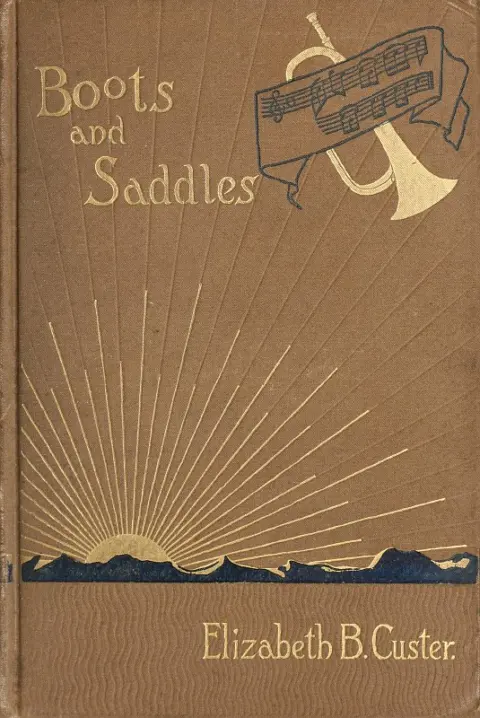
“Boots and Saddles”; Or, Life in Dakota with General Custer
Elizabeth Bacon Custer
THE CLASSIC COLLECTION · 1887
"Tenting on the Plains; or, General Custer in Kansas and Texas" by Elizabeth B. Custer is a historical account written in the late 19th century. The book recounts the experiences of General George Armstrong Custer and his wife, Libbie, as they embark on a journey to Texas after the American Civil War. Through vivid descriptions and personal reflections, it likely explores themes of military life, post-war challenges, and the camaraderie between Custer, his troops, and family. The opening of the narrative sets a poignant tone as General Custer prepares for departure from the Army of the Potomac amidst a heartfelt farewell from his soldiers. Libbie Custer reflects on the emotional weight of their parting, suggesting a deep bond with the men under her husband's command. The reader is introduced to the excitement of the journey to Texas, marked by the chaotic joy of discharged soldiers aboard the train and Libbie’s own anxieties about the challenges they would face in this lawless land. As they travel, the couple encounters moments that highlight the abrupt transition from military life to their new frontier adventures, emphasizing both the excitement and uncertainty that lay ahead.
Introduction adapted from the source catalogue; source summaries may be automatically generated.
Free to read · English · 136,932 words · No account needed
MAKE TIME FOR A GOOD BOOK
On by default. Untick to stop anonymous reading totals. Each page counts after 10 seconds in view. How this works.
Anonymous counting is on unless you have switched it off.
IT was well we had our horses at Fort Riley for recreation, as walking was almost out of the question in autumn. The wind blew unceasingly all the five years we were in Kansas, but it seemed to do its wildest work in autumn. No one had told us of its incessant activity, and I watched for it to quiet down for days after our arrival, and grew restless and dull for want of exercise, but dared not go out. As the post was on a plateau, the wind from the two river valleys swept over it constantly. The flag was torn into ribbons in no time, and the storm-flag, made smaller, and used in rainy weather, had to be raised a good deal, while the larger and handsomer one was being mended. We found that the other women of the garrison, who were there when we arrived, ventured out to see one another, and even crossed the parade-ground, when it was almost impossible to keep on one's feet. It seems to date very far back, when I recall that our dresses then measured five yards around, and were gathered as full as could be pressed into the waistband. These seven breadths of skirt flew out in advance of us, if they did not lift themselves over our heads. My skirts wrapped themselves around my husband's ankles, and rendered locomotion very difficult for us both, if we tried to take our evening stroll. He thought out a plan, which he helped me to carry into effect, by cutting bits of lead in small strips, and these I sewed into the hem. Thus loaded down, we took our constitutional about the post, and outwitted the elements, which at first bade fair to keep us perpetually housed.
There was very little social life in garrison that winter. The officers were busy studying tactics, and accustoming themselves to the new order of affairs, so very different from their volunteer experience. Had not everything been so novel, I should have felt disappointed in my first association with the regular army in garrison. I did not then consider that the few old officers and their families were really the regular army, and so was somewhat disheartened regarding our future associates. As fast as our own officers arrived, a part of the regiment that had garrisoned Fort Riley before we came went away; but it soon became too late in the season to send the remainder. The post was therefore crowded. The best manners with which all had made their début wore off, and some jangling began. Some drank too freely, and were placed under arrest, or released if they went on pledge. Nothing was said, of course, if they were sober enough for duty; but there were some hopeless cases from the first. For instance, a new appointee made his entrance into our parlor, when paying the visit that military etiquette requires, by falling in at the door, and after recovering an upright position, proceeded to entangle himself in his sword again, and tumble into a chair. I happened to be alone, and was, of course, very much frightened. In the afternoon the officers met in one of their quarters, and drew up resolutions that gave the new arrival the choice of a court-martial or his resignation before night; and by evening he had written out the papers resigning his commission. Another fine-looking man, whom the General worked long and faithfully to make a sober officer, had really some good instincts. He was so glad to get into our home circle, and was so social, telling the drollest stories of far Western life, where he had lived formerly, that I became greatly interested in his efforts at reformation. He was almost the first to be court-martialed for drunkenness on duty, and that was always a grief to us; but in those early days of our regiment's history, arrest, imprisonment and trial had to go on much of the time. The officer to whom I refer was getting into and out of difficulty incessantly. He repented in such a frank, regretful sort of way that my husband kept faith in his final reformation long after it seemed hopeless. One day I asked him to dinner. It was Thanksgiving, and on those days we tried to select the officers that talked most to us of their homes and parents. To my dismay, our reprobate came into the room with very uncertain gait. The other men looked anxiously at him. My husband was not in the parlor. I thought of other instances where these signs of intoxication had passed away in a little while, and tried to ignore his condition. He was sober enough to see the concerned look in his comrades' faces, and brought the tears to my eyes by walking up to me and saying, "Mrs. Custer, I'm sorry, but I think it would be best for me to go home." Who could help being grieved for a man so frank and humble over his failings? There were six years of such vicissitudes in this unfortunate man's life, varied by brave conduct in the Indian campaigns, before the General gave him up. He violated, at last, some social law that was considered an outrage beyond pardon, which compelled his departure from the Seventh. That first winter, while the General was trying to enforce one fact upon the new-comers, that the Seventh must be a sober regiment, it was a difficult and anything but pleasant experience.
Your reading position is saved on this browser. Take it to another device with a library code. Reading pages adapt to text, rather than matching a printed edition.
Elizabeth Bacon Custer
BEHIND THE BOOK
This eBook is for the use of anyone anywhere in the United States and most other parts of the world at no cost and with almost no restrictions whatsoever. You may copy it, give it away or re-use it under the terms of the Project Gutenberg License included with this eBook or online at www.gutenberg.org. If you are not located in the United States, you will have to check the laws of the country where you are located before using this eBook. Read the source licence.
The original source file, including credits and licence, is retained by this library. Request an original-format copy at no charge. Please include the book title and Project Gutenberg identifier #40731.
KEEP YOUR CURIOSITY GOING
Cécile Tormay

Moritz Busch
John L. Ransom
Frances Wright
Cécile Tormay

Mabel Potter Daggett