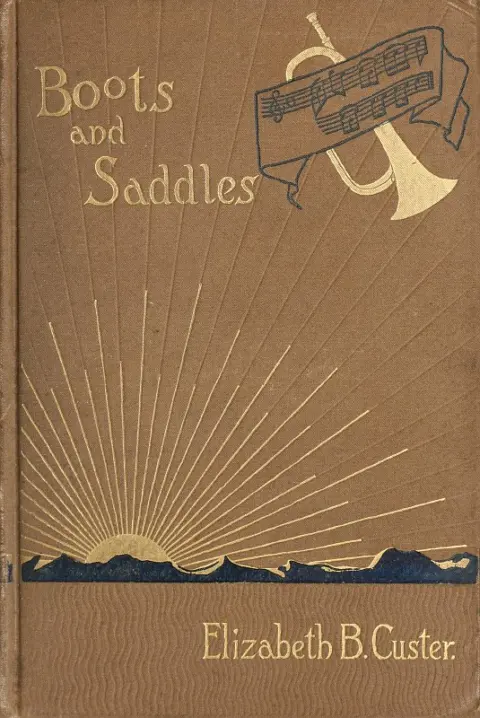
“Boots and Saddles”; Or, Life in Dakota with General Custer
Elizabeth Bacon Custer
THE CLASSIC COLLECTION · 1887
"Tenting on the Plains; or, General Custer in Kansas and Texas" by Elizabeth B. Custer is a historical account written in the late 19th century. The book recounts the experiences of General George Armstrong Custer and his wife, Libbie, as they embark on a journey to Texas after the American Civil War. Through vivid descriptions and personal reflections, it likely explores themes of military life, post-war challenges, and the camaraderie between Custer, his troops, and family. The opening of the narrative sets a poignant tone as General Custer prepares for departure from the Army of the Potomac amidst a heartfelt farewell from his soldiers. Libbie Custer reflects on the emotional weight of their parting, suggesting a deep bond with the men under her husband's command. The reader is introduced to the excitement of the journey to Texas, marked by the chaotic joy of discharged soldiers aboard the train and Libbie’s own anxieties about the challenges they would face in this lawless land. As they travel, the couple encounters moments that highlight the abrupt transition from military life to their new frontier adventures, emphasizing both the excitement and uncertainty that lay ahead.
Introduction adapted from the source catalogue; source summaries may be automatically generated.
Free to read · English · 136,932 words · No account needed
MAKE TIME FOR A GOOD BOOK
On by default. Untick to stop anonymous reading totals. Each page counts after 10 seconds in view. How this works.
Anonymous counting is on unless you have switched it off.
ALL the smaller schemes to tease our father Custer gave way to a grand one, concocted in the busy brains of his boys, to rob their parent. While the patriarch sat in the cabin, reading aloud to himself--as is still his custom--what he considered the soul-convincing editorial columns of a favorite paper, his progeny were in some sheltered corner of the guards, plotting the discomfiture of their father. The plans were well laid; but the General was obliged to give as much time to it, in a way, as when projecting a raid, for he knew he had to encounter a wily foe who was always on guard. The father, early in their childhood, playing all sorts of tricks on his boys, was on the alert whenever he was with them, to parry a return thrust. I believe several attempts had been made to take the old gentleman's money, but he was too wary. They knew that he had sewed some bills in his waistcoat, and that his steamer ticket and other money were in his purse. These he carefully placed under his pillow at night. He continues in his letter: "Tommy and I had a stateroom together, and on one night in particular, all the folks had gone to bed in the cabin, and Tom was hurrying me to go to bed. I was not sleepy, and did not want to turn in, but he hung round so, that at last I did go to our stateroom. He took the upper berth. I put my vest under the pillow, and was pulling off my boots, when I felt sure I saw something going out over the transom. I looked under the pillow, and my vest was gone. Then I waked Tommy, who was snoring already. I told him both my purse and vest were gone, and, as the saying is, I 'smelt the rat.' I opened the door, and felt sure that Autie had arranged to snatch the vest and purse when it was thrown out. I ran out in the cabin to his stateroom, but he had the start of me, and was locked in. I did not know for sure which was his room, so I hit and I thundered at his door. The people stuck their heads out of their staterooms, and over the transom came a glass of water. So I, being rather wet, concluded I would give it up till the next morning. And what do you think those scamps did? Tom, though I gave it to him well, wouldn't own up to a thing, and just said 'it was too bad such robberies went on in a ship like that;' he was very sorry for me, and alluded to the fact that the door being unlocked was proof that the thief had a skeleton key, and all that nonsense. Next morning Autie met me, and asked what on earth I had been about the night before. Such a fracas! all the people had come out to look up the matter, and there I was pounding at a young lady's door, a friend of Libbie's, and a girl I liked (indeed, I had taken quite a shine to her). They made out--those shameless rogues, and very solemn Autie was about it, too--that it was not a very fine thing for my reputation to be pounding on a young lady's door late at night, frightening her half to death, and obliging her to defend herself with a pitcher of water. She thought I had been trying to break in her door, and I had better go to her at once and apologize, as the whole party were being compromised by such scandal. They failed there; for I knew I was not at her door, and I knew who it was that threw the water on me. I was bound to try and get even with them, so one morning, while they were all at breakfast, I went to Autie's stateroom; Eliza was making up the bed. I looked for Autie's pocket-book, and found it under the pillow. I kept out of the way, and did not come near them for some days; but they got desperate, and were determined to beat me; so they made it up that Tommy was to get round me, seize me by my arms at the back, and Autie go through my pockets. Well, they left me without a dime, and I had to travel without paying, and those outlaws of boys got the clerk to come to me and demand my ticket. I told him I had none, that I had been robbed. He said he was sorry, but I would have to pay over again, as some one who stole the ticket would be likely to use it. I tried to tell him I would make it right before I left the boat, but I hadn't a penny then. Well, daughter, I came out best at the last, for Autie, having really all the money, though he wouldn't own up to it, had all the bills to pay, and when I got home I was so much the gainer, for it did not cost me anything from the time I left the boat, either, till we got home, and then Autie gave me up my pocket-book with all the money, and we all had a good laugh, while the boys told their mother of the pranks they had played on me."
Your reading position is saved on this browser. Take it to another device with a library code. Reading pages adapt to text, rather than matching a printed edition.
Elizabeth Bacon Custer
BEHIND THE BOOK
This eBook is for the use of anyone anywhere in the United States and most other parts of the world at no cost and with almost no restrictions whatsoever. You may copy it, give it away or re-use it under the terms of the Project Gutenberg License included with this eBook or online at www.gutenberg.org. If you are not located in the United States, you will have to check the laws of the country where you are located before using this eBook. Read the source licence.
The original source file, including credits and licence, is retained by this library. Request an original-format copy at no charge. Please include the book title and Project Gutenberg identifier #40731.
KEEP YOUR CURIOSITY GOING
Cécile Tormay

Moritz Busch
John L. Ransom
Frances Wright
Cécile Tormay

Mabel Potter Daggett