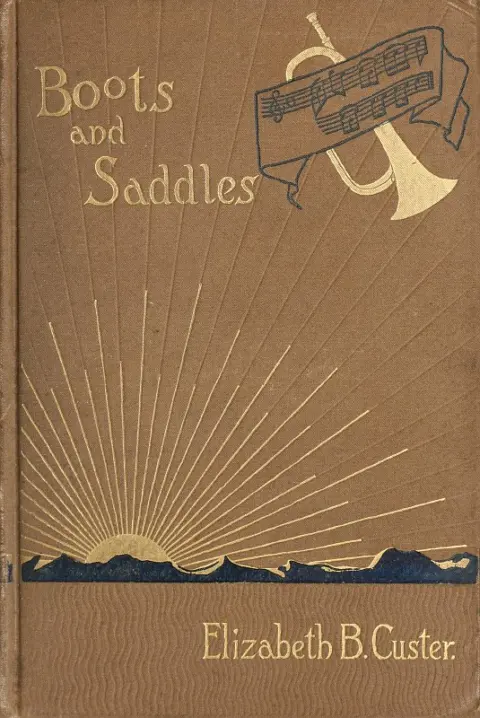
“Boots and Saddles”; Or, Life in Dakota with General Custer
Elizabeth Bacon Custer
THE CLASSIC COLLECTION · 1887
"Tenting on the Plains; or, General Custer in Kansas and Texas" by Elizabeth B. Custer is a historical account written in the late 19th century. The book recounts the experiences of General George Armstrong Custer and his wife, Libbie, as they embark on a journey to Texas after the American Civil War. Through vivid descriptions and personal reflections, it likely explores themes of military life, post-war challenges, and the camaraderie between Custer, his troops, and family. The opening of the narrative sets a poignant tone as General Custer prepares for departure from the Army of the Potomac amidst a heartfelt farewell from his soldiers. Libbie Custer reflects on the emotional weight of their parting, suggesting a deep bond with the men under her husband's command. The reader is introduced to the excitement of the journey to Texas, marked by the chaotic joy of discharged soldiers aboard the train and Libbie’s own anxieties about the challenges they would face in this lawless land. As they travel, the couple encounters moments that highlight the abrupt transition from military life to their new frontier adventures, emphasizing both the excitement and uncertainty that lay ahead.
Introduction adapted from the source catalogue; source summaries may be automatically generated.
Free to read · English · 136,932 words · No account needed
MAKE TIME FOR A GOOD BOOK
On by default. Untick to stop anonymous reading totals. Each page counts after 10 seconds in view. How this works.
Anonymous counting is on unless you have switched it off.
The tent might go down nightly for all I cared then. Every thought of separation departed, and I gave myself up to the happiest hours, clamping about the tent in those old troop boots, indifferent whether my shoes ever dried. The hours flew too fast, though, for very soon preparations began for a scout, which my husband was to command. It took a great deal of comforting to reconcile me to remaining behind. The General, as usual, had to beg me to remember how blessed we were to have been permitted to rejoin each other so early in the summer. He told me, over and over again, that there was nothing, he felt, that I would not encounter to come to him, and that if he was detained, he would send for me. Eliza and a faithful soldier were to be left to care for us. The cavalry departed, and again the days lengthened out longer and longer, until each one seemed forty-eight hours from sun to sun. We could scarcely take a short walk in safety. The Indians were all about us, and daily the sentinels were driven in, or attempts were made to stampede the horses and mules grazing about the post. The few officers remaining, in whose care we were placed, came or sent every day to our tents, which were up the creek a short distance, to inquire what they could do for our comfort. Mrs. Gibbs, with her boys, had joined her husband, and we were their neighbors.
It seemed, sometimes, as if we must get outside of our prescribed limits, the rolling bluffs beyond, tinged with green and beginning to have prairie flowers, looked so tempting. One evening we beguiled an officer, who was sitting under our tent fly, which was stretched in front for a shade, to take us for a little walk. Like many another man in the temporary possession of wheedling women, he went with us a little, and "just a little farther." Diana would have driven all thought of everything else save herself out of the gravest head. At last our escort saw the dark coming on so fast he insisted upon going home, and we reluctantly turned. As we came toward the post, the shadows were deepening in the twilight, and the figures of the sentinels were not visible. A flash, followed by a sound past our ears, that old campaigners describe as never to be forgotten when first heard, was the warning that we three were taken for Indians and fired upon by the sentinel. Another flash, but we stood rooted to the spot, stunned by surprise. The whizz and zip of the bullet seemed to be only a few inches from my ear. Still we were dazed, and had not the officer gained his senses our fate would have been then and there decided. The recruit, probably himself terrified, kept on sending those deadly little missives, with the terrible sound cutting the air around us. Our escort shouted, but it was too far for his voice to carry. Then he told us to run for our lives to a slight depression in the ground, and throw ourselves on our faces. I was coward enough to burrow mine in the prairie-grass, and for once in my life was devoutly grateful for being slender. Still, as I lay there quaking with terror, my body seemed to rise above the earth in such a monstrous heap that the dullest marksman, if he tried, might easily perforate me with bullets. What ages it seemed while we waited in this prostrate position, commanded by our escort not to move! The rain of bullets at last ceased, and blessed quiet came, but not peace of mind. The officer told us he would creep on his hands and knees through the hollow portions of the plain about the post, approach by the creek side, and inform the sentinels along the line, and as soon as they all knew who we were he would return for us. With smothered voices issuing from the grass where our faces were still crushed as low as we could get them, we implored to be allowed to creep on with him. We prayed him not to leave us out in the darkness alone. We begged him to tell us how he could ever find us again, if once he left us on ground that had no distinctive features by which he could trace his way back. But he was adamant: we must remain; and the ring of authority in his tone, besides the culprit feeling we had for having endangered his life, kept us still at last. As we lay there, our hearts' thumping seemed to lift us up in air and imperil anew our wretched existence. The pretty, rounded contour of the girl, which she had naturally taken such delight in, was now a source of agony to her, and she moaned out, "Oh! how high I seem to be above you! Oh, Libbie, do you think I lie as flat to the ground as you do?" and so on, with all the foolish talk of frightened women.
Your reading position is saved on this browser. Take it to another device with a library code. Reading pages adapt to text, rather than matching a printed edition.
Elizabeth Bacon Custer
BEHIND THE BOOK
This eBook is for the use of anyone anywhere in the United States and most other parts of the world at no cost and with almost no restrictions whatsoever. You may copy it, give it away or re-use it under the terms of the Project Gutenberg License included with this eBook or online at www.gutenberg.org. If you are not located in the United States, you will have to check the laws of the country where you are located before using this eBook. Read the source licence.
The original source file, including credits and licence, is retained by this library. Request an original-format copy at no charge. Please include the book title and Project Gutenberg identifier #40731.
KEEP YOUR CURIOSITY GOING
Cécile Tormay

Moritz Busch
John L. Ransom
Frances Wright
Cécile Tormay

Mabel Potter Daggett