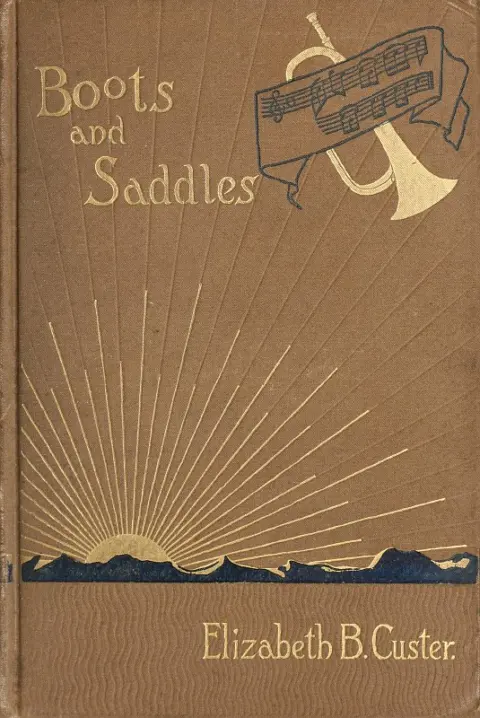
“Boots and Saddles”; Or, Life in Dakota with General Custer
Elizabeth Bacon Custer
THE CLASSIC COLLECTION · 1887
"Tenting on the Plains; or, General Custer in Kansas and Texas" by Elizabeth B. Custer is a historical account written in the late 19th century. The book recounts the experiences of General George Armstrong Custer and his wife, Libbie, as they embark on a journey to Texas after the American Civil War. Through vivid descriptions and personal reflections, it likely explores themes of military life, post-war challenges, and the camaraderie between Custer, his troops, and family. The opening of the narrative sets a poignant tone as General Custer prepares for departure from the Army of the Potomac amidst a heartfelt farewell from his soldiers. Libbie Custer reflects on the emotional weight of their parting, suggesting a deep bond with the men under her husband's command. The reader is introduced to the excitement of the journey to Texas, marked by the chaotic joy of discharged soldiers aboard the train and Libbie’s own anxieties about the challenges they would face in this lawless land. As they travel, the couple encounters moments that highlight the abrupt transition from military life to their new frontier adventures, emphasizing both the excitement and uncertainty that lay ahead.
Introduction adapted from the source catalogue; source summaries may be automatically generated.
Free to read · English · 136,932 words · No account needed
MAKE TIME FOR A GOOD BOOK
On by default. Untick to stop anonymous reading totals. Each page counts after 10 seconds in view. How this works.
Anonymous counting is on unless you have switched it off.
How often, in that first winter, I thought of my father's unstinted praise of the regular army, as he had known it at Sackett's Harbor and at Detroit, in Michigan's early days. I could not but wonder what he would think, to be let down in the midst of us. He used to say, in reference to my future, "Daughter, marrying into the army, you will be poor always; but I count it infinitely preferable to riches with inferior society. It consoles me to think you will be always associated with people of refinement." Meanwhile, the General was never done begging me to be silent about any new evidences of vulgarity. There were several high-bred women at Fort Riley; but they were so discreet I never knew but that they had been accustomed to such associations, until after the queer lot had departed and we dared to speak confidentially to one another.
Soon after the officers began to arrive in the autumn, an enlisted man, whom the General had known about in the regular army, reported for duty. He had reënlisted in the Seventh, hoping ultimately for a commission. He was soldierly in appearance, from his long experience in military life, and excellently well versed in tactics and regimental discipline. On this account he was made sergeant-major, the highest non-commissioned officer of a regiment; and, at his request, the General made application almost at once for his appointment as a lieutenant in the Seventh Cavalry. The application was granted, and the sergeant-major went to Washington to be examined. The examining board was composed of old and experienced officers, who were reported to be opposed to the appointment of enlisted men. At any rate, the applicant was asked a collection of questions that were seemingly unanswerable. I only remember one, "What does a regiment of cavalry weigh?" Considering the differences in the officers, men and horses, it would seem as if a correct answer were impossible. The sergeant-major failed, and returned to our post with the hopelessness before him of five years of association with men in the ranks; for there is no escaping the whole term of enlistment, unless it is found that a man is under age. But the General did not give up. He encouraged the disappointed man to hope, and when he was ordered before the board himself, he went to the Secretary of War and made personal application for the appointment. Washington was then full of men and their friends, clamoring for the vacancies in the new regiments; but General Custer was rarely in Washington, and was guarded in not making too many appeals, so he obtained the promise, and soon afterward the sergeant-major replaced the chevrons with shoulder-straps. Then ensued one of those awkward situations, that seem doubly so in a life where there is such marked distinction in the social standing of an officer and a private; and some of the Seventh Cavalry made the situation still more embarrassing by conspicuous avoidance of the new lieutenant, carefully ignoring him except where official relations existed. This seemed doubly severe, as they knew of nothing in the man's conduct, past or present, to justify them in such behavior. He had borne himself with dignity as sergeant-major, living very much to himself, and performing every duty punctiliously. Shortly before, he had been an officer like themselves in the volunteer service, and this social ostracism, solely on account of a few months of service as an enlisted man, was absurd. They went back to his early service as a soldier, determined to show him that he was not "to the manner born." The single men had established a mess, and each bachelor officer who came was promptly called upon and duly invited to join them at table. There was literally no other place to be fed. There were no cooks to be had in that unsettled land, and if there had been servants to hire, the exorbitant wages would have consumed a lieutenant's pay. There were enough officers in the bachelors' mess to carry the day against the late sergeant-major. My husband was much disturbed by this discourteous conduct; but it did not belong to the province of the commanding officer, and he was careful to keep the line of demarkation between social and official affairs distinct. Yet it did not take long for him to think a way out of the dilemma. He came to me to ask if I would be willing to have him in our family temporarily, and, of course, it ended in the invitation being given. In the evening, when our quarters filled up with the bachelor officers, they found the lieutenant whom they had snubbed established as one of the commanding officer's family. He remained as one of us until the officers formed another mess, as their number increased, and the new lieutenant was invited to join them. This was not the end of General Custer's marked regard for him, and as long as he lived he showed his unswerving friendship, and, in ways that the officer never knew, kept up his disinterested loyalty, making me sure, as years advanced, that he was worthy of the old adage, "Once a friend, always a friend." Until he was certain that there was duplicity and ingratitude, or that worst of sins, concealed enmity, he kept faith and friendships intact. At that time there was every reason in the world for an officer whose own footing was uncertain, and who owed everything to my husband, to remain true to him.
Your reading position is saved on this browser. Take it to another device with a library code. Reading pages adapt to text, rather than matching a printed edition.
Elizabeth Bacon Custer
BEHIND THE BOOK
This eBook is for the use of anyone anywhere in the United States and most other parts of the world at no cost and with almost no restrictions whatsoever. You may copy it, give it away or re-use it under the terms of the Project Gutenberg License included with this eBook or online at www.gutenberg.org. If you are not located in the United States, you will have to check the laws of the country where you are located before using this eBook. Read the source licence.
The original source file, including credits and licence, is retained by this library. Request an original-format copy at no charge. Please include the book title and Project Gutenberg identifier #40731.
KEEP YOUR CURIOSITY GOING
Cécile Tormay

Moritz Busch
John L. Ransom
Frances Wright
Cécile Tormay

Mabel Potter Daggett