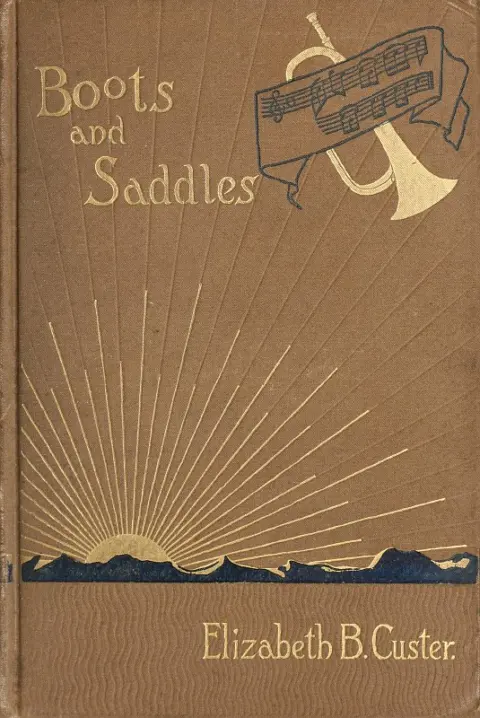
“Boots and Saddles”; Or, Life in Dakota with General Custer
Elizabeth Bacon Custer
THE CLASSIC COLLECTION · 1887
"Tenting on the Plains; or, General Custer in Kansas and Texas" by Elizabeth B. Custer is a historical account written in the late 19th century. The book recounts the experiences of General George Armstrong Custer and his wife, Libbie, as they embark on a journey to Texas after the American Civil War. Through vivid descriptions and personal reflections, it likely explores themes of military life, post-war challenges, and the camaraderie between Custer, his troops, and family. The opening of the narrative sets a poignant tone as General Custer prepares for departure from the Army of the Potomac amidst a heartfelt farewell from his soldiers. Libbie Custer reflects on the emotional weight of their parting, suggesting a deep bond with the men under her husband's command. The reader is introduced to the excitement of the journey to Texas, marked by the chaotic joy of discharged soldiers aboard the train and Libbie’s own anxieties about the challenges they would face in this lawless land. As they travel, the couple encounters moments that highlight the abrupt transition from military life to their new frontier adventures, emphasizing both the excitement and uncertainty that lay ahead.
Introduction adapted from the source catalogue; source summaries may be automatically generated.
Free to read · English · 136,932 words · No account needed
MAKE TIME FOR A GOOD BOOK
On by default. Untick to stop anonymous reading totals. Each page counts after 10 seconds in view. How this works.
Anonymous counting is on unless you have switched it off.
After our quarters were chosen by the Colonel, we took another house, of moderate size, bought a few pieces of furniture of an officer leaving the post, and began to live our first homelike life. The arrival of the new officers was for a time our only excitement. Most of them had been in the volunteer service, and knew nothing of the regular army. There was no one to play practical jokes on the first comers; but they had made some ridiculous errors in dress and deportment, when reporting at first, and they longed to take out their mortification at these harmless mistakes, by laying pitfalls for the verdant ones who were constantly arriving. The discipline of the regular army, and the punctilious observance compelling the wearing of the uniform, was something totally new to men who had known little of parades in their fighting days in the tented field. If it was possible to intimidate a new officer by tales of the strictness of the commanding officer regarding the personal appearance of his regiment, they did so. One by one, those who had preceded the last comer called in to pay their compliments; but by previous agreement they one and all dwelt upon the necessity of his making a careful toilet before he approached the august presence of the Lieutenant-colonel. Then one or two offered carelessly to help him get himself up for the occasion. Our brother Tom had arrived by this time, but there was nothing to be made out of him, for he had served a few months with a regular regiment before being transferred to ours. He was therefore sent one day to prepare me for the call of an officer who had been assisted into his new uniform by the mischievous knot of men who had been longest with us. If I had known to what test I was to be put to keep my face straight, or had dreamed what a gullible creature had come into their roguish hands, I would not have consented to receive him. But it was one of the imperative roles that each officer, after reporting for duty, must pay a formal visit to the commanding officer and his family. I went into the parlor to find a large, and at that time awkward, man, in full uniform, which was undeniably a tight fit for his rather portly figure. He wore cavalry boots, the first singularity I noticed, for they had such expanse of top I could not help seeing them. They are of course out of order with a dress coat. The red sash, which was then en règle for all officers, was spread from up under his arms to as far below the waist line as its elastic silk could be stretched. The sword-belt, with sabre attached, surrounded this; and, folded over the wide red front, were his large hands, encased in white cotton gloves. He never moved them; nor did he move an eyelash, so far as I could discover, though it seems he was full of internal tremors, for the officers had told him on no account to remove his regulation hat. At this he demurred, and told them I would surely think he was no gentleman; but they assured him I placed military etiquette far above any ordinary rule for manners in the presence of ladies, while the truth was I was rather indifferent as to military rules of dress. As this poor man sat there, I could think of nothing but a child who is so carefully dressed in new furbelows that it sits as if it were carved out of wood, for fear of disarranging the finished toilet. Diana made an almost instant excuse to leave the room. The General's mustache quivered, and he moved restlessly around, even coming again to shake hands with the automaton and bid him welcome to the regiment; but finally he dashed out of the door to enjoy the outburst of mirth that he could no longer control. I was thus left to meet the situation as best I could, but was not as fortunate as the General, who had a friendly mustache to curtain the quiver in his mouth. The poor victim apparently recalled to himself the martial attitude of Washington crossing the Delaware, or Napoleon at Waterloo, and did not alter the first position he had assumed. In trying to prevent him from seeing my confusion, I redoubled my efforts to entertain him, and succeeded only too well, for when he slowly moved out of the door I found myself tired out, and full of wrath toward my returning family. I never could remember that these little spurts of rage were the primest fun for my people. The poor officer who had been so guyed did not gratify his tormentors by getting angry, but fell to planning new mischief for the next arrival. He lost no time in begging my pardon for the hat, and though I never saw much of him afterward, he left only pleasant impressions on my mind of a kind-hearted man, and one of those rare beings who knew how to take a joke.
Your reading position is saved on this browser. Take it to another device with a library code. Reading pages adapt to text, rather than matching a printed edition.
Elizabeth Bacon Custer
BEHIND THE BOOK
This eBook is for the use of anyone anywhere in the United States and most other parts of the world at no cost and with almost no restrictions whatsoever. You may copy it, give it away or re-use it under the terms of the Project Gutenberg License included with this eBook or online at www.gutenberg.org. If you are not located in the United States, you will have to check the laws of the country where you are located before using this eBook. Read the source licence.
The original source file, including credits and licence, is retained by this library. Request an original-format copy at no charge. Please include the book title and Project Gutenberg identifier #40731.
KEEP YOUR CURIOSITY GOING
Cécile Tormay

Moritz Busch
John L. Ransom
Frances Wright
Cécile Tormay

Mabel Potter Daggett