The castaways
James Otis
THE CLASSIC COLLECTION · 1895
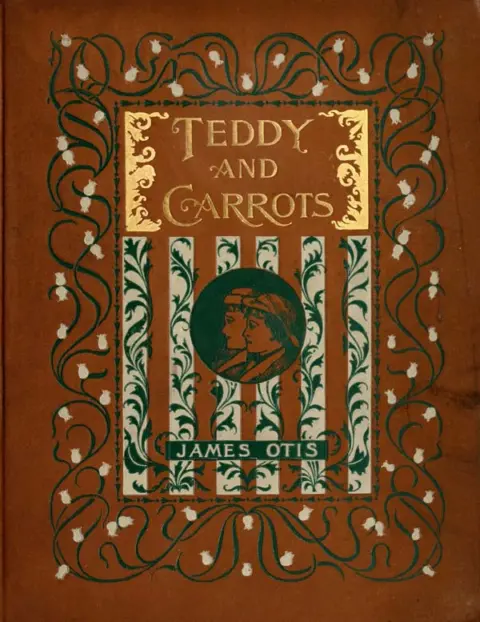
"Teddy and Carrots: Two Merchants of Newspaper Row" by James Otis is a fictional novel likely written in the late 19th century. The story centers around two young boys, Teddy Thurston and Joseph "Carrots" Williams, navigating the challenges of selling newspapers in New York City, where they confront bullies, form friendships, and seek to establish their place amid the rough streets. The narrative captures the struggles and resilience of youth in an urban environment, evoking themes of camaraderie and perseverance. At the start of the book, the reader meets Teddy, a newcomer to the city, who is eager to make a living selling newspapers. He quickly encounters trouble when confronted by Skip Jellison, a local bully, who attacks him and causes chaos in his attempts to sell papers. The scene unfolds as Teddy tries to defend himself, while Carrots, a bootblack and potential ally, observes the conflict and decides to help Teddy. Carrots’ initiative sets the stage for their burgeoning friendship and the larger challenges they will face together in the cutthroat world of newspaper selling, with the ever-present threat of conflict with Skip looming large.
Introduction adapted from the source catalogue; source summaries may be automatically generated.
Free to read · English · 46,209 words · No account needed
MAKE TIME FOR A GOOD BOOK
On by default. Untick to stop anonymous reading totals. Each page counts after 10 seconds in view. How this works.
Anonymous counting is on unless you have switched it off.
"He's over there; third cell from the end."
Carrots walked quickly to the place, looked in through the grated door, and saw Teddy lying on a wooden bench, which served the double purpose of a seat and a bed. The young prisoner's face was covered by his hands.
"Come, old man," Carrots said, soothingly, "you ought ter have more sand than to give up like this. Besides, ain't I here to help you?"
Teddy leaped to his feet immediately, and came to the door, through which Carrots thrust a very grimy hand as he said:
"Shake hands! Brace up, an' have some style about you! I've been 'tendin' to your business pretty nigh ever since you was gone, an' thought I'd jest run in to let you know everything will be all right; but you'll have to stay here till mornin'."
"Till mornin'?" Teddy repeated in dismay.
"Yes; that ain't sich a very long while, an' it'll take me till then to
get things fixed."
"How did they happen to let you in?"
"Oh, you see, the sergeant is an old friend of mine. I've blacked his boots, on an' off, for 'most a year."
Then Carrots, with the hope of cheering his friend, began to explain what might be done toward effecting the prisoner's release; and when it was time to bring the interview to a close, he had so far succeeded that Teddy was really quite hopeful, believing there was no serious obstacle in the way of his freedom.
Bidding Teddy adieu, Carrots left the station-house.
It was now so nearly dark that Carrots turned in the direction of his own home, for the purpose of gaining as much rest as possible before beginning what looked like a hard piece of work.
Now Carrots was a householder in his own right, or at least by right of
discovery.
More than one of his acquaintances had been eager to know where he lived; but he avoided all questions on the subject, save to one person--Teenie Massey.
In addition to his being a trusted friend, Teenie lived with his parents; therefore, when Carrots revealed the secret, it was with the knowledge that Master Massey would not wish to share the dwelling with him.
To avoid interference, Carrots always approached his home in the most cautious manner, and this occasion was no exception.
He walked leisurely along in the direction of Canal Street, as if going nowhere in particular, for the purpose of misleading any friends whom he might meet; and, on arriving at an alleyway which ran between two shops, he halted for an instant to make sure the coast was clear.
Your reading position is saved on this browser. Take it to another device with a library code. Reading pages adapt to text, rather than matching a printed edition.
BEHIND THE BOOK
This eBook is for the use of anyone anywhere in the United States and most other parts of the world at no cost and with almost no restrictions whatsoever. You may copy it, give it away or re-use it under the terms of the Project Gutenberg License included with this eBook or online at www.gutenberg.org. If you are not located in the United States, you will have to check the laws of the country where you are located before using this eBook. Read the source licence.
The original source file, including credits and licence, is retained by this library. Request an original-format copy at no charge. Please include the book title and Project Gutenberg identifier #35046.
KEEP YOUR CURIOSITY GOING
Coulson Kernahan

Maurice Baring
Frances Wright
Cécile Tormay

Frederic Jesup Stimson

W. H. P. (William Henry Pope) Jarvis