The castaways
James Otis
THE CLASSIC COLLECTION · 1895
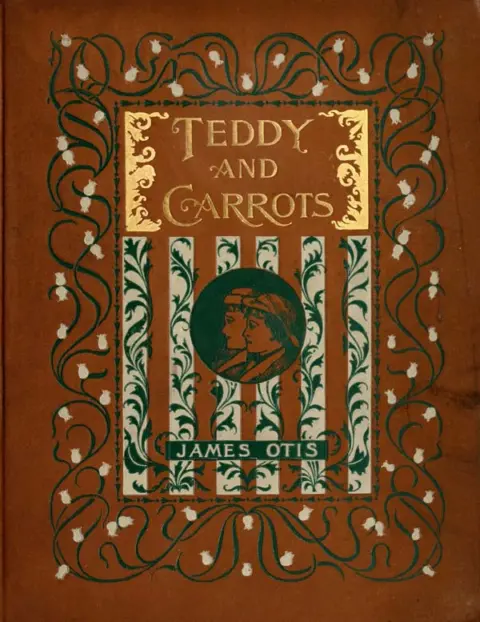
"Teddy and Carrots: Two Merchants of Newspaper Row" by James Otis is a fictional novel likely written in the late 19th century. The story centers around two young boys, Teddy Thurston and Joseph "Carrots" Williams, navigating the challenges of selling newspapers in New York City, where they confront bullies, form friendships, and seek to establish their place amid the rough streets. The narrative captures the struggles and resilience of youth in an urban environment, evoking themes of camaraderie and perseverance. At the start of the book, the reader meets Teddy, a newcomer to the city, who is eager to make a living selling newspapers. He quickly encounters trouble when confronted by Skip Jellison, a local bully, who attacks him and causes chaos in his attempts to sell papers. The scene unfolds as Teddy tries to defend himself, while Carrots, a bootblack and potential ally, observes the conflict and decides to help Teddy. Carrots’ initiative sets the stage for their burgeoning friendship and the larger challenges they will face together in the cutthroat world of newspaper selling, with the ever-present threat of conflict with Skip looming large.
Introduction adapted from the source catalogue; source summaries may be automatically generated.
Free to read · English · 46,209 words · No account needed
MAKE TIME FOR A GOOD BOOK
On by default. Untick to stop anonymous reading totals. Each page counts after 10 seconds in view. How this works.
Anonymous counting is on unless you have switched it off.
His surprise at meeting a friend, when he had expected to see the stern visage of a mere servant of justice, was quite as great as it was pleasing; and he marched up to the desk and said, familiarly:
"If I'd knowed you was here, I'd 'a' come before."
"I don't want my boots shined now. See you outside in the morning," said
the sergeant.
"But I ain't shinin'; I'm on business."
"Oh, you are, eh? Well, what's up?"
"One of the pleecemen 'round City Hall arrested a feller this mornin' what had jest walked down from Saranac; an' it's all wrong, I tell you,--all wrong."
"He's a friend of yours, I suppose?"
"Well, you can't exactly call him that. I never spoke to him till jest before this thing happened. I want ter git him right out, on 'portant business."
"I'm afraid you will have to wait a little while, and explain the whole affair to the judge in the morning. I haven't any authority to do a thing like that."
"Couldn't you fix it with the judge?"
"No, indeed," the officer replied, laughingly. "The best way is for you to go to the court yourself, and explain how it happened, unless he is really guilty, in which case I suppose he will have to go to the Island. I fancy a week up there wouldn't do him any harm."
"But, you see, it was jest this way"--and Carrots assumed an attitude such as one takes when about to begin a long story.
"Never mind it now. I can't stop to listen; and, besides, it wouldn't do
any good."
Carrots looked up as if surprised that an old friend should assume a dictatorial tone, and then, suddenly remembering that he had another favour to ask, added:
"Well, you can let me see him, can't you?"
"What good will that do?"
"Why, I jest want to brace him up a little. You see, he's pretty green, an' he must be feelin' awful bad by this time. I won't stay more'n five minutes, if you'll let me see him."
"All right; go down-stairs. You'll find him in one of the cells; and if the turnkey says anything, tell him I sent you."
Carrots did not wait for further instructions; but, fearful lest the permission should be withdrawn, hurried down the stairs at once, and was making a tour of the cells with the purpose of finding his friend, when the officer in charge stopped him.
"What do you want here?"
"The sergeant sent me down to see a friend of mine, that's all; an' I'm
lookin' for him."
"The boy they brought in this noon?"
"That's the very one."
Your reading position is saved on this browser. Take it to another device with a library code. Reading pages adapt to text, rather than matching a printed edition.
BEHIND THE BOOK
This eBook is for the use of anyone anywhere in the United States and most other parts of the world at no cost and with almost no restrictions whatsoever. You may copy it, give it away or re-use it under the terms of the Project Gutenberg License included with this eBook or online at www.gutenberg.org. If you are not located in the United States, you will have to check the laws of the country where you are located before using this eBook. Read the source licence.
The original source file, including credits and licence, is retained by this library. Request an original-format copy at no charge. Please include the book title and Project Gutenberg identifier #35046.
KEEP YOUR CURIOSITY GOING
Coulson Kernahan

Maurice Baring
Frances Wright
Cécile Tormay

Frederic Jesup Stimson

W. H. P. (William Henry Pope) Jarvis