The castaways
James Otis
THE CLASSIC COLLECTION · 1895
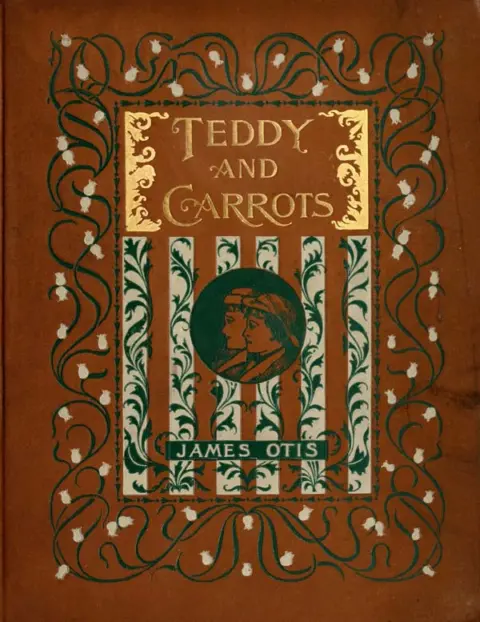
"Teddy and Carrots: Two Merchants of Newspaper Row" by James Otis is a fictional novel likely written in the late 19th century. The story centers around two young boys, Teddy Thurston and Joseph "Carrots" Williams, navigating the challenges of selling newspapers in New York City, where they confront bullies, form friendships, and seek to establish their place amid the rough streets. The narrative captures the struggles and resilience of youth in an urban environment, evoking themes of camaraderie and perseverance. At the start of the book, the reader meets Teddy, a newcomer to the city, who is eager to make a living selling newspapers. He quickly encounters trouble when confronted by Skip Jellison, a local bully, who attacks him and causes chaos in his attempts to sell papers. The scene unfolds as Teddy tries to defend himself, while Carrots, a bootblack and potential ally, observes the conflict and decides to help Teddy. Carrots’ initiative sets the stage for their burgeoning friendship and the larger challenges they will face together in the cutthroat world of newspaper selling, with the ever-present threat of conflict with Skip looming large.
Introduction adapted from the source catalogue; source summaries may be automatically generated.
Free to read · English · 46,209 words · No account needed
MAKE TIME FOR A GOOD BOOK
On by default. Untick to stop anonymous reading totals. Each page counts after 10 seconds in view. How this works.
Anonymous counting is on unless you have switched it off.
"Say, boys, come 'round over here by the fountain, an' I'll show you something!" Skip Jellison shouted to a party of his friends who were seated on a curbstone, not far from the Newsboys' Lodging House, gravely discussing a business proposition which had been made by Sid Barker.
"What's the matter?" Reddy Jackson asked, replacing his fragment of a
hat.
"Come over here; an' you must be quick about it, or the show will be
ended."
Skip was so excited that his acquaintances and friends concluded it must be something of considerable importance to cause him to move in such a lively manner, and they followed him a short distance down the street, until it was possible to have a full view of the fountain.
There the cause of Master Jellison's agitation could be seen.
Seated on the edge of the iron basin, with a newspaper parcel unrolled in front of him, was a boy, apparently about twelve years of age, who, to the newsboy spectators, looked painfully neat and clean. Skip and his friends saw that the boy was a stranger in the city.
The newcomer had taken from their newspaper wrappings a small cake of yellow soap, and a piece of cotton cloth.
Laying these on the iron edge of the fountain basin, he calmly proceeded to wash his face and hands, using a plentiful amount of soap; and then, to the intense astonishment of the spectators, applied the impromptu towel vigorously.
"Well, that feller's too good for down-town!" Skip said, in what he intended for a sarcastic tone. "He b'longs up at the Fif' Avenoo."
"Oh, he's jest got in from the country, an' is goin' to buy Brooklyn
Bridge," Sid suggested.
"Look at him! Jest look at him!" Skip cried, in mingled excitement and anger that the boy should be so criminally neat.
The stranger had taken from his valise of paper a comb, which he calmly proceeded to use, the water in the basin serving as a mirror; and then, to the surprise and disdain of the spectators, he gave his clothes a vigorous brushing with a whisk-broom.
"Well, see here!" and Skip spoke in the tone of one who is uncertain whether it is best to laugh or be angry, "that feller's makin' me tired. S'pos'n' we go over an' give him a shakin' up, jest for fun. Come on!" and Skip led the way across the street at full speed.
The stranger looked up calmly when they approached, but betrayed neither astonishment nor alarm; and Skip involuntarily halted a few paces away, as he asked, gruffly: "Say, young feller, what're you tryin' to do?"
"Can't you see?"
Your reading position is saved on this browser. Take it to another device with a library code. Reading pages adapt to text, rather than matching a printed edition.
BEHIND THE BOOK
This eBook is for the use of anyone anywhere in the United States and most other parts of the world at no cost and with almost no restrictions whatsoever. You may copy it, give it away or re-use it under the terms of the Project Gutenberg License included with this eBook or online at www.gutenberg.org. If you are not located in the United States, you will have to check the laws of the country where you are located before using this eBook. Read the source licence.
The original source file, including credits and licence, is retained by this library. Request an original-format copy at no charge. Please include the book title and Project Gutenberg identifier #35046.
KEEP YOUR CURIOSITY GOING
Coulson Kernahan

Maurice Baring
Frances Wright
Cécile Tormay

Frederic Jesup Stimson

W. H. P. (William Henry Pope) Jarvis