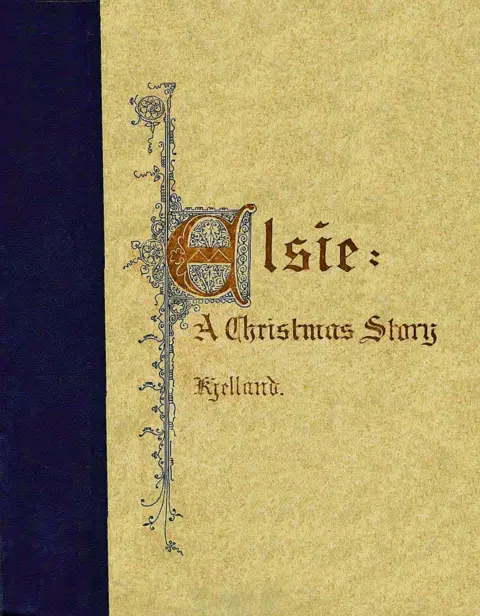
Elsie
Alexander Lange Kielland
THE CLASSIC COLLECTION · 1891
"Tales of Two Countries" by Alexander Lange Kielland is a collection of short stories written during the late 19th century. The narratives explore a diverse range of characters and situations, likely reflecting on social issues, human experiences, and moral dilemmas through the lens of life in Norway and France. With an introduction hinting at a deeper social commentary, the tales aim to bridge cultures while examining themes of love, aspiration, and the contrasting realities of different social classes. The opening of the book establishes a foundation for its thematic explorations, beginning with a close look at Alexander Kielland himself, highlighting his intellectual promise, transformation into a respected author, and his ability to blend elegant writing with social critique. The stories are introduced with references to various characters whose lives are marked by social challenges and personal conflicts. The first tale, "Pharaoh," focuses on a young woman's struggles with her past and her unsettling feelings about her wealthy life juxtaposed against the poverty and despair she has escaped. As she attends a ball, memories surge, exposing the inner tumult of someone torn between societal status and her connections to a painful history. This story sets a tone of introspection and reveals Kielland's deft handling of social commentary, indicating that the subsequent stories will similarly tackle the intricate web of human emotions and class distinctions.
Introduction adapted from the source catalogue; source summaries may be automatically generated.
Free to read · English · 44,363 words · No account needed
MAKE TIME FOR A GOOD BOOK
On by default. Untick to stop anonymous reading totals. Each page counts after 10 seconds in view. How this works.
Anonymous counting is on unless you have switched it off.
“Do you know him?” asked Cousin Hans, anxiously.
“Yes, a little, just as half the town knows him, from having seen him on the esplanade, where he walks every day.”
“Yes, that was just where I saw him,” said his nephew. “What an interesting old gentleman he looks. I should like so much to have a talk with him.”
“That wish you can easily gratify,” answered Uncle Frederick. “You need only place yourself anywhere on the ramparts and begin drawing lines in the sand, then he’ll come to you.”
“Come to you?” said Cousin Hans.
“Yes, he’ll come and talk to you. But you must be careful: he’s
dangerous.”
“Eh?” said Cousin Hans.
“He was once very nearly the end of me.”
“Ah!” said Cousin Hans.
“Yes, with his talk, you understand.”
“Oh?” said Cousin Hans.
“You see, he has two stories,” continued Uncle Frederick, “the one, about a sham fight in Sweden, is a good half-hour long. But the other, the battle of Waterloo, generally lasts from an hour and a half to two hours. I have heard it three times.” And Uncle Frederick sighed deeply.
“Are they so very tedious, then, these stories? asked Cousin Hans.
“Oh, they’re well enough for once in a way,” answered his uncle, “and if you should get into conversation with the captain, mark what I tell you: If you get off with the short story, the Swedish one, you have nothing to do but alternately to nod and shake your head. You’ll soon pick up the lay of the land.”
“The lay of the land?” said Cousin Hans.
“Yes, you must know that he draws the whole manoeuvre for you in the sand; but it’s easy enough to understand if only you keep your eye on A and B. There’s only one point where you must be careful not to put your foot in it.”
“Does he get impatient, then, if you don’t understand?” asked Cousin
Hans.
“No, quite the contrary; but if you show that you’re not following, he begins at the beginning again, you see! The crucial point in the sham fight,” continued his uncle, “is the movement made by the captain himself, in spite of the general’s orders, which equally embarrassed both friends and foes. It was this stroke of genius, between ourselves, which forced them to give him the Order of the Sword, to induce him to retire. So when you come to this point, you must nod violently, and say: ‘Of course--the only reasonable move--the key to the position.’ Remember that--the key.”
“The key,” repeated Cousin Hans.
Your reading position is saved on this browser. Take it to another device with a library code. Reading pages adapt to text, rather than matching a printed edition.
Alexander Lange Kielland
Alexander Lange Kielland
Alexander Lange Kielland
BEHIND THE BOOK
This eBook is for the use of anyone anywhere in the United States and most other parts of the world at no cost and with almost no restrictions whatsoever. You may copy it, give it away or re-use it under the terms of the Project Gutenberg License included with this eBook or online at www.gutenberg.org. If you are not located in the United States, you will have to check the laws of the country where you are located before using this eBook. Read the source licence.
The original source file, including credits and licence, is retained by this library. Request an original-format copy at no charge. Please include the book title and Project Gutenberg identifier #8663.
KEEP YOUR CURIOSITY GOING
Coulson Kernahan

Maurice Baring
Frances Wright
Cécile Tormay

Frederic Jesup Stimson

W. H. P. (William Henry Pope) Jarvis