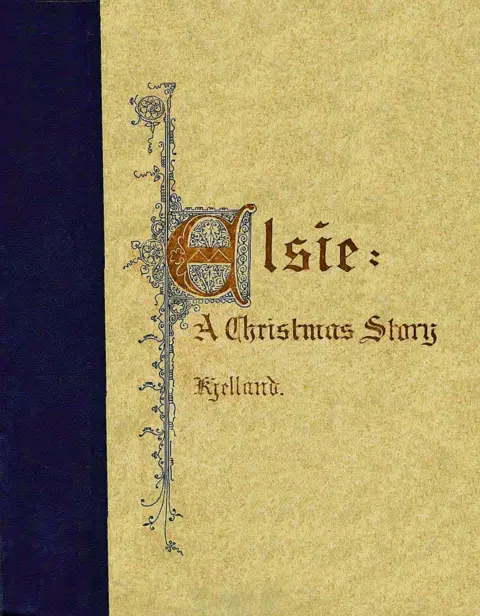
Elsie
Alexander Lange Kielland
THE CLASSIC COLLECTION · 1891
"Tales of Two Countries" by Alexander Lange Kielland is a collection of short stories written during the late 19th century. The narratives explore a diverse range of characters and situations, likely reflecting on social issues, human experiences, and moral dilemmas through the lens of life in Norway and France. With an introduction hinting at a deeper social commentary, the tales aim to bridge cultures while examining themes of love, aspiration, and the contrasting realities of different social classes. The opening of the book establishes a foundation for its thematic explorations, beginning with a close look at Alexander Kielland himself, highlighting his intellectual promise, transformation into a respected author, and his ability to blend elegant writing with social critique. The stories are introduced with references to various characters whose lives are marked by social challenges and personal conflicts. The first tale, "Pharaoh," focuses on a young woman's struggles with her past and her unsettling feelings about her wealthy life juxtaposed against the poverty and despair she has escaped. As she attends a ball, memories surge, exposing the inner tumult of someone torn between societal status and her connections to a painful history. This story sets a tone of introspection and reveals Kielland's deft handling of social commentary, indicating that the subsequent stories will similarly tackle the intricate web of human emotions and class distinctions.
Introduction adapted from the source catalogue; source summaries may be automatically generated.
Free to read · English · 44,363 words · No account needed
MAKE TIME FOR A GOOD BOOK
On by default. Untick to stop anonymous reading totals. Each page counts after 10 seconds in view. How this works.
Anonymous counting is on unless you have switched it off.
The last conjecture was, perhaps, a result of the dread of mothers-in-law inculcated by all reputable authors; but it was none the less confident on that account. And now it only remained for Cousin Hans to discover, in the first place, where she lived, in the second place who she was, and in the third place how he could make her acquaintance.
Where she lived he would soon learn, for was she not on her way home? Who she was, he could easily find out from the neighbors. And as for making her acquaintance--good heavens! is not a little difficulty an indispensable part of a genuine romance?
Just as the chase was at its height, the quarry disappeared into a gate-way; and it was really high time, for, truth to tell, the hunter was rather exhausted.
He read with a certain relief the number, “34,” over the gate, then went a few steps farther on, in order to throw any possible observer off the scent, and stopped beside a street-lamp to recover his breath. It was, as aforesaid, a warm day; and this, combined with his violent emotion, had thrown Hans into a strong perspiration. His toilet, too, had been disarranged by the reckless eagerness with which he had hurled himself into the chase.
He could not help smiling at himself, as he stood and wiped his face and neck, adjusted his necktie, and felt his collar, which had melted on the sunny side. But it was a blissful smile, he was in that frame of mind in which one sees, or at any rate apprehends, nothing of the external world; and he said to himself, half aloud, “Love endures everything, accepts everything.”
“And perspires freely,” said a fat little gentleman whose white waistcoat suddenly came within Cousin Hans’s range of vision.
“Oh, is that you, uncle?” he said, a little abashed.
“Of course it is,” answered Uncle Frederick. “I’ve left the shady side of the street expressly to save you from being roasted. Come along with me.”
Thereupon he tried to drag his nephew with him, but Hans resisted. “Do you know who lives at No. 34, uncle?”
“Not in the least; but do let us get into the shade,” said Uncle Frederick; for there were two things he could not endure: heat and laughter--the first on account of his corpulence, and the second on account of what he himself called “his apoplectic tendencies.”
“By-the-bye,” he said, when they reached the cool side of the street, and he had taken his nephew by the arm, “now that I think of it, I do know, quite well, who lives in No. 34; it’s old Captain Schrappe.”
Your reading position is saved on this browser. Take it to another device with a library code. Reading pages adapt to text, rather than matching a printed edition.
Alexander Lange Kielland
Alexander Lange Kielland
Alexander Lange Kielland
BEHIND THE BOOK
This eBook is for the use of anyone anywhere in the United States and most other parts of the world at no cost and with almost no restrictions whatsoever. You may copy it, give it away or re-use it under the terms of the Project Gutenberg License included with this eBook or online at www.gutenberg.org. If you are not located in the United States, you will have to check the laws of the country where you are located before using this eBook. Read the source licence.
The original source file, including credits and licence, is retained by this library. Request an original-format copy at no charge. Please include the book title and Project Gutenberg identifier #8663.
KEEP YOUR CURIOSITY GOING
Coulson Kernahan

Maurice Baring
Frances Wright
Cécile Tormay

Frederic Jesup Stimson

W. H. P. (William Henry Pope) Jarvis