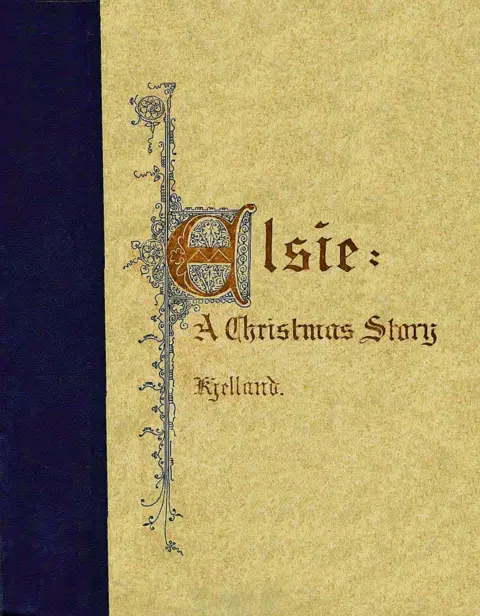
Elsie
Alexander Lange Kielland
THE CLASSIC COLLECTION · 1891
"Tales of Two Countries" by Alexander Lange Kielland is a collection of short stories written during the late 19th century. The narratives explore a diverse range of characters and situations, likely reflecting on social issues, human experiences, and moral dilemmas through the lens of life in Norway and France. With an introduction hinting at a deeper social commentary, the tales aim to bridge cultures while examining themes of love, aspiration, and the contrasting realities of different social classes. The opening of the book establishes a foundation for its thematic explorations, beginning with a close look at Alexander Kielland himself, highlighting his intellectual promise, transformation into a respected author, and his ability to blend elegant writing with social critique. The stories are introduced with references to various characters whose lives are marked by social challenges and personal conflicts. The first tale, "Pharaoh," focuses on a young woman's struggles with her past and her unsettling feelings about her wealthy life juxtaposed against the poverty and despair she has escaped. As she attends a ball, memories surge, exposing the inner tumult of someone torn between societal status and her connections to a painful history. This story sets a tone of introspection and reveals Kielland's deft handling of social commentary, indicating that the subsequent stories will similarly tackle the intricate web of human emotions and class distinctions.
Introduction adapted from the source catalogue; source summaries may be automatically generated.
Free to read · English · 44,363 words · No account needed
MAKE TIME FOR A GOOD BOOK
On by default. Untick to stop anonymous reading totals. Each page counts after 10 seconds in view. How this works.
Anonymous counting is on unless you have switched it off.
At last five o’clock struck. He had already taken up his position on the ramparts, whence he could survey the whole esplanade. Quite right: there came the black frock-coat, the light trousers, and the well-brushed hat.
Cousin Hans felt his heart palpitate a little. At first he attributed this to a sense of shame in thus craftily setting a trap for the good old captain. But he soon discovered that it was the sight of the beloved one’s father that set his blood in a ferment. Thus reassured, he began, in accordance with Uncle Frederick’s advice, to draw strokes and angles in the sand, attentively fixing his eyes, from time to time, upon the Castle of Akerhuus.
The whole esplanade was quiet and deserted. Cousin Hans could hear the captain’s firm steps approaching; they came right up to him and stopped. Hans did not look up; the captain advanced two more paces and coughed. Hans drew a long and profoundly significant stroke with his stick, and then the old fellow could contain himself no longer.
“Aha, young gentleman,” he said, in a friendly tone, taking off his hat, “are you making a plan of our fortifications?”
Cousin Hans assumed the look of one who is awakened from deep contemplation, and, bowing politely, he answered with some embarrassment: “No, it’s only a sort of habit I have of trying to take my bearings wherever I may be.”
“An excellent habit, a most excellent habit,” the captain exclaimed with
warmth.
“It strengthens the memory,” Cousin Hans remarked, modestly.
“Certainly, certainly, sir!” answered the captain, who was beginning to be much pleased by this modest young man.
“Especially in situations of any complexity,” continued the modest young man, rubbing out his strokes with his foot.
“Just what I was going to say!” exclaimed the captain, delighted. “And, as you may well believe, drawings and plans are especially indispensable in military science. Look at a battle-field, for example.”
“Ah, battles are altogether too intricate for me,” Cousin Hans interrupted, with a smile of humility.
“Don’t say that, sir!” answered the kindly old man. “When once you have a bird’s-eye view of the ground and of the positions of the armies, even a tolerably complicated battle can be made quite comprehensible.--This sand, now, that we have before us here, could very well be made to give us an idea, in miniature, of, for example, the battle of Waterloo.”
“I have come in for the long one,” thought Cousin Hans, “but never mind! [Note: In English in the original.] I love her.”
Your reading position is saved on this browser. Take it to another device with a library code. Reading pages adapt to text, rather than matching a printed edition.
Alexander Lange Kielland
Alexander Lange Kielland
Alexander Lange Kielland
BEHIND THE BOOK
This eBook is for the use of anyone anywhere in the United States and most other parts of the world at no cost and with almost no restrictions whatsoever. You may copy it, give it away or re-use it under the terms of the Project Gutenberg License included with this eBook or online at www.gutenberg.org. If you are not located in the United States, you will have to check the laws of the country where you are located before using this eBook. Read the source licence.
The original source file, including credits and licence, is retained by this library. Request an original-format copy at no charge. Please include the book title and Project Gutenberg identifier #8663.
KEEP YOUR CURIOSITY GOING
Coulson Kernahan

Maurice Baring
Frances Wright
Cécile Tormay

Frederic Jesup Stimson

W. H. P. (William Henry Pope) Jarvis