Seeing France with Uncle John
Anne Warner
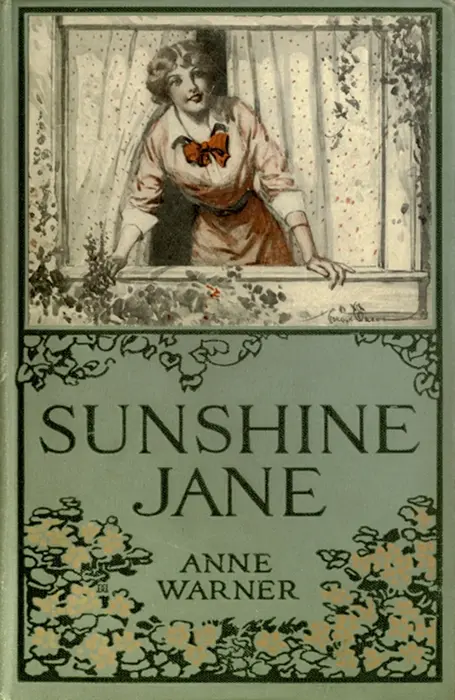
THE CLASSIC COLLECTION · 1913
"Sunshine Jane" by Anne Warner is a novel written in the early 20th century. The story revolves around a young nurse, Jane, who arrives in a small village to care for her invalid aunt, Susan, while Matilda, the other aunt, takes a much-needed vacation. The narrative hints at profound transformations both in Susan's life and in the village's dynamics as Jane's sunny disposition begins to challenge the status quo, introducing themes of optimism, healing, and personal growth. The opening of the novel introduces us to the village and its inhabitants, who are blissfully unaware of the significant changes brewing with Jane's arrival. As Jane travels to her aunt's home, we see glimpses of the somber, constricted lives of the villagers, particularly her aunts, whose perspectives on life are clouded by illness and dissatisfaction. Matilda, who has been an overbearing caretaker to Susan, is depicted as stern and controlling, while Susan's fragile self-worth is compounded by her dependency on Matilda. Jane's arrival is poised to disrupt this dynamic, as she embodies hope and the potential for joy, intent on making a positive impact during her stay. The reader gets a sense that this seemingly mundane setting is on the brink of change, propelled by Jane's vibrant spirit and the interwoven lives of the characters.
Introduction adapted from the source catalogue; source summaries may be automatically generated.
Free to read · English · 44,419 words · No account needed
MAKE TIME FOR A GOOD BOOK
On by default. Untick to stop anonymous reading totals. Each page counts after 10 seconds in view. How this works.
Anonymous counting is on unless you have switched it off.
AFTER dinner that day Emily Mead came with her work. Emily Mead was one of those nondescript girls who seem to spring up more and more thickly in these troublous, churned-up times of ours.
Too pretty to be plain, too unattractive to be beautiful. Too well-to-do to need to work, too poor to attain to anything for which she longed. Too clever to belong to her class, not clever enough to rise above it. Altogether a very fit subject for Jane to "sunshine," as her aunt put it.
"How do you get along with old Mrs. Croft?" she asked, directly she was
seated.
"She's asleep yet," Jane said; "she was so restless all night."
"She always sleeps days and is awake all night; didn't you know that before?" queried Emily, in surprise. "Some one ought to have told you."
"It doesn't matter," said Jane serenely. There was never any bravado in her serenity; it was quite sincere.
"That was what made Katie so mad," Emily continued. "She said it gave her her days, to be sure, but, as she couldn't very well sleep, too, all day, she never really had any time herself."
"We'll get along all right," said Jane quietly; "old people have ways, and then they change and have other ways, and the rest must expect to be considerate."
"Mercy on us, I wonder what she'll change to next," said Susan, with feeling. She had just returned from listening at the invalid's door.
"Don't worry, Auntie,--just remember!" Jane's smile was at once bright and also a bit admonitory.
"I'm trying to believe that everything's all right always, too," said Susan to Emily, "but, oh, my!"
They went out on the shady side of the house to where a little table stood, which was made out of a board nailed into a cut-off tree stump. Jane and Emily carried chairs, and Susan brought her darning basket. It was delightfully pleasant. From time to time Jane or her aunt slipped in and listened at the door, but old Mrs. Croft slept on like a baby.
"I do wonder if Katie Croft has really gone for good!" Emily said to Susan, while Jane was absent on one of these errands.
"I can't trust myself even with my own opinions," said Susan reservedly; "I haven't much time to get changed before Matilda comes, you know, and I want to believe in Jane's religion if I can. It's so kind of warm and comforting. I like it."
"Jane," Emily said, turning towards her when she returned, "I've come to-day on an awfully serious errand, and I want you to help me."
"I will certainly, if I can. What is it?"
Your reading position is saved on this browser. Take it to another device with a library code. Reading pages adapt to text, rather than matching a printed edition.
BEHIND THE BOOK
This eBook is for the use of anyone anywhere in the United States and most other parts of the world at no cost and with almost no restrictions whatsoever. You may copy it, give it away or re-use it under the terms of the Project Gutenberg License included with this eBook or online at www.gutenberg.org. If you are not located in the United States, you will have to check the laws of the country where you are located before using this eBook. Read the source licence.
The original source file, including credits and licence, is retained by this library. Request an original-format copy at no charge. Please include the book title and Project Gutenberg identifier #37972.
KEEP YOUR CURIOSITY GOING

David Patterson (Spirit) Hatch

David Patterson (Spirit) Hatch

David Patterson (Spirit) Hatch
Coulson Kernahan

Ralph Waldo Emerson

Maurice Baring