THE CLASSIC COLLECTION✦An outlaw’s diary: the CommuneCLASSIC FREE BOOKS
An outlaw’s diary: the Commune
Cécile Tormay
THE CLASSIC COLLECTION · 1888
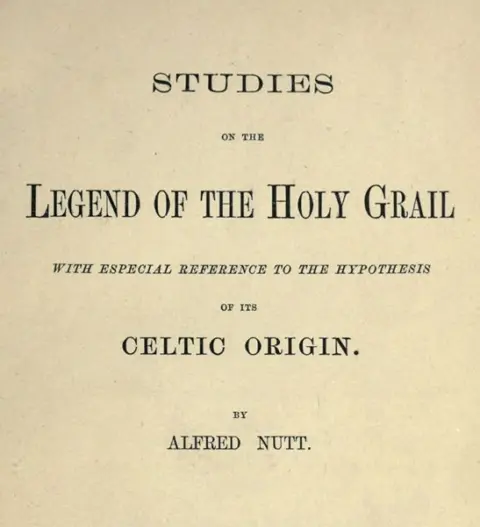
"Studies on the Legend of the Holy Grail" by Alfred Trübner Nutt is a scholarly publication written in the late 19th century. This work examines the various forms and origins of the Holy Grail legend, with a strong emphasis on its connections to Celtic traditions and influences. The book serves as both a study of the Grail Romance cycle and an investigation into the historical, literary, and mythical aspects of the legend. The opening of the scholarly work introduces the author’s intent to explore the different iterations of the Grail legend and their relationships to one another. It begins with a dedication to J. F. Campbell, highlighting the significance of Celtic tradition in Nutt's interpretation. The introduction outlines the structure of the studies, noting that the work does not aim for exhaustiveness but rather focuses on specific aspects of the Grail narrative. Nutt emphasizes the challenges historians face in tracing the origins of the Grail stories, navigating through various manuscripts and forms of the legend, while preparing to delve into the particulars of significant texts that have shaped the legend's evolution.
Introduction adapted from the source catalogue; source summaries may be automatically generated.
Free to read · English · 125,175 words · No account needed
MAKE TIME FOR A GOOD BOOK
On by default. Untick to stop anonymous reading totals. Each page counts after 10 seconds in view. How this works.
Anonymous counting is on unless you have switched it off.
The results of the investigation may be summed up as follows: the origin of the Grail romances must be sought for in a Christian legend based partly upon the canonical, partly upon the uncanonical, writings. This Christian legend was woven into the Breton sagas by the author of the oldest Grail romance; the theories of Provençal Spanish, or Celtic origin are equally untenable, nor is there any need to countenance the fable of a Latin original. Chronologically, the versions arrange themselves thus:--
(1) Between 1170 and 1190 (probably about 1183) Robert de Borron wrote his trilogy: Joseph of Arimathea--Merlin--Perceval. Sources: Christian legend (Acta, Pilati, Descensus Christi, Vindicta Salvatoris) and Breton sagas (Brut?). Here the Grail is simply a vessel of grace.
(2) About 1189 Chrestien began his Conte du Graal, the main source of which was the third part of Borron's poem. Marvellous food properties attributed to the Grail; introduction of the bleeding lance, silver dish, and magic sword.
(3) Between 1190 and 1200 Gautier de Doulens continued Chrestien's poem. Main sources, third part of (1) and first part of same for Early History--introduction of broken sword.
(4) Between 1190 and 1200 (but after Gautier?) the Queste du St. Graal written as continuation to the Lancelot. Sources (1) and (2) (for lance) and perhaps (3). New personages, Mordrain, Nascien, etc., introduced into Early History.
(5) Before 1204 Grand St. Graal written, mainly resting upon (4) but with use also of first part of (1).
(6) Between 1214 and 1220. Manessier's continuation of the Conte du Graal. For the Early History (5) made use of.
(7) Before 1225 Gerbert of Montreuil's additions to Manessier. Both
(4) and (5) used.
(8) About 1225 Perceval li Gallois; compiled from all the previous
versions.[68]
That part of Birch-Hirschfeld's theory which excited the most attention in Germany bore upon the relationship of Wolfram to Chrestien (see infra, Appendix A). In other respects his theory won very general acceptance. The commendatory notices were, however, of a slight character, and no new facts were adduced in support of his thesis. One opponent, however, he found who did more than rest his opposition upon the view of Wolfram's relationship to Chrestien. This was E. Martin, who ("Zeitschrift für d. Alterthumskunde," 1878, pp. 84 etc.) traversed most of Birch-Hirschfeld's conclusions. Whilst accepting the priority of Queste over Grand St. Graal he did not see the necessity of fixing 1204 as a terminus ad quem for the latter work as we now have it, as Helinandus' statement might have referred to an older version; if the Grand St. Graal could not be dated neither could the Queste. As for the Didot-Perceval there was nothing to prove that it was either Borron's work or the source of Chrestien and Gautier. Birch-Hirschfeld's arguments to show the interpolation of the lance passages were unsound; it was highly improbable either that Chrestien should have used the Perceval as alleged, or that Borron, the purely religious writer of the Joseph, should have changed his style so entirely in the Perceval. Moreover, Birch-Hirschfeld made Borron dedicate a work to Gautier of Montbeliard before 1183 when the latter must have been quite a young man, nor was there any reason to discredit Hélie de Borron's testimony that he and Robert had been companions in arms, a fact incredible had the one written forty years before the other. The work of Chrestien and his continuators must be looked upon as the oldest we had of the Grail cycle. It was likely that older versions had been lost. A Latin version might well have existed, forms such as Joseph de Barimaschie (i.e., ab Arimathea) pointed to it. Martin followed up this attack in his "Zur Gralsage, Untersuchungen," Strasburg, 1880. A first section is devoted to showing that Wolfram must have had other sources than Chrestien, and that in consequence such portions of his presentment as differ from Chrestien's must be taken into account in reconstructing the original form of the romance. The second and third sections deal with Heinrich von dem Türlin's "Die Crone," and with the earliest form of the tradition. Gawain's second visit to the Grail Castle, as told of by Heinrich (supra, p. 26) has features in common with the widely-spread traditions of aged men slumbering in caves or ruined castles, unable to die until the right word is uttered which breaks their spell. This conception differs from the one found in all the other versions inasmuch as in them the wonder-working question releases, not from unnaturally prolonged life, but from sore disease. Can a parallel be found in Celtic tradition to this sufferer awaiting deliverance? Does not Arthur, wounded well nigh to death by his nephew Modred, pass a charmed life in Avalon, whither Morgan la Fay carried him for his healing, and shall he not return thence to free his folk? The original conception is mythic--the summer god banished by the winter powers, but destined to come back again. The sage of Arthur's waiting, often in some subterranean castle, is widely spread, two of the earliest notices (those of Gervasius of Tilbury, in the "Otia Imperialia," p. 12 of Liebrecht's edition, and of Caesarius of Heisterbach) connect it with Etna--the tradition had followed the Norman Conquerors of Sicily thither--and from Sicily it would seem to have penetrated to Germany, being first found in German tradition as told of Frederick II. Again Gerald (A.D. 1188) in the "Itinerarium Cambriae" (Frankfort, 1603, p. 827, L. 48) tells of a mountain chain in the South-East of Wales: "quorum principalis Cadair Arthur dicitur i. Cathedra Arthuri, propter gemina promontorii cacumina in cathedrae modum se praeferentia. Et quoniam in alto cathedra et in ardua sita est, summo et maximo Britonum Regi Arthuro vulgari nuncupatione est assignata." The Eildon Hills may be noted in the same connection, "in which all the Arthurian chivalry await, in an enchanted sleep, the bugle blast of the adventurer who will call them at length to a new life" (Stuart Glennie, "Arthurian Localities," p. 60). If the Grail King is Arthur, the bleeding lance is evidently the weapon wherewith he was so sorely wounded. And the Grail? this is originally a symbol of plenty, of a joyous and bountiful life, hence of Avalon, that land of everlasting summer beyond the waves, wherein, as the Vita Merlini has it, they that visit Arthur find "planitiem omnibus deliciis plenam." Of those versions of the romance in which the Christian conception of the Grail is predominant, Robert de Borron's poem (composed about 1200) is the earliest, and in it, maugre the Christianising of the story, the Celtic basis is apparent: the Grail host go a questing Avalonwards; the first keepers are Brons and Alain, purely Celtic names, the former of which may be compared with Bran; the empty seat calls to mind the Eren stein in Ulrich von Zatzikhoven's Lanzelot, whereof (verse 5,178) ist gesaget daz er den man niht vertruoc an dem was valsch oder haz. Admitting the purely Christian origin of the Grail leads to this difficulty: the vessel in which Christ's blood was received was a bowl, not an open or flat dish like that used in commemoration of the Last Supper. Evidently the identification of the Grail with the Last Supper cup is the latest of a series of transformations. Nor can the Christian origin of the legend be held proved by the surname of Fisher given to the Grail-keeper. True, neither Chrestien nor Wolfram explains this surname, whilst in Borron's poem there is at least a fish caught. But if the fish had really the symbolic meaning ascribed to it would not a far greater stress be laid upon it? In any case this one point is insufficient to prove the priority of Borron, and it is simpler to believe that the surname of Fisher had in the original Celtic tradition a significance now lost. Birch-Hirschfeld's theory supposes, too, a development contrary to that observed elsewhere in mediæval tradition. The invariable course is from the racial-heathen to the Christian legendary stage. Is it likely that in the twelfth century, a period of such highly developed mystic fancy, an originally Christian legend should lose its mystic character and become a subject for minstrels to exercise their fancy upon? In the earlier form of the romance there is an obvious contrast between the task laid upon the Grail quester and that laid upon Gawain at Castle Marvellous. The first has suffered change by its association with Christian legend; but the second, even in those versions influenced by the legend, has retained its primitive Celtic character. The trials which Gawain has to undergo may be compared with those imposed on him who seeks to penetrate into the underworld, as pictured in the Purgatorium S. Patricii, in the Visio Tnugdali, etc. This agrees well with the presentment of Castle Marvellous, an underworld realm where dwell four queens long since vanished from Arthur's court, and which, according to Chrestien (verse 9,388), Gawain, having once found, may no longer leave. One of these queens is Arthur's mother, whom a magician had carried off, a variant it would seem of the tradition which makes Arthur's father, Uther, win Igerne from her husband by Merlin's magic aid. Many other reminiscences of Celtic tradition may be found in the romances--Orgeleuse, whom Gawain finds sitting under a tree by a spring, is just such a water fairy as may be met with throughout the whole range of Celtic folk-lore, and differs profoundly from the Germanic conception of such beings.
Your reading position is saved on this browser. Take it to another device with a library code. Reading pages adapt to text, rather than matching a printed edition.
BEHIND THE BOOK
This eBook is for the use of anyone anywhere in the United States and most other parts of the world at no cost and with almost no restrictions whatsoever. You may copy it, give it away or re-use it under the terms of the Project Gutenberg License included with this eBook or online at www.gutenberg.org. If you are not located in the United States, you will have to check the laws of the country where you are located before using this eBook. Read the source licence.
The original source file, including credits and licence, is retained by this library. Request an original-format copy at no charge. Please include the book title and Project Gutenberg identifier #42205.
KEEP YOUR CURIOSITY GOING
Cécile Tormay

Moritz Busch
John L. Ransom

Maurice Baring
Frances Wright
Cécile Tormay