THE CLASSIC COLLECTION✦An outlaw’s diary: the CommuneCLASSIC FREE BOOKS
An outlaw’s diary: the Commune
Cécile Tormay
THE CLASSIC COLLECTION · 1888
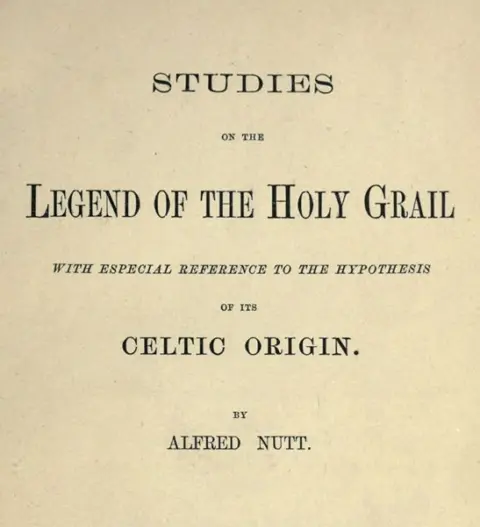
"Studies on the Legend of the Holy Grail" by Alfred Trübner Nutt is a scholarly publication written in the late 19th century. This work examines the various forms and origins of the Holy Grail legend, with a strong emphasis on its connections to Celtic traditions and influences. The book serves as both a study of the Grail Romance cycle and an investigation into the historical, literary, and mythical aspects of the legend. The opening of the scholarly work introduces the author’s intent to explore the different iterations of the Grail legend and their relationships to one another. It begins with a dedication to J. F. Campbell, highlighting the significance of Celtic tradition in Nutt's interpretation. The introduction outlines the structure of the studies, noting that the work does not aim for exhaustiveness but rather focuses on specific aspects of the Grail narrative. Nutt emphasizes the challenges historians face in tracing the origins of the Grail stories, navigating through various manuscripts and forms of the legend, while preparing to delve into the particulars of significant texts that have shaped the legend's evolution.
Introduction adapted from the source catalogue; source summaries may be automatically generated.
Free to read · English · 125,175 words · No account needed
MAKE TIME FOR A GOOD BOOK
On by default. Untick to stop anonymous reading totals. Each page counts after 10 seconds in view. How this works.
Anonymous counting is on unless you have switched it off.
The question as to the authorship of the Grand St. Graal and the Queste, the latter so confidently attributed to W. Map, may now profitably be investigated. Map, who we know flourished 1143-1210 (see supra, p. 5), took part in all the political and social movements of his time. If we believe the testimony of the MSS. which ascribe to him the authorship of the following romances: (1) the Lancelot, in three parts; (2) the Queste; (3) the Mort Artur; (4) the Grand St. Graal, he would seem to have shown a literary activity quite incompatible with his busy life, when it is remembered how slow literary composition was in those days. Nor can it be reconciled with the words of Giraldus Cambrensis,[65] although Paulin Paris (Rom. i. 472) has attempted such a reconciliation by the theory that the words dicere and verba dare referred to composition in the vernacular, and that Map was opposing not his oratorical to Gerald's literary activity, but his French to Gerald's Latin works. Against this initial improbability and Gerald's positive testimony must be set, it is true, the witness of writers of the time and of the MSS. The most important is that of Hélie de Borron in his prologue to Guiron le Courtois.[66] After telling how Luces de Gast was the first to translate from the Latin book into French, and he did part of the story of Tristan, he goes on: "Apriés s'en entremist maistre Gautiers Map qui fu clers au roi Henry et devisa cil l'estoire de monseigneur Lancelot du Lac, que d'autre chose ne parla il mie gramment en son livre. Messiers Robers de Borron s'en entremist après. Je Helis de Borron, par la prière monseigneur de Borron, et pour ce que compaignon d'armes fusmes longement, en commençai mon livre du Bret." Again in the epilogue to the Bret,[67] "Je croi bien touchier sor les livres que maistres Gautiers Maup fist, qui fit lou propre livre de monsoingnour Lancelot dou Lac; et des autres granz livres que messires Robert de Berron fit, voudrai-je prendre aucune flor de la matière ... en tel meniere que li livres de monsoingnour Luces de Gant et de maistre Gautier Maapp et ciz de monsoingnour Robert de Berron qui est mes amis et mes paranz charnex s'acourderont au miens livres--et je qui sui appelex Helyes de Berron qui fui engendrez dou sanc des gentix paladins des Barres qui de tous tens ont été commendeour et soingnor d'Outres en Roménie qui ores est appelée France." Now Hélie cannot possibly belong to the reign of Henry II (+ 1189) as asserted by Hucher (p. 59), as he speaks of Map in the past tense (fu clers), and Map outlived Henry, moreover the mention of Romenie proves the passage to have been written after the foundation of the Latin Empire in 1304. Hélie's testimony is thus not that of an immediate contemporary, and it only shows that shortly after Map's death the Lancelot was ascribed to him. It is, moreover, in so far tainted, that he speaks with equal assurance respecting the great Latin book which of course never existed; nor can we believe him when he says that he was the comrade of Robert de Borron, as this latter wrote before Chrestien, and must have been at least thirty years older than Hélie, who in the Guiron (written about 1220) calls himself a young man. How is it with the testimony of the MSS.? Those of the Lancelot have unfortunately lost their colophon, owing to the Queste being almost invariably added; those of the Queste show as a rule a colophon such as the one quoted by Paulin Paris from the Bibl. Nat., MS. 6,963 (MSS. Franç II., p. 361): "Maistre Gautiers Map les estrait pour son livre faire dou Saint-Graal, pour l'amor del roy Henri son seignor, qui fist l'estore translater dou latin en françois." A similar statement occurs in a MS. of the Mort Artur (Bib. Nat. 6,782.). Both are equally credible. Now as the King can only be Henry II (+ 1189) and as the Queste preceded the Mort Artur it must be put about 1185, and Chrestien's Conte du Graal about 1180, an improbably early date when it is recollected that the Conte du Graal is Chrestien's last work. The form, too, of these colophons, expressed as they are in the third person, so different from the garrulous first person complacency with which Luces de Gast and Hélie de Borron announce their authorship, excites the suspicion that we have here not the author's own statement, but that of a copyist following a traditional ascription. Whether or no Map wrote the Lancelot, it may safely be assumed that he did not write the Queste, or a fortiori the Grand St. Graal. The tradition as to his authorship of these romances may have originated in Geoffrey's mention of the Gualterus archidiaconus Oxenfordensis, to whom he owed his MS. of the Historia Regum Britanniae. A similar instance of traditional ascription on the part of the copyist may be noted in the MSS. of the Grand St. Graal, the author of which is declared to be Robert de Borron. The ordinary formulæ (quoted supra, p. 5) should be compared with Borron's own words in the Joseph (supra, p. 5) and the difference in form noted. What proves these passages to be interpolations is that the author of the Grand St. Graal especially declares in his prologue that his name must remain a secret. The colophons in question are simply to be looked upon as taken over from the genuine ascription of Borron's poem, and there is no positive evidence as to the authorship of either the Queste or the Grand St. Graal; both works are probably French in origin, as is shown by the mention of Meaux in the Grand St. Graal. As for the date of Borron's poem, a terminus ad quem is fixed by that of the Conte du Graal (1180); and as the poem is dedicated to Gautier of Montbeliard, who can hardly have been born before 1150, and who must have attained a certain age before he could become Robert's patron, it must fall between the years 1170 and 1190.
Your reading position is saved on this browser. Take it to another device with a library code. Reading pages adapt to text, rather than matching a printed edition.
BEHIND THE BOOK
This eBook is for the use of anyone anywhere in the United States and most other parts of the world at no cost and with almost no restrictions whatsoever. You may copy it, give it away or re-use it under the terms of the Project Gutenberg License included with this eBook or online at www.gutenberg.org. If you are not located in the United States, you will have to check the laws of the country where you are located before using this eBook. Read the source licence.
The original source file, including credits and licence, is retained by this library. Request an original-format copy at no charge. Please include the book title and Project Gutenberg identifier #42205.
KEEP YOUR CURIOSITY GOING
Cécile Tormay

Moritz Busch
John L. Ransom

Maurice Baring
Frances Wright
Cécile Tormay