THE CLASSIC COLLECTION✦An outlaw’s diary: the CommuneCLASSIC FREE BOOKS
An outlaw’s diary: the Commune
Cécile Tormay
THE CLASSIC COLLECTION · 1888
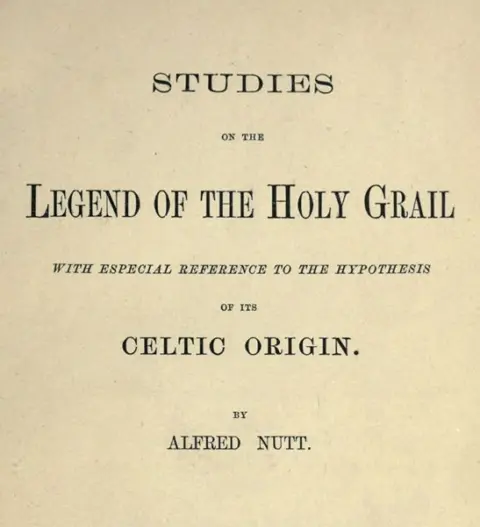
"Studies on the Legend of the Holy Grail" by Alfred Trübner Nutt is a scholarly publication written in the late 19th century. This work examines the various forms and origins of the Holy Grail legend, with a strong emphasis on its connections to Celtic traditions and influences. The book serves as both a study of the Grail Romance cycle and an investigation into the historical, literary, and mythical aspects of the legend. The opening of the scholarly work introduces the author’s intent to explore the different iterations of the Grail legend and their relationships to one another. It begins with a dedication to J. F. Campbell, highlighting the significance of Celtic tradition in Nutt's interpretation. The introduction outlines the structure of the studies, noting that the work does not aim for exhaustiveness but rather focuses on specific aspects of the Grail narrative. Nutt emphasizes the challenges historians face in tracing the origins of the Grail stories, navigating through various manuscripts and forms of the legend, while preparing to delve into the particulars of significant texts that have shaped the legend's evolution.
Introduction adapted from the source catalogue; source summaries may be automatically generated.
Free to read · English · 125,175 words · No account needed
MAKE TIME FOR A GOOD BOOK
On by default. Untick to stop anonymous reading totals. Each page counts after 10 seconds in view. How this works.
Anonymous counting is on unless you have switched it off.
Chrestien's work, which ended at v. 10,601, may be dated as having been begun not later than 1189 (vide supra, p. 4). Its unfinished state accounts for its having so little positive information about the Grail, as Chrestien evidently meant to reserve this information for the end of the story. But this very freedom with which the subject is handled is a proof that he had before him a work whence he could extract and adapt as he saw fit; moreover we have (Prologue, v. 475, etc.) his own words to that effect. With Chrestien's account of the Grail--a bowl bejewelled, of wondrous properties, borne by a maiden, preceded by a bleeding lance, accompanied by a silver plate, guarded by a king wounded through both ankles (whose only solace is fishing, whence his surname), ministering to the king's father, sought for by Perceval, nephew to the fisher king, its fate bound up with a question which the seeker must put concerning it--may be compared that of the Queste, in which nothing is known of a question by which the Grail kingship may be obtained (although it relates the same incident of Lancelot), which knows not of one wounded king, centre of the action, but of two, both of secondary importance (though possibly Chrestien's Fisher King's father may have given the hint for Mordrain), in which the lance is of minor importance instead of being on the same level as the Grail. Is it not evident that the Queste took over these features from Chrestien, compelled thereto by the celebrity of the latter's presentment? The Queste thus presupposes the following works: a Lancelot, an Early History, a Quest other than that of Chrestien's, and finally Chrestien as the lame king and lance features show. It thus falls between 1189 (Chrestien begun) and 1204 (Grand St. Graal ended).
With respect to the three continuators of Chrestien it would seem that Gautier de Doulens' account of the Grail, as found in the Montpellier MS., knowing as it does only of Joseph, and making the Fisher King and Perceval descendants of his, belongs to an older stage of development than that of Manessier and Gerbert, both of whom are familiar with the Mordrain group, and follows that of the original version upon which both the Queste and the Grand St. Graal are based. There is nothing to show that Gautier knew of the Queste, whilst from Gautier the Queste may have possibly have taken Perceval's sister and the broken sword. Gautier would thus seem to have written immediately after Chrestien, and before the Queste, i.e., about 1195. As for the date of the other two continuators, the fact of their having used the Queste is only one proof of the lateness of their composition (as to the date of which see supra, p. 4). It must be noted that whilst in their account of the Grail Chrestien's continuators are in substantial accord with the Queste versions, and yet do not contradict Chrestien himself, they add considerably to his account of the lance. This is readily explained by the fact that as Chrestien gave no information respecting the origin of either of the relics, they, the continuators, had to seek such information elsewhere; they found all they could wish respecting the Grail, but nothing as to the lance, the latter having been first introduced by Chrestien, and the Queste versions knowing nothing respecting it beyond what he told. Thus, thrown upon their own resources, they hit upon the device of identifying the lance with the spear with which Jesus was pierced as He hung on the Cross. This idea, a most natural one, may possibly have been in Chrestien's intent, and may have been suggested to him by the story of the discovery of the Holy Lance in Antioch half a century before. It must, however, be admitted that the connection of the lance with the Grail legend in its earliest form is very doubtful, and that Celtic legends may possibly have furnished it to Chrestien, and indicated the use to which he intended putting it. The analysis, so far, of the romances has resulted in the presupposition of an earlier form; this earlier form, the source or basis of all the later versions of the legend, exists in the so-called Petit St. Graal of Robert de Borron. Of this work, found in two forms, a prose and a poetic one, the poetic form, pace Hucher, is obviously the older, Hucher's proofs of lateness going merely to show that the sole existing MS. is a recent one, and has admitted new speech-forms;[62] moreover the prose versions derive evidently from one original. The greater simplicity of the poem as compared with the Grand St. Graal proves its anteriority in that case; Paulin Paris' hypothesis that the poem in its present state is a second draft, composed after the author had made acquaintance with the Grand St. Graal, is untenable, the poem's reference (v. 929 etc.) to the "grant livre" and to the "grant estoire dou Graal," written by "nul home qui fust mortal" (v. 3,495-6) not being to the Grand St. Graal, but having, on the contrary, probably suggested to the writer of the latter his fiction of Christ's being the real author of his work. The Grand St. Graal used the poem conjointly with the Queste, piecing out the one version by help of the other, and thereby entirely missing the sequence of ideas in the poem, which is as follows: Sin, the cause of want among the people; the separation of the pure from the impure by means of the fish (symbol of Christ) caught by Brons, which fish does not feed the people, but, in conjunction with the Grail, severs the true from the false disciples; punishment of the self-willed false disciple; reward of Brons by charge of the Grail. In the Grand St. Graal, on the contrary, the fish is no symbol, but actual food, a variation which must be laid to the account of the Queste. In a similar way the two Alains in the Grand St. Graal may be accounted for, the one as derived from the poem, the second from the Queste. As far as conception is concerned, the later work is no advance upon the earlier one. To return to Borron's work, which consists of three sections; there is no reason to doubt his authorship of the second, Merlin, or of the third, Perceval, although one MS. only of the former mentions the fact, and it is, moreover, frequently found in connection with other romances, in especial with the Lancelot; as for Perceval, the silence of the unique MS. as to Borron is no argument, as it is equally silent in the Joseph of Arimathea section. All outward circumstances go to show that Borron divided his work into three parts, Joseph, Merlin, Perceval. But, if so, the last part must correspond in a fair measure to the first one; recollect, however, that we are dealing with a poet of but little invention or power of giving unity to discordant themes, and must not expect to find a clearly traced plan carried out in every detail. Thus the author's promise in Joseph to speak later of Moses and Petrus seems not to be fulfilled, but this is due to Borron's timidity in the invention of new details. What is said of Moses does not disagree with the Joseph, whereas a later writer would probably follow the Grand St. Graal account; as for Petrus he is to be recognised in the hermit Perceval's uncle. There may be some inconsistency here, but Borron can be inconsistent, as is shown by his treatment of Alain, who at first vows to remain virgin, and afterwards marries. But a graver argument remains to be met; the lance occurs in Perceval--now ex hypothesi the first introduction of the lance is due to Chrestien. The lance, however, only occurs in two passages, both obviously interpolated. The identity of authorship is evident when the style and phraseology of the two works are compared; in both the Grail is always li graaux or else li veissel, not as with the later versions, li saint graaux; both speak of la grace dou graal; in both the Grail is bailli to its keeper, who has it en guarde; the empty seat is li liu vit, not the siège perilleux. The central conception, too, is the same--the Trinity of Grail-keepers symbolising the Divine Trinity. The secret words given by Christ with the Grail to Joseph in prison, by him handed on to Brons, are confided at the end of the Perceval by Brons to the hero--and there is no trace of the Galahad form of the Quest, as would inevitably have been the case had the Perceval been posterior in date to the Queste. As the Perceval is connected with the Joseph, so it is equally with the Merlin; it is remarkable that neither Merlin nor Blaise play a prominent part in the Queste versions, but in Borron's poem Merlin is the necessary binding link between the Apostolic and Arthurian ages. Again the whole character of the Perceval speaks for its being one of the earliest works of the cycle; either it must have used Chrestien and Gautier or they it; if the former, is it credible that just those adventures which were necessary to supply the ending to the Joseph could have been picked out? But it is easy to follow the way in which Chrestien used the Perceval; having the three-part poem before him he took the third only for his canvas, left out all that in it related to the first two parts, all, moreover, that related to the origin and early history of the Grail; the story of the childhood is half indicated in the Perceval, and Chrestien may have had Breton lays with which to help himself out; all relating to the empty seat is left out as reaching back into the Early History; the visit to Gurnemanz is introduced to supply a motive for the hero's conduct at the Grail Castle; the wound of the Fisher King is again only an attempt of Chrestien's to supply a more telling motive; as for the sword Chrestien invented it; as he also did the Grail-messenger, whose portrait he copied from that of Rosette la Blonde. The order of the last episodes is altered by Chrestien sensibly for the better, as, with him, Perceval's doubt comes first, then the Good Friday reproof, then the confession to and absolution by the hermit; whereas in the Perceval the hero after doubt, reproof, and absolution rides off again a-tourneying, and requires a second reproof at Merlin's hands. It is easy to see here which is the original, which the copy. Chrestien thus took with clear insight just what he wanted in the Perceval to fit out his two heroes with adventures.[63] As for Borron's guiding conception, his resolve to have nothing to do with the Early History made him neglect it entirely; he only cared to produce a knightly poem, and we find, in consequence, that he has materialised all the spiritual elements of his model. Gautier de Doulens' method of proceeding was much simpler: he took over all those adventures that Chrestien purposely left out, and they may be found brought together (verses 22,390-27,390) with but few episodes (Perceval's visit to Blanchefleur, etc.) entirely foreign to the model amongst them.[64] The Perceval cannot be later than Gautier, as otherwise it could not stand in such close relationship to the Joseph and Merlin; it must, therefore, be the source of the Conte du Graal, and a necessary part of Borron's poem, which in its entirety is the first attempt to bring the Joseph of Arimathea legend into connection with the Arthur sage. The question as to the origin of the Grail would thus seem answered, the Christian legendary character of Borron's conception being evident; but there still remains the possibility that that conception is but the Christianised form of an older folk-myth. Such a one has been sought for in Celtic tradition. The part played by Merlin in the trilogy might seem to lend colour to such an hypothesis, but his connection with the legend is a purely artificial one. Nor is the theory of a Celtic origin strengthened by reference to the Mabinogi of Peredur. This knows nought of Merlin, and is nearer to Chrestien than to the Didot-Perceval, and may, indeed, be looked upon as simply a clumsy retelling of the Conte du Graal with numerous additions. A knowledge of the Didot-Perceval on Chrestien's part must be presupposed, as where could he have got the Fisher King and Grail Castle save from a poem which dealt with the Early History of the Grail, a thing the Mabinogi does not do. But, it may be said, Chrestien used the Mabinogi conjointly with Borron's poem. That the Welsh tale is, on the contrary, only a copy is apparent from the following considerations:--It mixes up Gurnemanz and the Fisher King; it puts in the mouth of Peredur's mother an exclamation about the knights, "Angels they are my son," obviously misread from Perceval's exclamation to the same effect in Chrestien's poem; Perceval's love-trance over the three blood drops in the snow is explained in Chrestien by the hero's passion for Blanchefleur, but is quite inexplicable in the Mabinogi; again, in the Welsh tale, the lance and basin episode is quite a secondary one, a fact easily explained if it is looked upon as a vague reminiscence of Chrestien's unfinished work; moreover the Mabinogi lays great stress upon the lance, which has already been shown to belong to a secondary stage in the development of the legend. Again the word Graal occurs frequently in old Welsh literature, and invariably in its French form, never translated by any equivalent Welsh term. As for the name Peredur, it is understandable that the Welsh storyteller should choose the name of a national hero, instead of the foreign name Perceval; the etymology Basin-Seeker is untenable. There is no real analogy between the Grail and the magic cauldron of Celtic fable, which is essentially one of renovation, whereas the Grail in the second stage only acquires miraculous feeding, and in the third stage healing powers. It is of course not impossible that such adventures in the Mabinogi, as cannot be referred directly to Chrestien, may belong to a genuine Peredur sage.
Your reading position is saved on this browser. Take it to another device with a library code. Reading pages adapt to text, rather than matching a printed edition.
BEHIND THE BOOK
This eBook is for the use of anyone anywhere in the United States and most other parts of the world at no cost and with almost no restrictions whatsoever. You may copy it, give it away or re-use it under the terms of the Project Gutenberg License included with this eBook or online at www.gutenberg.org. If you are not located in the United States, you will have to check the laws of the country where you are located before using this eBook. Read the source licence.
The original source file, including credits and licence, is retained by this library. Request an original-format copy at no charge. Please include the book title and Project Gutenberg identifier #42205.
KEEP YOUR CURIOSITY GOING
Cécile Tormay

Moritz Busch
John L. Ransom

Maurice Baring
Frances Wright
Cécile Tormay