THE CLASSIC COLLECTION✦An outlaw’s diary: the CommuneCLASSIC FREE BOOKS
An outlaw’s diary: the Commune
Cécile Tormay
THE CLASSIC COLLECTION · 1888
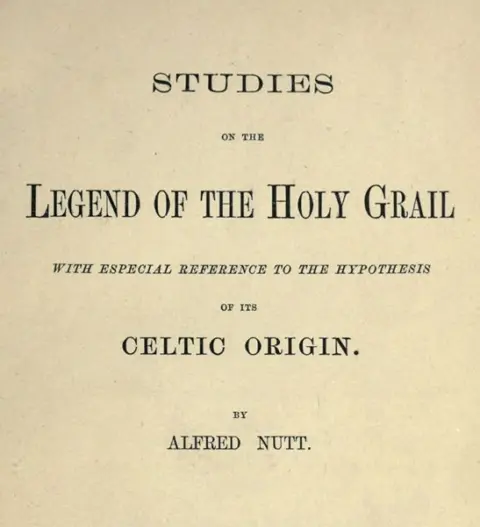
"Studies on the Legend of the Holy Grail" by Alfred Trübner Nutt is a scholarly publication written in the late 19th century. This work examines the various forms and origins of the Holy Grail legend, with a strong emphasis on its connections to Celtic traditions and influences. The book serves as both a study of the Grail Romance cycle and an investigation into the historical, literary, and mythical aspects of the legend. The opening of the scholarly work introduces the author’s intent to explore the different iterations of the Grail legend and their relationships to one another. It begins with a dedication to J. F. Campbell, highlighting the significance of Celtic tradition in Nutt's interpretation. The introduction outlines the structure of the studies, noting that the work does not aim for exhaustiveness but rather focuses on specific aspects of the Grail narrative. Nutt emphasizes the challenges historians face in tracing the origins of the Grail stories, navigating through various manuscripts and forms of the legend, while preparing to delve into the particulars of significant texts that have shaped the legend's evolution.
Introduction adapted from the source catalogue; source summaries may be automatically generated.
Free to read · English · 125,175 words · No account needed
MAKE TIME FOR A GOOD BOOK
On by default. Untick to stop anonymous reading totals. Each page counts after 10 seconds in view. How this works.
Anonymous counting is on unless you have switched it off.
Zarncke's acute article was a praiseworthy attempt to construct a working hypothesis of the growth of the cycle. But it is full of grave misconceptions, as was, perhaps, inevitable in a hasty survey of such an immense body of literature. The versions are "placed" most incorrectly. The argumentation is frequently marred by a priori reasoning, such as that Chrestien, the acknowledged leading poet of the day, could not have copied Kiot, and by untenable assertions, such as that Bran, in the Mabinogi of Branwen, the daughter of Llyr, is perhaps a distant echo of Hebron in Robert de Borron's poem. He had, however, the great merit of clearing the ground for his pupil, A. Birch-Hirschfeld, and urging him to undertake what still remains the most searching and exhaustive survey of the whole cycle: "Die Sage vom Gral," etc. As Birch-Hirschfeld's analysis is at present the only basis for sound criticism, I shall give his views fully:--The Grand St. Graal, as the fullest of the versions dealing with the Early History of the Grail, is the best starting-point for investigation. From its pronounced religious tone monkish authorship may be inferred. Its treatment of the subject is not original as is shown by (1) the repetition ad nauseam of the same motive (e.g., that of the lance wound four times), (2) the pedigrees, (3) the allusions to adventures not dealt with in the book, and in especial to the Promised Knight. The testimony of Helinand (see supra, p. 52), which is of first-rate importance, does not allow of a later date for the Grand St. Graal than 1204. On turning to the Queste it is remarkable that though sometimes found in the MSS. in conjunction with the Grand St. Graal it is also found with the Lancelot, and, when the hero's parentage is considered, it seems more likely that it was written to supplement the latter than the former work. This supposition is adverse to any claim it may lay to being held the earliest treatment of the subject, as it is highly improbable that the Grail legend occupied at the outset such an important place in the Arthurian romance as is thus accorded to it. Such a claim is further negatived by the fact that the Queste has three heroes, the second of whom is obviously the original one of an older version. In estimating the relationship between the Grand St. Graal and the Queste it should be borne in mind that the latter, in so far as it deals with the Early History, mentions only Joseph, Josephe, Evelach (Mordrain) and Seraphe (Nascien), from whom descends Galahad; that it brings Joseph to England, and that it does not give any explanation of the nature of the Grail itself. It omits Brons, Alain, the explanation of the name "rich fisherman," the name of Moys, although his story is found in substantially the same shape as in the Grand St. Graal, and is silent as to the origin of the bleeding lance. If it were younger than and derived from the Grand St. Graal alone, these points, all more important for the Early History than the Mordrain episodes would surely have been dwelt upon. But then if the Grand St. Graal is the younger work, whence does it derive Brons, Alain, and Petrus, all of whom are introduced in such a casual way? There was obviously a previous Early History which knew nothing of Josephe or of Mordrain and his group, the invention of the author of the Queste, whence they passed into the Grand St. Graal, and were fused in with the older form of the legend. There is, moreover, a positive reference on the part of the Grand St. Graal to the Queste (vol. ii., p. 225). The author of the Queste introduced his new personages for the following reasons: He had already substituted Galahad for the original hero, and to enhance his importance gives him a fictitious descent from a companion of Joseph. From his model he learnt of Joseph's wanderings in the East, hence the Eastern origin of the Mordrain group. In the older form the Grail had passed into the keeping of Joseph's nephew, in the Queste the Promised Knight descends from the nephew of Mordrain; Brons, as the ancestor of the original Quest hero necessarily disappears in the Queste, and his place is in large measure taken by Josephe. The priority of the Queste over the Grand St. Graal, and the use of the former by the latter may thus be looked upon as certain. But if Mordrain is the invention of the Queste, what is the meaning of his illness, of his waiting for the Promised Knight, of the bleeding lance, and of the lame king whom it heals? These seem to have no real connection with the Grail, and are apparently derived from an older work, namely, Chrestien's Conte du Graal.
Your reading position is saved on this browser. Take it to another device with a library code. Reading pages adapt to text, rather than matching a printed edition.
BEHIND THE BOOK
This eBook is for the use of anyone anywhere in the United States and most other parts of the world at no cost and with almost no restrictions whatsoever. You may copy it, give it away or re-use it under the terms of the Project Gutenberg License included with this eBook or online at www.gutenberg.org. If you are not located in the United States, you will have to check the laws of the country where you are located before using this eBook. Read the source licence.
The original source file, including credits and licence, is retained by this library. Request an original-format copy at no charge. Please include the book title and Project Gutenberg identifier #42205.
KEEP YOUR CURIOSITY GOING
Cécile Tormay

Moritz Busch
John L. Ransom

Maurice Baring
Frances Wright
Cécile Tormay