READ · DISCOVER · ENJOYClassic literature · Always free
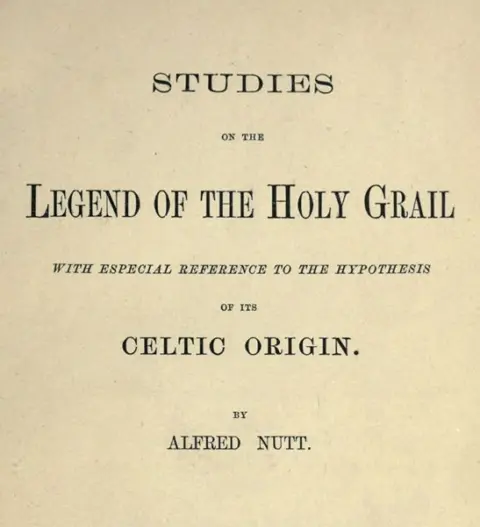
Studies on the Legend of the Holy Grail With Especial Reference to the Hypothesis of Its Celtic Origin — digital edition cover

THE CLASSIC COLLECTION · 1888

Studies on the Legend of the Holy Grail With Especial Reference to the Hypothesis of Its Celtic Origin

"Studies on the Legend of the Holy Grail" by Alfred Trübner Nutt is a scholarly publication written in the late 19th century. This work examines the various forms and origins of the Holy Grail legend, with a strong emphasis on its connections to Celtic traditions and influences. The book serves as both a study of the Grail Romance cycle and an investigation into the historical, literary, and mythical aspects of the legend. The opening of the scholarly work introduces the author’s intent to explore the different iterations of the Grail legend and their relationships to one another. It begins with a dedication to J. F. Campbell, highlighting the significance of Celtic tradition in Nutt's interpretation. The introduction outlines the structure of the studies, noting that the work does not aim for exhaustiveness but rather focuses on specific aspects of the Grail narrative. Nutt emphasizes the challenges historians face in tracing the origins of the Grail stories, navigating through various manuscripts and forms of the legend, while preparing to delve into the particulars of significant texts that have shaped the legend's evolution.

Introduction adapted from the source catalogue; source summaries may be automatically generated.

Start reading ↓

Free to read · English · 125,175 words · No account needed

MAKE TIME FOR A GOOD BOOK

Studies on the Legend of the Holy Grail With Especial Reference to the Hypothesis of Its Celtic Origin

On by default. Untick to stop anonymous reading totals. Each page counts after 10 seconds in view. How this works.

Anonymous counting is on unless you have switched it off.

Studies on the Legend of the Holy Grail With Especial Reference to the Hypothesis of Its Celtic Origin

(d) GERBERT.--(According to Birch Hirschfeld interpolated between Gautier and Manessier, and joining on therefore to the last incident in Gautier.)[12]

(1) Perceval's sin in having indirectly caused the death of his mother disables him from making whole the broken sword, and he must set forth again in search of the Grail. In the night he dreams a danger threatens his sister, and on the morrow he wakes up in open field, the Grail Castle having vanished. (2) He comes to a fair castle in the midst of a meadow, and, finding the door shut, knocks at it with his sword till the latter breaks. An old man appears, and tells him the broken sword will cost him seven years more wanderings until he come again to the Grail Castle. All he can do for Perceval is to give him a letter which heals the wounded and makes the wearer invincible. (3) Perceval riding thence through country that the day before was waste and folkless, finds it now well cultivated and peopled; all press round him and bless him for the change wrought by his asking concerning the Grail. (4) He comes to a castle wherein is a forge guarded by two serpents, and on it was a sword forged for a year, and it might not be broken, save in a certain danger, or mended save at the same forge. Perceval, after resisting the devil in the shape of a fair maid, attacks and overcomes the two serpents, and has his sword mended by the blacksmith, who tells him how he broke it at the gate of Paradise. (5) After making whole by his letter two knights of the Round Table who had lost their wits in Castle Dolorous, Perceval comes to Carlion, to Arthur's court, and accomplishes the adventure of the Perillous Seat which a fairy had sent to Arthur. Only the destined Grail-finder might sit in it. Six knights who had previously essayed the feat had been swallowed up by the earth; they reappear when Perceval is successful. (6) Perceval is called away from the court by a forsaken damsel, whose false lover he compels to marry her; then, after overcoming fresh temptation in damsel-shape, he comes to his sister's castle, overcomes her adversary, who turns out to be Mordret, and reaches the Castle of Maidens, where he is healed of his wounds by the lady of the castle, his cousin. She tells him of his mother, Philosofine, and how the Grail was taken from the ken of man owing to the sinfulness of the world. Perceval leaves his sister in this castle where dames are chaste and damsels maids. (7) Returning to court, whither Mordret had preceded him in sorry plight, Perceval is mocked at by Kex, whom he overcomes, and afterwards meets Gauvain and Tristan. (8) Leaving the court, he meets with four knights carrying their father, mortally wounded, accompanies them to their castle, recognises in the wounded knight, Gornumant, who had knighted him, swears to avenge him, tells all that has befallen himself, and learns that the cause of his successive failures is his forsaking his betrothed, Blanchefleur, whom he knows to be Gornumant's niece. He is told that if he listen heedfully to mass and marry the damsel all will be well, and he will learn the secrets of lance and Grail. But first Perceval overcomes a hideous hag, who by night brings to life Gornumant's enemies slain during the day. She has a potion, whereof Christ made use in the sepulchre, and with it she quickens the dead. She recognizes Perceval and acknowledges him as her conqueror, yet while she lives he shall know nought of the Grail; she works by order of the King of the Waste City, who hates all Christian folk. Perceval tries the virtue of the potion on the most valiant of his enemies, with whom he engages in a fresh and desperate struggle, heals Gornumant with it, and sets off to marry Blanchefleur, as he is wishful to live cleanly and fly deadly sin. (9) She is overjoyed at his arrival; preparations are made for the marriage; the night before, she comes to his bedside in smock and mantle, and they pass the night side by side, but with the sheet between them. The wedding follows, and then, fearful of losing the heavenly joy for sake of carnal longing, they resolve to resist the devil and live virgin-wise, for virginity surpasseth aught else, even as the topaz does crystal. Perceval, in a dream, is assured that of his seed shall be the Swan Knight and the deliverer of the Holy Sepulchre. Meanwhile he is still to search after lance and Grail. (10) On the morrow he quits Blanchefleur, "maid she laid her to bed, maid she arose;" frees a maiden pursued by a brutal knight; (11) comes to a castle where the wayfarer must first fight against four knights and then against the lord of the castle; does away with this custom; (12) comes to cross roads, whereof one is safe and easy, the other adventurous and full of danger; meets a knight all on fire; sees two hermits, one kneeling at a cross, the other scourging it; then a wonderful beast, a doe followed by fawns, which assail and devour her; (13) is presented at a hermit's with a shield none but the Grail-winner may wear, after which the table heretofore meanly spread is covered with rich fare, and learns the meaning of the mystic scenes he has witnessed. (14) He is summoned by a damsel, who tells him of the Dragon King, lord of a heathen folk dwelling in mid-sea, possessor of a shield whereon is painted a dragon that belches forth flame. Perceval sets forth to attack him, resists the devil who dwells in the dragon head, thanks to his miraculous shield whereon the cross is painted, and forces him to flee; continues the fight against the Dragon Knight without his shield, and slays him, but not till he has repented him of his sins. (15) Meanwhile a thief has made off with the shield, in pursuing whom Perceval comes to an abbey, where he learns the story of Joseph of Arimathea. Some forty years after the Crucifixion lived a heathen king, Evelac, in Sarras, wherefrom the Saracens have their name, sore pressed by Tholomes, King of Syria. But Joseph of Barimaschie, who had been five years in Pilate's service, comes to him, and with him his brother-in-law, Seraphe; he promised the King victory if he would let himself be baptized. The King consented, and received the name of Mordrach. Joseph then came to this land, and with him sixty folk and two fair ladies, whereof the one, Philosophine, bore a plate, the other an ever-bleeding lance, whilst Joseph had a vessel, never saw man a fairer one. But King Crudel flung Joseph and his companions into prison, where they dwelt forty days, but it harmed them not, as through the Holy Grail they were filled with great plenty and had every wish fulfilled. Now, Mordrains, learning this, brought together a great host, invaded King Crudel's lands, attacked and slew him. Mordrains, disarming, was found to be covered with wounds, none of which he had felt. On the morrow Joseph put up a table, altar-wise, and thereon laid the Grail, which Mordrains seeing, pressed near to. But an angel with a fiery sword kept him back, and a voice assured him he had laid such a burden on his shoulders as he might not pass away, nor would his wounds be healed until should come the true knight, loved of Christ, sinless, and in his arms he, Mordrains, should die. And till then the Host should be his only food. Since then three hundred years have passed, and the monks have heard that the knight is in the land who shall ask concerning lance and Grail, and thereby heal the king. (16) Perceval leaves on the morrow and comes to a castle wherein is a coffin, brought thereto in a boat drawn by a swan; none save the best knight in the world may open it. All have tried, even Gauvain, and failed. Perceval succeeds, and finds in the coffin the body of a knight, former lord of the castle, and a letter setting forth that he who should open the coffin was his murderer. Perceval, attacked in consequence by the dead man's sons, defends himself by making a buttress of the youngest son's body. Afterwards he overcomes the folk of the castle, and delivers Gauvain, held prisoner therein. (17) Perceval, after confessing his sins to a hermit, has an adventure with the devil, who comes out of a tomb, but whom he forces back therein. (18) He then succours a maiden whom her jealous lover has thrown into a fountain; (19) punishes a damsel who tempts him in traitrous-wise; (20) meets with and is sore pressed by a giant, whom he overcomes; (21) has a fresh and victorious encounter with Kex, and, finally, (22) arrives at crossways, is directed by the cross to the Fisher King's court, reaches it, asks straightway for the Grail, is questioned by the King and relates his allegorical adventures. At table the Grail appears, followed by lance and sword. Perceval pieces together the sword, and the King, full of joy, embraces him.

Your reading position is saved on this browser. Take it to another device with a library code. Reading pages adapt to text, rather than matching a printed edition.

BEHIND THE WORDS

About Alfred Trübner Nutt

Alfred Trübner Nutt (1856–1910). Explore Studies on the Legend of the Holy Grail With Especial Reference to the Hypothesis of Its Celtic Origin in this collection. These books span fantasy & fairy tales, history, romance.

Explore this author’s books →

THE READERS’ VERDICT

How did this story stay with you?

Not rated yet
Your rating for Studies on the Legend of the Holy Grail With Especial Reference to the Hypothesis of Its Celtic Origin

Be the first to share your verdict.

One rating per browser, which you can change or remove. A necessary browser identifier remembers your vote. How ratings work

A GOOD STORY DESERVES COMPANY

Pass this book along.

A great read is even better when it’s shared.

SEND A LITTLE INSPIRATION

Share this book

BEHIND THE BOOK

Edition & source details.

Title
Studies on the Legend of the Holy Grail With Especial Reference to the Hypothesis of Its Celtic Origin
Author
Alfred Trübner Nutt
First publication (Open Library catalogue match)
1888
Digital edition publisher
Project Gutenberg
Gutenberg release date
2013-02-26
Language
English
Source edition imprint
Not stated in source catalogue
Source identifier
Project Gutenberg #42205
Contributors
No additional named contributors in source metadata

Public-domain source & licence

This eBook is for the use of anyone anywhere in the United States and most other parts of the world at no cost and with almost no restrictions whatsoever. You may copy it, give it away or re-use it under the terms of the Project Gutenberg License included with this eBook or online at www.gutenberg.org. If you are not located in the United States, you will have to check the laws of the country where you are located before using this eBook. Read the source licence.

Full source licence and obtaining an original copy

The original source file, including credits and licence, is retained by this library. Request an original-format copy at no charge. Please include the book title and Project Gutenberg identifier #42205.

the full Project Gutenberg License must appear
prominently whenever any copy of a Project Gutenberg work (any work
on which the phrase “Project Gutenberg” appears, or with which the
phrase “Project Gutenberg” is associated) is accessed, displayed,
performed, viewed, copied or distributed:

This eBook is for the use of anyone anywhere in the United States and most
other parts of the world at no cost and with almost no restrictions
whatsoever. You may copy it, give it away or re-use it under the terms
of the Project Gutenberg™ License included with this eBook or online
at www.gutenberg.org. If you
are not located in the United States, you will have to check the laws
of the country where you are located before using this eBook.

1.E.2. If an individual Project Gutenberg electronic work is
derived from texts not protected by U.S. copyright law (does not
contain a notice indicating that it is posted with permission of the
copyright holder), the work can be copied and distributed to anyone in
the United States without paying any fees or charges. If you are
redistributing or providing access to a work with the phrase “Project
Gutenberg” associated with or appearing on the work, you must comply
either with the requirements of paragraphs 1.E.1 through 1.E.7 or
obtain permission for the use of the work and the Project Gutenberg
trademark as set forth in paragraphs 1.E.8 or 1.E.9.

1.E.3. If an individual Project Gutenberg electronic work is posted
with the permission of the copyright holder, your use and distribution
must comply with both paragraphs 1.E.1 through 1.E.7 and any
additional terms imposed by the copyright holder. Additional terms
will be linked to the Project Gutenberg License for all works
posted with the permission of the copyright holder found at the
beginning of this work.

1.E.4. Do not unlink or detach or remove the full Project Gutenberg
License terms from this work, or any files containing a part of this
work or any other work associated with Project Gutenberg.

1.E.5. Do not copy, display, perform, distribute or redistribute this
electronic work, or any part of this electronic work, without
prominently displaying the sentence set forth in paragraph 1.E.1 with
active links or immediate access to the full terms of the Project
Gutenberg License.

1.E.6. You may convert to and distribute this work in any binary,
compressed, marked up, nonproprietary or proprietary form, including
any word processing or hypertext form. However, if you provide access
to or distribute copies of a Project Gutenberg work in a format
other than “Plain Vanilla ASCII” or other format used in the official
version posted on the official Project Gutenberg website
(www.gutenberg.org), you must, at no additional cost, fee or expense
to the user, provide a copy, a means of exporting a copy, or a means
of obtaining a copy upon request, of the work in its original “Plain
Vanilla ASCII” or other form. Any alternate format must include the
full Project Gutenberg License as specified in paragraph 1.E.1.

1.E.7. Do not charge a fee for access to, viewing, displaying,
performing, copying or distributing any Project Gutenberg works
unless you comply with paragraph 1.E.8 or 1.E.9.

1.E.8. You may charge a reasonable fee for copies of or providing
access to or distributing Project Gutenberg electronic works
provided that:

• You pay a royalty fee of 20% of the gross profits you derive from
the use of Project Gutenberg works calculated using the method
you already use to calculate your applicable taxes. The fee is owed
to the owner of the Project Gutenberg trademark, but he has
agreed to donate royalties under this paragraph to the Project
Gutenberg Literary Archive Foundation. Royalty payments must be paid
within 60 days following each date on which you prepare (or are
legally required to prepare) your periodic tax returns. Royalty
payments should be clearly marked as such and sent to the Project
Gutenberg Literary Archive Foundation at the address specified in
Section 4, “Information about donations to the Project Gutenberg
Literary Archive Foundation.”

• You provide a full refund of any money paid by a user who notifies
you in writing (or by e-mail) within 30 days of receipt that s/he
does not agree to the terms of the full Project Gutenberg™
License. You must require such a user to return or destroy all
copies of the works possessed in a physical medium and discontinue
all use of and all access to other copies of Project Gutenberg™
works.

• You provide, in accordance with paragraph 1.F.3, a full refund of
any money paid for a work or a replacement copy, if a defect in the
electronic work is discovered and reported to you within 90 days of
receipt of the work.

• You comply with all other terms of this agreement for free
distribution of Project Gutenberg™ works.


1.E.9. If you wish to charge a fee or distribute a Project
Gutenberg™ electronic work or group of works on different terms than
are set forth in this agreement, you must obtain permission in writing
from the Project Gutenberg Literary Archive Foundation, the manager of
the Project Gutenberg™ trademark. Contact the Foundation as set
forth in Section 3 below.

1.F.

1.F.1. Project Gutenberg volunteers and employees expend considerable
effort to identify, do copyright research on, transcribe and proofread
works not protected by U.S. copyright law in creating the Project
Gutenberg™ collection. Despite these efforts, Project Gutenberg™
electronic works, and the medium on which they may be stored, may
contain “Defects,” such as, but not limited to, incomplete, inaccurate
or corrupt data, transcription errors, a copyright or other
intellectual property infringement, a defective or damaged disk or
other medium, a computer virus, or computer codes that damage or
cannot be read by your equipment.

1.F.2. LIMITED WARRANTY, DISCLAIMER OF DAMAGES - Except for the “Right
of Replacement or Refund” described in paragraph 1.F.3, the Project
Gutenberg Literary Archive Foundation, the owner of the Project
Gutenberg™ trademark, and any other party distributing a Project
Gutenberg™ electronic work under this agreement, disclaim all
liability to you for damages, costs and expenses, including legal
fees. YOU AGREE THAT YOU HAVE NO REMEDIES FOR NEGLIGENCE, STRICT
LIABILITY, BREACH OF WARRANTY OR BREACH OF CONTRACT EXCEPT THOSE
PROVIDED IN PARAGRAPH 1.F.3. YOU AGREE THAT THE FOUNDATION, THE
TRADEMARK OWNER, AND ANY DISTRIBUTOR UNDER THIS AGREEMENT WILL NOT BE
LIABLE TO YOU FOR ACTUAL, DIRECT, INDIRECT, CONSEQUENTIAL, PUNITIVE OR
INCIDENTAL DAMAGES EVEN IF YOU GIVE NOTICE OF THE POSSIBILITY OF SUCH
DAMAGE.

1.F.3. LIMITED RIGHT OF REPLACEMENT OR REFUND - If you discover a
defect in this electronic work within 90 days of receiving it, you can
receive a refund of the money (if any) you paid for it by sending a
written explanation to the person you received the work from. If you
received the work on a physical medium, you must return the medium
with your written explanation. The person or entity that provided you
with the defective work may elect to provide a replacement copy in
lieu of a refund. If you received the work electronically, the person
or entity providing it to you may choose to give you a second
opportunity to receive the work electronically in lieu of a refund. If
the second copy is also defective, you may demand a refund in writing
without further opportunities to fix the problem.

1.F.4. Except for the limited right of replacement or refund set forth
in paragraph 1.F.3, this work is provided to you ‘AS-IS’, WITH NO
OTHER WARRANTIES OF ANY KIND, EXPRESS OR IMPLIED, INCLUDING BUT NOT
LIMITED TO WARRANTIES OF MERCHANTABILITY OR FITNESS FOR ANY PURPOSE.

1.F.5. Some states do not allow disclaimers of certain implied
warranties or the exclusion or limitation of certain types of
damages. If any disclaimer or limitation set forth in this agreement
violates the law of the state applicable to this agreement, the
agreement shall be interpreted to make the maximum disclaimer or
limitation permitted by the applicable state law. The invalidity or
unenforceability of any provision of this agreement shall not void the
remaining provisions.

1.F.6. INDEMNITY - You agree to indemnify and hold the Foundation, the
trademark owner, any agent or employee of the Foundation, anyone
providing copies of Project Gutenberg™ electronic works in
accordance with this agreement, and any volunteers associated with the
production, promotion and distribution of Project Gutenberg™
electronic works, harmless from all liability, costs and expenses,
including legal fees, that arise directly or indirectly from any of
the following which you do or cause to occur: (a) distribution of this
or any Project Gutenberg work, (b) alteration, modification, or
additions or deletions to any Project Gutenberg work, and (c) any
Defect you cause.

Section 2. Information about the Mission of Project Gutenberg

Project Gutenberg is synonymous with the free distribution of
electronic works in formats readable by the widest variety of
computers including obsolete, old, middle-aged and new computers. It
exists because of the efforts of hundreds of volunteers and donations
from people in all walks of life.

Volunteers and financial support to provide volunteers with the
assistance they need are critical to reaching Project Gutenberg’s
goals and ensuring that the Project Gutenberg collection will
remain freely available for generations to come. In 2001, the Project
Gutenberg Literary Archive Foundation was created to provide a secure
and permanent future for Project Gutenberg and future
generations. To learn more about the Project Gutenberg Literary
Archive Foundation and how your efforts and donations can help, see
Sections 3 and 4 and the Foundation information page at www.gutenberg.org.

Section 3. Information about the Project Gutenberg Literary Archive Foundation

The Project Gutenberg Literary Archive Foundation is a non-profit
501(c)(3) educational corporation organized under the laws of the
state of Mississippi and granted tax exempt status by the Internal
Revenue Service. The Foundation’s EIN or federal tax identification
number is 64-6221541. Contributions to the Project Gutenberg Literary
Archive Foundation are tax deductible to the full extent permitted by
U.S. federal laws and your state’s laws.

The Foundation’s business office is located at 41 Watchung Plaza #516,
Montclair NJ 07042, USA, +1 (862) 621-9288. Email contact links and up
to date contact information can be found at the Foundation’s website
and official page at www.gutenberg.org/contact

Section 4. Information about Donations to the Project Gutenberg
Literary Archive Foundation

Project Gutenberg™ depends upon and cannot survive without widespread
public support and donations to carry out its mission of
increasing the number of public domain and licensed works that can be
freely distributed in machine-readable form accessible by the widest
array of equipment including outdated equipment. Many small donations
($1 to $5,000) are particularly important to maintaining tax exempt
status with the IRS.

The Foundation is committed to complying with the laws regulating
charities and charitable donations in all 50 states of the United
States. Compliance requirements are not uniform and it takes a
considerable effort, much paperwork and many fees to meet and keep up
with these requirements. We do not solicit donations in locations
where we have not received written confirmation of compliance. To SEND
DONATIONS or determine the status of compliance for any particular state
visit www.gutenberg.org/donate.

While we cannot and do not solicit contributions from states where we
have not met the solicitation requirements, we know of no prohibition
against accepting unsolicited donations from donors in such states who
approach us with offers to donate.

International donations are gratefully accepted, but we cannot make
any statements concerning tax treatment of donations received from
outside the United States. U.S. laws alone swamp our small staff.

Please check the Project Gutenberg web pages for current donation
methods and addresses. Donations are accepted in a number of other
ways including checks, online payments and credit card donations. To
donate, please visit: www.gutenberg.org/donate.

Section 5. General Information About Project Gutenberg electronic works

Professor Michael S. Hart was the originator of the Project
Gutenberg concept of a library of electronic works that could be
freely shared with anyone. For forty years, he produced and
distributed Project Gutenberg eBooks with only a loose network of
volunteer support.

Project Gutenberg eBooks are often created from several printed
editions, all of which are confirmed as not protected by copyright in
the U.S. unless a copyright notice is included. Thus, we do not
necessarily keep eBooks in compliance with any particular paper
edition.

Most people start at our website which has the main PG search
facility: www.gutenberg.org.

This website includes information about Project Gutenberg,
including how to make donations to the Project Gutenberg Literary
Archive Foundation, how to help produce our new eBooks, and how to
subscribe to our email newsletter to hear about new eBooks.


KEEP YOUR CURIOSITY GOING

Your next chapter awaits.

Your privacy choices

Reading is always free. You can change these settings at any time.

Book banners link to our books on simonward.net. They do not use advertising cookies or tracking.

Privacy & cookie policy · Reading data and privacy controls