READ · DISCOVER · ENJOYClassic literature · Always free
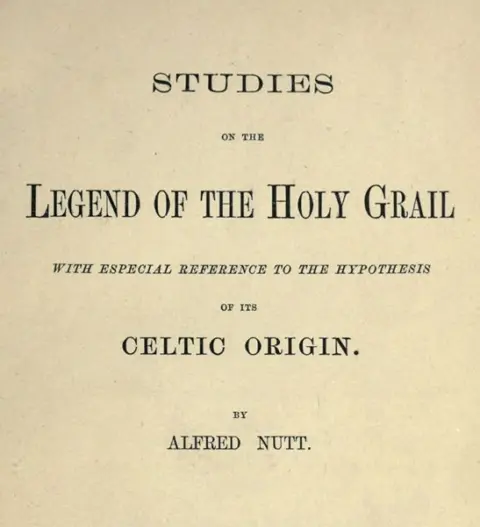
Studies on the Legend of the Holy Grail With Especial Reference to the Hypothesis of Its Celtic Origin — digital edition cover

THE CLASSIC COLLECTION · 1888

Studies on the Legend of the Holy Grail With Especial Reference to the Hypothesis of Its Celtic Origin

"Studies on the Legend of the Holy Grail" by Alfred Trübner Nutt is a scholarly publication written in the late 19th century. This work examines the various forms and origins of the Holy Grail legend, with a strong emphasis on its connections to Celtic traditions and influences. The book serves as both a study of the Grail Romance cycle and an investigation into the historical, literary, and mythical aspects of the legend. The opening of the scholarly work introduces the author’s intent to explore the different iterations of the Grail legend and their relationships to one another. It begins with a dedication to J. F. Campbell, highlighting the significance of Celtic tradition in Nutt's interpretation. The introduction outlines the structure of the studies, noting that the work does not aim for exhaustiveness but rather focuses on specific aspects of the Grail narrative. Nutt emphasizes the challenges historians face in tracing the origins of the Grail stories, navigating through various manuscripts and forms of the legend, while preparing to delve into the particulars of significant texts that have shaped the legend's evolution.

Introduction adapted from the source catalogue; source summaries may be automatically generated.

Start reading ↓

Free to read · English · 125,175 words · No account needed

MAKE TIME FOR A GOOD BOOK

Studies on the Legend of the Holy Grail With Especial Reference to the Hypothesis of Its Celtic Origin

On by default. Untick to stop anonymous reading totals. Each page counts after 10 seconds in view. How this works.

Anonymous counting is on unless you have switched it off.

Studies on the Legend of the Holy Grail With Especial Reference to the Hypothesis of Its Celtic Origin

Here the section which goes under the name of Gautier ends.

[A portion of Gautier's section of the Conte du Graal is found in the Berne MS., partly edited, partly summarised, by Rochat in his work, Ein unbekannter Percheval li Gallois (vide infra p. 101). This version offers some remarkable peculiarities. It has a short introduction of thirteen lines; then follows line 21,930 of Gautier in Potvin's text (Mons MS.). An incident follows, omitted in the Mons MS., but found in Montpellier and in Paris, 794: Perceval meets a huntsman who upbraids him for having been at the Fisher King's court, and failed to ask about Grail and bleeding lance. Then follow Incidents 6, 7 (8 is absent so far as one can judge from Rochat's summary), 9 to 13 (in which Perceval does not apparently send Garalas and his love to Arthur), and 14 to end, the following finish being then tacked on: The Fisher King is father to Alain le Gros, husband to Enigeus, sister to that Joseph who, when Christ's body was taken down from the Cross, had it from Pilate as a reward for his services. Joseph had the vessel prepared to catch in it the blood from the body; it was the same Jesus had made the Sacrament in on the Thursday before. The Fisher King dies on the third day and Perceval reigns in his stead.][11]

The Conte du Graal is continued by--

(c) MANESSIER.--(1) Perceval, full of joy, sits down to table; after the meal, lance, Grail, and a goodly silver dish pass before the royal table away into the next room. Perceval, sighing, asks concerning these objects and the maidens bearing them. (2) The King tells as follows: the lance is that wherewith Longis pierced God's side that day he hung on the Cross (Montpellier MS.: When Longis withdrew the spear the blood ran down to feet, so that Joseph of Barimacie turned black from sorrow, and he collected the blood in the holy vessel). On Perceval's asking further, the Grail is the vessel wherein the holy precious blood of our Lord was received. Then Perceval asks how it came thither; (3) Joseph brought it when he departed from the prison whence he was freed by Vespasian. He baptized forty of his friends, and wandered forth with them till they came to Sarras, where, as the tale tells, they found the King in the Temple of the Sun. Joseph helped the King against his enemies by means of a red cross which he fixed on the King's shield. Evelac, such was the King's name, won the battle thereby, was baptized, and renamed Noodrans. It went so likewise with his brother-in-law, Salafrès, renamed Natiien. Joseph departed thence, ever bearing the Grail with him, till at length he came hither, converted the land, and I, of his seed, am keeping manor and Grail, the which shall never dwell elsewhere, God willing. (Montpellier MS. merely says, how Joseph was put into a dark prison, and kept there forty years, but the Lord sent him the sweetness of the Grail twice or thrice a day. Tiberius and Vespasian deliver him and bring him to Rome, whence he carries away the lance.) (4) To Perceval's questions concerning the damsels: the Grail-bearer is of royal blood, and pure maid, or God might not let her hold it, she is my child; the dish-bearer is also of high lineage, daughter to King Goon Desert. (5) The King would then go to sleep, but Perceval would know about the broken sword: In Quiquagrant dwelt Goon Desert, the King's brother. Besieged by Espinogre he made a sally and slew him. Espinogre's nephew swore revenge; donning the armour of a knight of Goon Desert, he slew him, but the sword broke when the traitrous blow was struck. Goon Desert's body was brought to his brother's castle, whither came, too, his daughter with the broken sword, foretelling that a knight should come, rejoin the pieces, and avenge the foul blow. The Fisher King taking up the fragments incautiously was pierced through the thigh, and the wound might not be healed until his brother's death was avenged. The murderer's name is Partiniaus, Lord of the Red Tower. Perceval vows to avenge this wrong, but first, despite the King's strong hints that it is bed-time, must learn (6) about the candles on the trees, how they are fay trees, and the lights deceiving ones, but they might not deceive Perceval, he being destined to achieve the wonders of the earth, and he has put an end to this illusion; (7) how the black hand haunted a chapel wherein Pinogres had slain his mother, and over four thousand knights had been slain by it. (8) Perceval starting on the morrow in search of Partinal meets with Saigremors, and with him delivers a damsel from ten robber knights. Perceval, wounded, stays a month at the damsel's castle, and (9) the story tells for some fifteen hundred verses (36,100-37,400) of Saigremors; how he pursues the robber knights, comes to the Castle of Maidens, delivers the dame thereof from a knight, Calides, who wars upon her, and afterwards delivers another maiden, to whom two knights were offering violence; (10) then, for over two thousand verses of Gauvain; how he prepares to set forth again in search of the Fisher King; how a maiden comes to him whose brother had been slain in his service, reproaches Gauvain for his conduct at the Fisher King's castle, and carries him off; how he saves a maid going to be burnt; how after other adventures he slays King Margon, returns to Arthur's court, fights with Kex to avenge the brother of the damsel, etc. (11) Meanwhile Perceval, leaving the damsel who has tended him right well, rides forth into a wood, where he is overtaken by a great storm of thunder and hail, after which he comes to the chapel where lies the body of the knight slain by the black hand. Perceval strives with the devil to whom this belongs, overcomes, and with the help of a hermit who tells him the tale of all the knights who had fallen there, buries the body. He then confesses to the hermit, who warns him not to think of acquiring fame, but rather to save his soul. (12) Perceval, riding forth on the morrow, is met by the devil, who throws him from his horse; he finds another, mounts it, but coming to a stream luckily crosses himself, when it disappears; it was the devil. (13) A damsel passes by with a bark, wherein Perceval mounts; she minds him of Blanchefleur, and desire masters him, but again he crosses himself in time, and ship and damsel vanish. (14) A hermit comes who instructs him concerning all these things, brings him where he finds a fresh steed, and to a fair castle. Perceval overcomes a knight who would bar his passing, delivers the lady love of Dodinel from a felon knight; is appealed to for help by a damsel of Blanchefleur's, oppressed by Arides of Cavalon. (15) Setting off to the succour of his lady love, his horse falls lame, he comes to a smith who tells him his name is Tribuet, the forger of the broken sword. Tribuet makes the sword whole, and bids Perceval guard it well, never had king or conqueror a better one. (16) Perceval reaches Bel Repaire, overcomes Arides, whom he sends to Arthur's court, bidding him announce his own arrival for Whitsuntide. He then quits Blanchefleur, and (17) meets with the Coward Knight, who will not fight even when he sees two damsels carried off by ten knights. Perceval attacks the ravishers, the Coward Knight is drawn into the struggle, and quits himself valiantly. The rescued damsels bring the knights to their castle, where Perceval, sore wounded, remains for two months. (18) Meanwhile Saigremors has announced Perceval's arrival at Camelot. Whitsuntide passing, all the knights set forth in search of him, and, amongst others, Boort; he meets his brother Lyonel led, bound and naked, by six knights, who scourge him, and at the same moment he hears the plaint of a maid to whom a knight is doing violence. Her he succours, then hurries after his brother, whom, meanwhile, Gauvain has rescued. Lyonel bitterly reproaches his brother for abandoning him, and falls upon him, sword in hand; Boort offers no defence, and would be slain but for a passing knight, Calogrinant, who pays for his interference with his life. Finally, heavenly intervention appeases Lyonel. Calogrinant is buried by a hermit. (19) Perceval, healed, leaves the castle together with the Coward Knight, is present with him at a tournament, at which he distinguishes himself above all others, leaves his companion, to whom he gives the name Le Hardis, and (20) meets Hector, who challenges him. The two fight, and well-nigh kill each other. To them, lying on the field of combat, appears an angel with the Grail, and makes them whole. (21) Perceval rides on to Partinal's castle, before which stands a fir tree whereon hangs a shield. Perceval throws this down, whereupon Partinal appears and a desperate combat ensues, ended by the overthrow of Partinal, and, as he will submit to no conditions, his death. Perceval cuts off his head and makes for the Grail Castle, but only after a summer's seeking, lights upon it chancewise. (22) As he nears the castle, the warders come to the King, telling him a knight is coming with a head hanging at his saddle-bow; hereupon the King leaps to his feet and is straightway made whole. Partinal's head is stuck on a pike on the highest tower of the castle. After supper, at which the same mystic procession of talismans takes place as heretofore, the King learns Perceval's name, and thereby finds that he is his own sister's son. He would hand him his crown, but Perceval has vowed not to take it, his uncle living. (23) He returns to Arthur's court, overcoming on the way seven knights, and tells his adventures, which Arthur has written down and kept in a box at Salisbury. The Grail damsel appears and tells Perceval his uncle is dead. Perceval goes to Corbière accompanied by all the court, who assist at his crowning and remain with him a month, during which time the Grail feeds all with the costliest foods. He marries his cousins, the two Grail-bearers, to two valiant kings, and reigns in peace for seven years. (24) After which time he follows a hermit into the wilderness, accompanied by Grail, lance, and holy dish. He serves the Lord for ten years, and, when he dies, Grail, lance, and dish were doubtless carried up to heaven, for since that day no man saw them.

Your reading position is saved on this browser. Take it to another device with a library code. Reading pages adapt to text, rather than matching a printed edition.

BEHIND THE WORDS

About Alfred Trübner Nutt

Alfred Trübner Nutt (1856–1910). Explore Studies on the Legend of the Holy Grail With Especial Reference to the Hypothesis of Its Celtic Origin in this collection. These books span fantasy & fairy tales, history, romance.

Explore this author’s books →

THE READERS’ VERDICT

How did this story stay with you?

Not rated yet
Your rating for Studies on the Legend of the Holy Grail With Especial Reference to the Hypothesis of Its Celtic Origin

Be the first to share your verdict.

One rating per browser, which you can change or remove. A necessary browser identifier remembers your vote. How ratings work

A GOOD STORY DESERVES COMPANY

Pass this book along.

A great read is even better when it’s shared.

SEND A LITTLE INSPIRATION

Share this book

BEHIND THE BOOK

Edition & source details.

Title
Studies on the Legend of the Holy Grail With Especial Reference to the Hypothesis of Its Celtic Origin
Author
Alfred Trübner Nutt
First publication (Open Library catalogue match)
1888
Digital edition publisher
Project Gutenberg
Gutenberg release date
2013-02-26
Language
English
Source edition imprint
Not stated in source catalogue
Source identifier
Project Gutenberg #42205
Contributors
No additional named contributors in source metadata

Public-domain source & licence

This eBook is for the use of anyone anywhere in the United States and most other parts of the world at no cost and with almost no restrictions whatsoever. You may copy it, give it away or re-use it under the terms of the Project Gutenberg License included with this eBook or online at www.gutenberg.org. If you are not located in the United States, you will have to check the laws of the country where you are located before using this eBook. Read the source licence.

Full source licence and obtaining an original copy

The original source file, including credits and licence, is retained by this library. Request an original-format copy at no charge. Please include the book title and Project Gutenberg identifier #42205.

the full Project Gutenberg License must appear
prominently whenever any copy of a Project Gutenberg work (any work
on which the phrase “Project Gutenberg” appears, or with which the
phrase “Project Gutenberg” is associated) is accessed, displayed,
performed, viewed, copied or distributed:

This eBook is for the use of anyone anywhere in the United States and most
other parts of the world at no cost and with almost no restrictions
whatsoever. You may copy it, give it away or re-use it under the terms
of the Project Gutenberg™ License included with this eBook or online
at www.gutenberg.org. If you
are not located in the United States, you will have to check the laws
of the country where you are located before using this eBook.

1.E.2. If an individual Project Gutenberg electronic work is
derived from texts not protected by U.S. copyright law (does not
contain a notice indicating that it is posted with permission of the
copyright holder), the work can be copied and distributed to anyone in
the United States without paying any fees or charges. If you are
redistributing or providing access to a work with the phrase “Project
Gutenberg” associated with or appearing on the work, you must comply
either with the requirements of paragraphs 1.E.1 through 1.E.7 or
obtain permission for the use of the work and the Project Gutenberg
trademark as set forth in paragraphs 1.E.8 or 1.E.9.

1.E.3. If an individual Project Gutenberg electronic work is posted
with the permission of the copyright holder, your use and distribution
must comply with both paragraphs 1.E.1 through 1.E.7 and any
additional terms imposed by the copyright holder. Additional terms
will be linked to the Project Gutenberg License for all works
posted with the permission of the copyright holder found at the
beginning of this work.

1.E.4. Do not unlink or detach or remove the full Project Gutenberg
License terms from this work, or any files containing a part of this
work or any other work associated with Project Gutenberg.

1.E.5. Do not copy, display, perform, distribute or redistribute this
electronic work, or any part of this electronic work, without
prominently displaying the sentence set forth in paragraph 1.E.1 with
active links or immediate access to the full terms of the Project
Gutenberg License.

1.E.6. You may convert to and distribute this work in any binary,
compressed, marked up, nonproprietary or proprietary form, including
any word processing or hypertext form. However, if you provide access
to or distribute copies of a Project Gutenberg work in a format
other than “Plain Vanilla ASCII” or other format used in the official
version posted on the official Project Gutenberg website
(www.gutenberg.org), you must, at no additional cost, fee or expense
to the user, provide a copy, a means of exporting a copy, or a means
of obtaining a copy upon request, of the work in its original “Plain
Vanilla ASCII” or other form. Any alternate format must include the
full Project Gutenberg License as specified in paragraph 1.E.1.

1.E.7. Do not charge a fee for access to, viewing, displaying,
performing, copying or distributing any Project Gutenberg works
unless you comply with paragraph 1.E.8 or 1.E.9.

1.E.8. You may charge a reasonable fee for copies of or providing
access to or distributing Project Gutenberg electronic works
provided that:

• You pay a royalty fee of 20% of the gross profits you derive from
the use of Project Gutenberg works calculated using the method
you already use to calculate your applicable taxes. The fee is owed
to the owner of the Project Gutenberg trademark, but he has
agreed to donate royalties under this paragraph to the Project
Gutenberg Literary Archive Foundation. Royalty payments must be paid
within 60 days following each date on which you prepare (or are
legally required to prepare) your periodic tax returns. Royalty
payments should be clearly marked as such and sent to the Project
Gutenberg Literary Archive Foundation at the address specified in
Section 4, “Information about donations to the Project Gutenberg
Literary Archive Foundation.”

• You provide a full refund of any money paid by a user who notifies
you in writing (or by e-mail) within 30 days of receipt that s/he
does not agree to the terms of the full Project Gutenberg™
License. You must require such a user to return or destroy all
copies of the works possessed in a physical medium and discontinue
all use of and all access to other copies of Project Gutenberg™
works.

• You provide, in accordance with paragraph 1.F.3, a full refund of
any money paid for a work or a replacement copy, if a defect in the
electronic work is discovered and reported to you within 90 days of
receipt of the work.

• You comply with all other terms of this agreement for free
distribution of Project Gutenberg™ works.


1.E.9. If you wish to charge a fee or distribute a Project
Gutenberg™ electronic work or group of works on different terms than
are set forth in this agreement, you must obtain permission in writing
from the Project Gutenberg Literary Archive Foundation, the manager of
the Project Gutenberg™ trademark. Contact the Foundation as set
forth in Section 3 below.

1.F.

1.F.1. Project Gutenberg volunteers and employees expend considerable
effort to identify, do copyright research on, transcribe and proofread
works not protected by U.S. copyright law in creating the Project
Gutenberg™ collection. Despite these efforts, Project Gutenberg™
electronic works, and the medium on which they may be stored, may
contain “Defects,” such as, but not limited to, incomplete, inaccurate
or corrupt data, transcription errors, a copyright or other
intellectual property infringement, a defective or damaged disk or
other medium, a computer virus, or computer codes that damage or
cannot be read by your equipment.

1.F.2. LIMITED WARRANTY, DISCLAIMER OF DAMAGES - Except for the “Right
of Replacement or Refund” described in paragraph 1.F.3, the Project
Gutenberg Literary Archive Foundation, the owner of the Project
Gutenberg™ trademark, and any other party distributing a Project
Gutenberg™ electronic work under this agreement, disclaim all
liability to you for damages, costs and expenses, including legal
fees. YOU AGREE THAT YOU HAVE NO REMEDIES FOR NEGLIGENCE, STRICT
LIABILITY, BREACH OF WARRANTY OR BREACH OF CONTRACT EXCEPT THOSE
PROVIDED IN PARAGRAPH 1.F.3. YOU AGREE THAT THE FOUNDATION, THE
TRADEMARK OWNER, AND ANY DISTRIBUTOR UNDER THIS AGREEMENT WILL NOT BE
LIABLE TO YOU FOR ACTUAL, DIRECT, INDIRECT, CONSEQUENTIAL, PUNITIVE OR
INCIDENTAL DAMAGES EVEN IF YOU GIVE NOTICE OF THE POSSIBILITY OF SUCH
DAMAGE.

1.F.3. LIMITED RIGHT OF REPLACEMENT OR REFUND - If you discover a
defect in this electronic work within 90 days of receiving it, you can
receive a refund of the money (if any) you paid for it by sending a
written explanation to the person you received the work from. If you
received the work on a physical medium, you must return the medium
with your written explanation. The person or entity that provided you
with the defective work may elect to provide a replacement copy in
lieu of a refund. If you received the work electronically, the person
or entity providing it to you may choose to give you a second
opportunity to receive the work electronically in lieu of a refund. If
the second copy is also defective, you may demand a refund in writing
without further opportunities to fix the problem.

1.F.4. Except for the limited right of replacement or refund set forth
in paragraph 1.F.3, this work is provided to you ‘AS-IS’, WITH NO
OTHER WARRANTIES OF ANY KIND, EXPRESS OR IMPLIED, INCLUDING BUT NOT
LIMITED TO WARRANTIES OF MERCHANTABILITY OR FITNESS FOR ANY PURPOSE.

1.F.5. Some states do not allow disclaimers of certain implied
warranties or the exclusion or limitation of certain types of
damages. If any disclaimer or limitation set forth in this agreement
violates the law of the state applicable to this agreement, the
agreement shall be interpreted to make the maximum disclaimer or
limitation permitted by the applicable state law. The invalidity or
unenforceability of any provision of this agreement shall not void the
remaining provisions.

1.F.6. INDEMNITY - You agree to indemnify and hold the Foundation, the
trademark owner, any agent or employee of the Foundation, anyone
providing copies of Project Gutenberg™ electronic works in
accordance with this agreement, and any volunteers associated with the
production, promotion and distribution of Project Gutenberg™
electronic works, harmless from all liability, costs and expenses,
including legal fees, that arise directly or indirectly from any of
the following which you do or cause to occur: (a) distribution of this
or any Project Gutenberg work, (b) alteration, modification, or
additions or deletions to any Project Gutenberg work, and (c) any
Defect you cause.

Section 2. Information about the Mission of Project Gutenberg

Project Gutenberg is synonymous with the free distribution of
electronic works in formats readable by the widest variety of
computers including obsolete, old, middle-aged and new computers. It
exists because of the efforts of hundreds of volunteers and donations
from people in all walks of life.

Volunteers and financial support to provide volunteers with the
assistance they need are critical to reaching Project Gutenberg’s
goals and ensuring that the Project Gutenberg collection will
remain freely available for generations to come. In 2001, the Project
Gutenberg Literary Archive Foundation was created to provide a secure
and permanent future for Project Gutenberg and future
generations. To learn more about the Project Gutenberg Literary
Archive Foundation and how your efforts and donations can help, see
Sections 3 and 4 and the Foundation information page at www.gutenberg.org.

Section 3. Information about the Project Gutenberg Literary Archive Foundation

The Project Gutenberg Literary Archive Foundation is a non-profit
501(c)(3) educational corporation organized under the laws of the
state of Mississippi and granted tax exempt status by the Internal
Revenue Service. The Foundation’s EIN or federal tax identification
number is 64-6221541. Contributions to the Project Gutenberg Literary
Archive Foundation are tax deductible to the full extent permitted by
U.S. federal laws and your state’s laws.

The Foundation’s business office is located at 41 Watchung Plaza #516,
Montclair NJ 07042, USA, +1 (862) 621-9288. Email contact links and up
to date contact information can be found at the Foundation’s website
and official page at www.gutenberg.org/contact

Section 4. Information about Donations to the Project Gutenberg
Literary Archive Foundation

Project Gutenberg™ depends upon and cannot survive without widespread
public support and donations to carry out its mission of
increasing the number of public domain and licensed works that can be
freely distributed in machine-readable form accessible by the widest
array of equipment including outdated equipment. Many small donations
($1 to $5,000) are particularly important to maintaining tax exempt
status with the IRS.

The Foundation is committed to complying with the laws regulating
charities and charitable donations in all 50 states of the United
States. Compliance requirements are not uniform and it takes a
considerable effort, much paperwork and many fees to meet and keep up
with these requirements. We do not solicit donations in locations
where we have not received written confirmation of compliance. To SEND
DONATIONS or determine the status of compliance for any particular state
visit www.gutenberg.org/donate.

While we cannot and do not solicit contributions from states where we
have not met the solicitation requirements, we know of no prohibition
against accepting unsolicited donations from donors in such states who
approach us with offers to donate.

International donations are gratefully accepted, but we cannot make
any statements concerning tax treatment of donations received from
outside the United States. U.S. laws alone swamp our small staff.

Please check the Project Gutenberg web pages for current donation
methods and addresses. Donations are accepted in a number of other
ways including checks, online payments and credit card donations. To
donate, please visit: www.gutenberg.org/donate.

Section 5. General Information About Project Gutenberg electronic works

Professor Michael S. Hart was the originator of the Project
Gutenberg concept of a library of electronic works that could be
freely shared with anyone. For forty years, he produced and
distributed Project Gutenberg eBooks with only a loose network of
volunteer support.

Project Gutenberg eBooks are often created from several printed
editions, all of which are confirmed as not protected by copyright in
the U.S. unless a copyright notice is included. Thus, we do not
necessarily keep eBooks in compliance with any particular paper
edition.

Most people start at our website which has the main PG search
facility: www.gutenberg.org.

This website includes information about Project Gutenberg,
including how to make donations to the Project Gutenberg Literary
Archive Foundation, how to help produce our new eBooks, and how to
subscribe to our email newsletter to hear about new eBooks.


KEEP YOUR CURIOSITY GOING

Your next chapter awaits.

Your privacy choices

Reading is always free. You can change these settings at any time.

Book banners link to our books on simonward.net. They do not use advertising cookies or tracking.

Privacy & cookie policy · Reading data and privacy controls